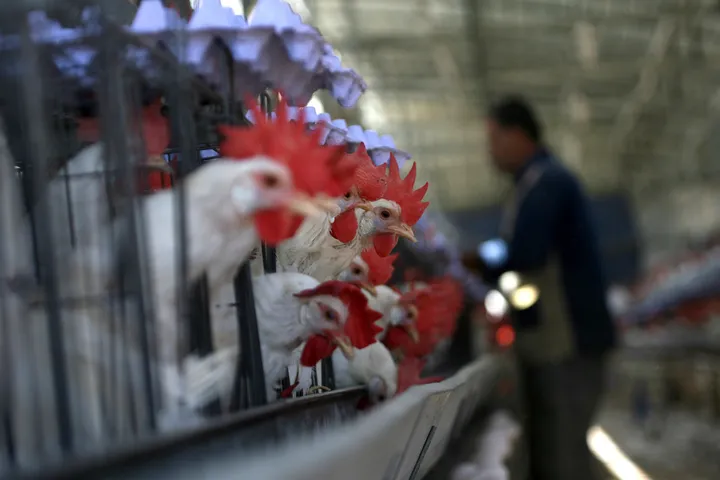
Who could defend sacrificing animals? Really. Isn't it just barbaric and shouldn't we admit that it is a primitive relic of an ignorant time? As someone who has not eaten chicken or meat for decades, I would nonetheless like to speak up on behalf of sacrifice.
Much of the Hebrew Bible elaborates on the theme of sacrifices. Reading the particulars of this bloody enterprise, moderns turn their heads away in distaste. It seems primitive at best, savage at worst. Why does the Bible ordain that God would be worshiped with a blood slicked pageant of slaughtered animals? Those wishing to point to the essential irrationality and even cruelty of religious practice often cite animal sacrifice. Along with other such reflexive prejudices, this misses the profundity of ancient sacrifice.
The first function of sacrifice is to heighten the consciousness of the one who brings the offering. In every relationship, part of the measure of love is the willingness to forgo; I will sacrifice sleep, food, time, money, almost anything for someone whom I love. A sacrifice of negligible worth is no certain sign of devotion. Love is demanding; the lover must offer something valuable. In ancient Israel, offering the products of labor -- crops, animals -- showed deep connection. Love for God was demonstrated by the readiness to give one's most valuable possessions.
The great medieval philosopher Maimonides, in fact, argues that animal sacrifice was ordained to replace human sacrifice. One needed to keep the sense of giving something important, he writes, but without the evil of killing a human being. This was God's way of weaning the Israelites from the earlier, heinous practice. Nonetheless, the central dilemma remains. Is this simply a (somewhat less) repulsive practice planted at the heart of Judaism?
Sacrifice actually enshrines an important idea, one which is just beginning to be revived today. Most sacrifices were eaten. What then is the difference between a sacrifice at the Temple and what happens in a modern slaughterhouse?
I once visited a poultry factory. There I was introduced to a man who mordantly styled himself the "goop scooper" (do I need to describe his job?). I watched the beheaded chickens swing around on a gruesome wheel to drop almost acrobatically into a chemical vat to be cleaned. Such a spectacle is not for the fainthearted. Surely a factory where cows are killed for meat would be immeasurably more difficult to bear for the uninitiated (see Upton Sinclair's "The Jungle" for a masterful and stomach-turning description. More recently, Jonathan Safran Foer's "Eating Animals" is a readable and powerful depiction). There is no sense of the awe of taking life. The animal is less a living thing than a consumer good, and slaughter is the means of bringing it to market. By the time we get the cellophane wrapped package, flesh, sinew, blood and bones are sanitized and ready to go. It is as routinized as an oil change.
Not so in the ancient Temple. The full import of taking life was borne in upon the supplicant. The life was claimed with holiness, accompanied by prayers before God. The spectacle was not about product but about piety. When Jews sacrificed in the Temple, they reminded themselves of the Source of all life. Sacrifice induced awe. Nothing in God's creation was mere commodity. In our own day people are just beginning to realize what it means to subject other living creatures to large scale, mechanized slaughter for food.
We see sacrifice as primitive because most of us are sheltered from the reality of what we eat. One of the reasons I do not eat meat is the realization that buying meat is a sleight of hand: The consumer decides not to watch how cattle are raised or killed so that she can simply whisk away the clean wrapped cut.
The ancient Israelite knew what he was offering; he had raised that animal, fed it and was now participating in a fully conscious decision to bring it to its death at the altar.
At the Temple, the priests presided and Psalms were sung. When we buy at the supermarket, we check the USDA inspection sticker.
Now, who is primitive?
Editor's Note: The title of this piece has been updated from 'Why Animal Sacrifice is Good' to 'In Defense of Animal Sacrifice' to more accurately reflect the views of the author.
You can follow Rabbi Wolpe on Facebook.
Paul Brandeis Raushenbush: HuffPost Religion Round-Up: July 24-31
Judaism 101: Qorbanot: Sacrifices and Offerings
What replaced animal sacrifices in Jewish practice?
Animal sacrifice - Wikipedia, the free encyclopedia
Religious Animal Slaughter Ban Passes In The Netherlands
Dutch approve ban on religious animal slaughter - Yahoo! News
AP: Dutch consider banning religious animal slaughter - Pew Forum ...
When I bacame a man I put away childish things.
I do not transfer responsibility to others to do what might be distasteful to me.
Human beings are capable of taking the responsibility to breed and grow plants and
animals to sustain their livelyhood. Animals must be killed to provide necessary protein for
my family's diet. I do not shirk the responsibility to perform that necessary task.
I beleive society has a responsibility to remove certain breeds of dogs from the animal
population. If one of those threatens the wellbeing of my family, I have a gun and a shovel.
On the way to a childs funeral everyone is in unforgiving remorse of themselves for not
taking that responsibility, and can die from it themselves. I will not let that happen to my family.
Breeding these types of animals ought to be punishable by stiff sentences.
Leaves and grass and menure provide fertilizer for a garden. One shovel and a halfassed
work ethic can easily easily grow all the crops a family can ear. I am partial to simply
planting tomatoes, bell and bananna peppers, three kinds of squash, cucumbers and lots
of spinich, mustard and turnip greens.
Wierd superstitions play no part in the common sense of doing the necessary tasks.
I would put those in the classifiation of childish things
This type of sacrifice was wholly burnt. None of it is eaten by anyone; the fire consumed it all. In fact, the fire was never extinguished: “The fire shall ever be burning upon the altar; it shall never go out†(Lev. 6:13).
The worshiper brought a male animal—a bull, lamb, goat, pigeon, or turtledove (depending largely upon the worshiper’s wealth)—to the door of the tent or temple. The animal had to be without blemish. The worshiper then placed his hands upon the animal’s head and it was “accepted for him to make atonement for him†(Lev. 1:4). The laying of hands was a ceremonial act whereby the worshiper blessed or prepared the sacrificial animal. The animal was then killed at the door. Immediately, the priest collected the animal’s blood and sprinkled it about the altar. (Priests never drank the blood.) Next, the priest quartered the animal, offered its head and fat on the altar, then washed the legs and entrails in water and offered them. Any remains might be cast aside into the ashes.
.. great example of 'compassion'.
Sacrificial worship was universal at one time. It has purpose and meaning which many moderns do not understand. It was not restricted to animals but included other things like grain, fruit, wine, water, etc. If one is open to the phenomological experience of the human race, worship in all its forms has meaning. Much of the hostility being expressed is grounded in lack of understanding of the inner experience of the holy and the many ways it is legitimately expresses..
There is much in the totality of existence that is not subject to objective experimentation and quantification. The existence of our own being is something we take on subjective experience. I am because I am. It is self evident.
Or, we could talk like adults, be rational, and put childish things behind us. Feel free to believe anything you want, but if you try to convince others of superstition and myth, you will need something better than that. Else, would you like me to tell you all about the invisible goblin I have in this box?
Surely an intelligent god would do better than that.
Yes. Yes it is. I don't care what an old book says.
1) Sacrifice was mainly used to bribe the god(s) to do something for you. EX: Help crops grow, or heal people.
2) If you eat the sacrificial meat, then it's not a real sacrifice, is it? If you give it to god(s) then you didn't get to eat it.
3) Are you saying we should return to sacrificial rituals? Else, what? Should I also sacrifice a chicken if I get sick rather than going to a doctor? Really?
4) People would be better off being rational, rather than more superstitious. Should we adhere to all the rules in the old testament? EX: Kill other tribes or your family if they don't believe in your god(s), or if they work on the sabbath. Can't eat shrimp or lobster. Can’t have clothes made from two different materials. Can't use yeast. Check out evilbible.com, it's all really in the bible folks!
Learn about real life, and less about fairy tales. Check out Humanism too.
2) Much of the sacrificial meat was used to sustain the Levitical priesthood, as was the sacrificial grain, et al.
3) The sacrifices were commanded to those who believe in God, so that would not apply to everyone else, including humanists. There was also never a sense that sacrifice was to promote healing, or to be used in lieu of any sort of occupation, be it doctor, farmer, or judge.
4) The rules contained in the Torah must be examined within their context, not merely by the segments gleaned and posted on anti-faith websites.
Ignorance is as much a disease of atheists and humanists as it is of the religious. You mention real life, and yet you certainly adhere to beliefs that are contrary to fact and logic (look at Macro-evolution and the supposed non-historicity of the Bible).
ajfits.wordpress.com