The heart of the Passover Seder is a summary of Israelite history to be recited as the citizen presents the first fruits. It would be as if on tax day we would say "And the pilgrims came from a far away land" and recite American history before offering taxes in gratitude.
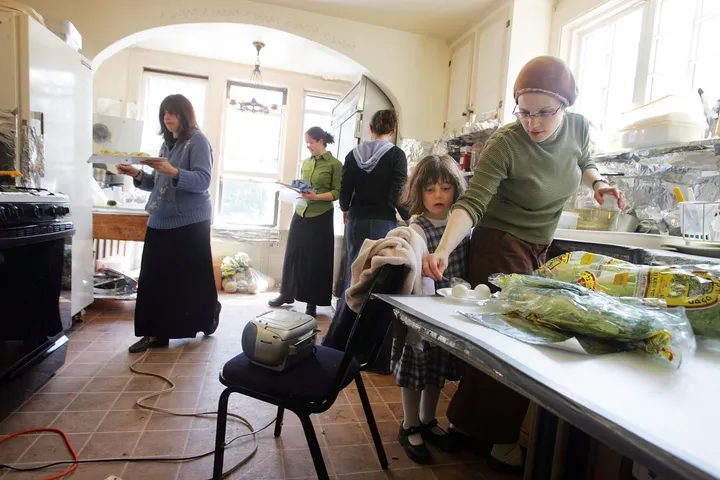
The recitation reinforces the idea that we came from slavery to freedom. Again and again we are told that we were strangers, slaves, dispossessed. For most of my life when I went to a Seder, someone would help in the kitchen, serving food, cleaning up. It was paid work, of course, but until a few years ago it did not occur to me that while I was remembering being an Israelite, I was in the position of an Egyptian.
The equivalence is not exact but the underlying principle endures. The one with power -- economic, social, political, military -- is in the position of an ancient Egyptian in the Exodus story. The question is not the morality of having power but the morality of how one uses it.
Shakespeare put it succinctly, of course: "O, it is excellent to have a giant's strength, But it is tyrannous to use it like a giant." Thirty-six times the Torah reminds us of the ethics of treating the stranger. On Passover we remember what it is like to be a stranger. Yet there are strangers all around us; sometimes they are in our home serving us our food. I wonder how often we pay attention to the stranger standing alongside us? Most of us have the strength of giants. We swagger with the enchanting wonder of that strength. The message of the Passover Seder is not to flee power, since power is essential to survive and to do good. We should, however, distrust the ego-intoxicating feeling of power.
"Paper or plastic?" Who acknowledges the person that speaks those routine words? For on Passover we were not only liberated from slavery -- we were liberated to community. Israel could not become a people as slaves because their relationships to each other were determined by a master. They were liberated to receive the Torah which taught that each human being is in God's image. They were freed not to survive but to love.
A Hasidic Rabbi once went to visit his friend. His friend studied while his child cried in the next room. The Rabbi asked him "Don't you hear your child? Why don't you go to him?" His friend, emerging from the reverie of learning, said "You know, I get so immersed in the intricacy and beauty of Torah that I tune out the world." The Rabbi admonished him, "If your Torah makes you neglect the cry of a child, then your Torah is no Torah."
If you conduct a Seder where those who help you stay until the early hours, without acknowledgement and thanks, with little money, then your Pesach is no Pesach. If you don't remember that slavery and oppression and sorrow and brokenness were not only in the past but the present, your Pesach is no Pesach. If you think that affliction only happens to the Jewish people, and that the suffering of others can be safely neglected, your Pesach is no Pesach, and your Seder is a wasted meal.
My father used to tell me that it haunted him to wonder what he would have done had he been a guard in a concentration camp. Given that power, would he have had the strength to be humane? As American Jews sitting down to a Seder, in terms of power, we are the Egyptians. Let us act like Israelites.
Please visit Rabbi Wolpe's Facebook page.