
Shavuot is a much neglected holiday. Mentioned in the Hebrew Bible as a harvest festival and enjoying equal status with Passover and Sukkot, Shavuot is of shorter duration than her sister festivals and has fewer distinctive rituals; as a result, observance of the holiday has tended to be minimal.
Nonetheless, it is undergoing something of a revival.
Since the destruction of the Second Temple, Shavuot has been identified as the time at which the revelation of the Torah to the Jewish people occurred on Mt. Sinai. With the growth of serious Torah study by Jews, it has become an occasion not only to pray in the synagogue and to read the Biblical account of Moses receiving the law, but also to engage in all-night study sessions of sacred texts.
When Jews gather in their synagogues for Shavuot this year, they will continue these traditions of study, and they will use them to reflect on what transpired at Sinai.
The Biblical account of the revelation at Sinai is a story of such stunning power and drama -- "there were thunders and lightnings and a thick cloud upon the mount, and the voice of a horn exceeding loud ... and the whole mount quaked greatly" (Exodus 19) -- that even the most detached Jewish worshippers will be drawn to confront the significance of these events. Some will understand them literally and some metaphorically, but many will conclude, after struggling with the text and its commentaries, that in some way they too were at Sinai. They will say, as Jews have been saying for more than 3000 years, that somehow their DNA was present in the crowd.
But they will also confront another subject -- and one of special significance this week.
While the giving of the law at Sinai had implications for all of humankind, it is for the Jews a particularistic event that brought Israel into being; it set in place the terms of the covenant, marrying the Jewish people to God and God to the Jewish people. But the rabbis, with a characteristic sense of balance and of irony, were not content with that message alone, and therefore they mandated that on Shavuot, the Book of Ruth is to be read. The Jews were God's chosen people, but Jewish distinctiveness did not permit indifference to the plight of outsiders who exist on the margins of society.
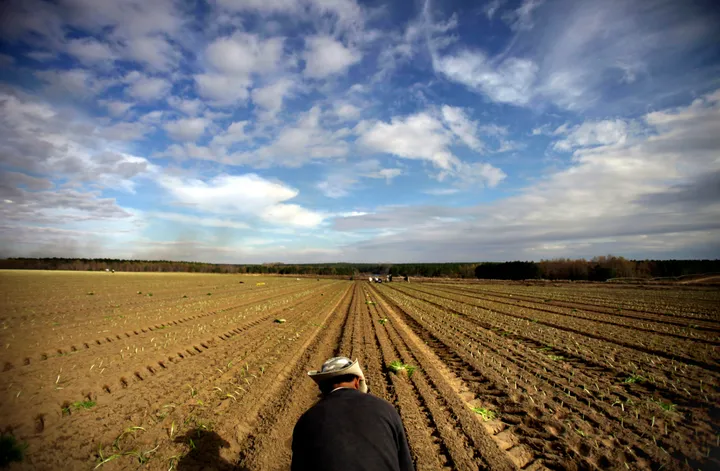
And who was Ruth? She was a migrant worker and a foreigner. And not just a foreigner, but a Moabite -- and the Moabites were the lowest of the low. Even the Egyptians, who had enslaved the Jews for generations, could eventually marry into the people of Israel; but the Moabites, who had attacked the Jews as they fled Egypt, were forbidden to do so forever (Deuteronomy 23:4-5).
And yet Ruth, a young widow and a member of this despised people, had made her way to Israel, accompanying her impoverished mother-in-law Naomi on her return to the land of her birth. When they arrived in Bethlehem, Naomi did not even introduce her, sensing perhaps the revulsion that her friends and family might feel. But knowing that without her efforts her family would starve, Ruth set out to work. And she expressed a willingness to love Naomi's people, even if her status as a Moabite elicited only contempt.
Ultimately, of course, Ruth was accepted, married a kinsman of Naomi, and was to become the great-grandmother of King David. It seems fitting that this is the story we read the week after the State of Alabama has passed a draconian law that will embitter the lives of foreigners who have come to our shores -- foreigners prepared, like Ruth, to do back-breaking, thankless work, and to confront hatred at every turn. It is true that immigration laws are a complicated topic, but surely we can do better than the current system of punitive laws that needlessly separate families, harass and exploit the vulnerable, and leave hard-working people in a shadowy legal status.
The lesson of Shavuot is that at the very moment when we embrace God, we need to think of the foreigners, the illegal workers, and the migrants -- and embrace them as God has embraced us. Our fellow citizens in Alabama -- and in Georgia and Arizona before them -- see themselves as God-loving, Bible-reading Americans. My suggestion is that they spend some time reading the Book of Ruth.