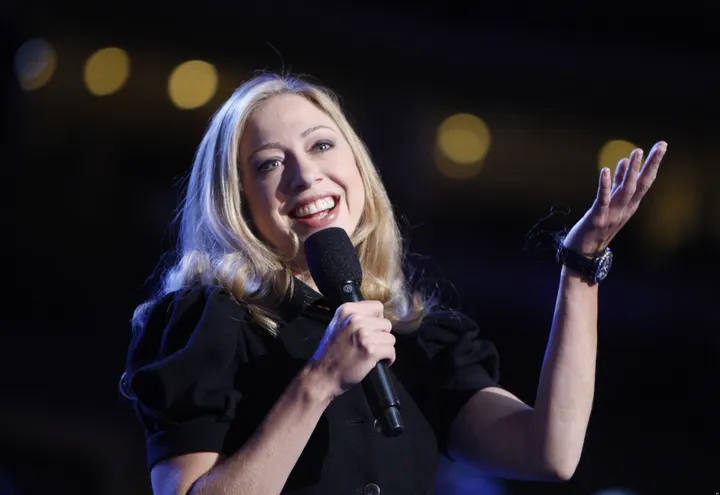
However intriguing it may be, the larger-than-life hubbub surrounding this Saturday evening's Clinton-Mezvinsky wedding -- who is invited and who feels snubbed, what the menu and wine list are, what the bride and her party will wear, who will be officiating and who will be entertaining, and all the levels of secrecy -- actually does not affect the vast majority of Americans except as voyeuristic entertainment. There is, however, an important, challenging, and hopeful story worth telling about the nature of America reflected in this high-profile wedding.
The Clinton-Mezvinsky wedding is a perfect expression of the emerging American religious and social landscape in which one's inherited group identity bears little or no significance on one's marriage. As a consequence of the unprecedented freedom we enjoy to cross boundaries that even a generation ago would have been taboo, the majority of Americans, including more than 80 percent of those under 30 years of age, accept marriage across all types of boundaries, including ethnic and racial. The silos between groups are rapidly becoming permeable, and this shift in notions of group loyalty and exclusivity, especially as individuals form their most intimate relationships independent of any restrictive creedal or tribal inheritances, marks an uncharted world.
Welcome to the new world of religion in America. Chelsea's parents were an interdenominational marriage of a social justice Methodist and a Baptist, which would have been unheard of 50 years ago. Chelsea grew up proudly within mainstream Protestantism, while Marc was raised clearly identified in a mainstream Jewish denomination. Their marriage is the next generational step in crossing borders -- from Methodist-Baptist to Christian-Jew. What is unprecedented -- wonderful for some and horrifying to others -- is that in this era no one needs to reject his or her identity to cross these century-old boundaries. Multiple identities -- in the example of the Clinton-Mezvinsky wedding, at least three different traditions being brought to bear -- is the new reality.
None of this should be surprising, as we Americans have been significantly changing the ways we identity ourselves by religion. The fastest-growing religious identity, now the third largest in the United States according to the 2009 American Religious Identity Study (ARIS), is "none" (18 percent), which is not to be confused with either atheist or agnostic. Moreover, according to all surveys on religious identities, including those done by traditional evangelicals, we Americans are increasingly becoming what I call "mixers, blenders, benders and switchers" (MBBS). We customize our religious identities -- less in terms of some group-belonging need, creedal purity, or theological consistency, and more in order to get a job done -- and in doing so, we find greater meaning and purpose. Identity, including our religious identity, is becoming fluid, permeable, and an ongoing construction -- a verb rather than a noun.
Millions of us are moving from the cathedral to the bazaar. Of course, you cannot have people mixing religious ideas and practices in a divine smorgasbord of choice, creating families with diverse inheritances, and, because of new powerful technologies from search engines to connection technologies, getting their religious and spiritual resources independent of religious authorities and expect existing religious institutions to be unaffected. The existing business models and organizational structures of mainstream religion are, as in many fields of meaning-making today (journalism, film, and music), increasingly unsustainable. Fewer and fewer Americans are getting religion in the cathedrals. They are getting what they need to get their spiritual/meaning-making job done in the bazaar, which has a very different model of authority and hierarchy, has very limited barriers of entry and far more choices, and which tends to be a user-friendly and open source environment.
This is unnerving stuff, and predictably, we have some religious communities becoming more conformist, exclusive, and intolerant while others are becoming more diverse, inclusive, and syncretistic -- all this as mainstream religious institutions in America have dramatically weakened over the past two decades, according to all measures (affiliation, membership, and attendance). Note that the Clinton-Mezvinsky wedding is being held in neither a church nor a synagogue and that finding clergy that can speak across boundaries while retaining the integrity of each tradition Chelsea and Marc bring to their wedding is no easy task. (In fact, no Conservative rabbi, the tradition in which the groom was raised, is permitted to officiate at an inter-marriage.)
Religious leaders who do not see these changes as threatening the integrity of their faiths and groups will need to be concerned less with creating good upstanding members of their group (theologically or sociologically) and more with providing wisdom and practice drawn from their tradition that is accessible, usable, and good enough to get the job done: helping "mixers, blenders, benders, and switchers" construct ever-changing lives that are more ethical, vital, and loving within their already-existing webs of relations.
Yes, there will be loss, about which traditionalists are appropriately feeling scared and angry and which liberals and secularists tend to deny. But just as the most important part of a bowl is the empty space that can be filled, so this loss can open space for a new reality, one that holds the potential for a much richer and better world as we transcend the exclusivity of our creeds, dogmas, and tribes, and -- here is the contemporary challenge -- as we include the best of our inherited traditions. Loving each other across boundaries and building families to which multiple traditions are brought is far better for the planet than what our religions have too often done: demonizing the other.
At their best, ancient religious traditions know this, which is why at some level, they all teach that we are one global family. Well, from climate change to terrorism, from SARS to markets, our problems clearly cross all borders. Now we are transitioning into some next expression of this intuition, culturally and religiously. This is hard for the purists and fundamentalists, and so we are seeing backlash all over the planet, and indeed there are no roadmaps -- so we are making it up as we go along. But the more people love each other, and the more people with different inheritances and traditions form intimate relationships and families, the better we will understand each other across all boundaries, and the wiser we will be at knowing what from our rich traditions we need to let go of and transcend, and what we need to bring along with us to help us create better lives and build a better world.
Mazel Tov, Marc and Chelsea!