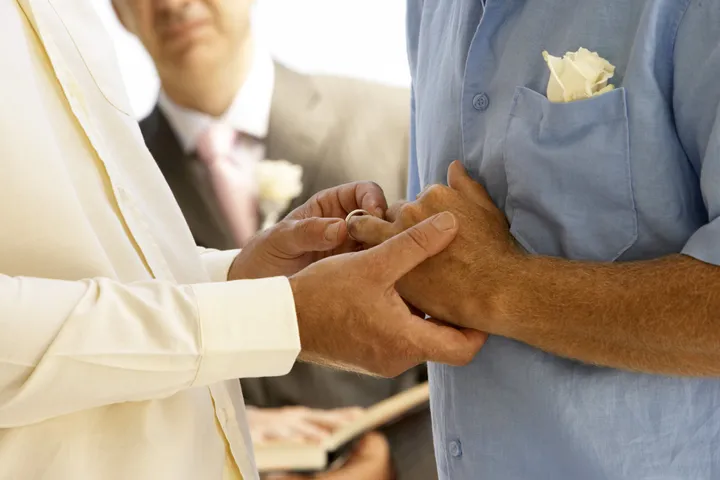
This past week in synagogues throughout the world, the weekly portion of Scripture included the following verse from the book of Leviticus: "Do not lie with a male as one lies with a woman; it is an abomination." This proscription has obviously been the source of heated and often vicious debate over the past decades as homosexuals have courageously come out of the closet and forced our culture to wrestle with its full humanity. My colleague Rabbi Brad Hirschfield posted an important and nuanced post on Huffington Post -- "Is Homosexuality an Abomination? Wrestling with Leviticus 18:22" -- suggesting that because this cultural change in attitude towards homosexuals is very complex, the debate would be far more productive if people hid less behind Scripture and ideology and focused more on why this particular issue is so important to them personally. In Rabbi Hirschfield's words, "compassion for an idea is hard to generate, but compassion for a real person is less so."
It strikes me that the way human rights issues have played out since the beginning of modernity -- which, not surprisingly, coincides with the separation of church and state -- should give us all reason to take a deep breath. There is a sort of humbling inevitability to the process of inclusion and to where we place ourselves along the continuum of human rights debate. One of the many ways to characterize the modern experience is the ongoing expansion of human rights and the increasing inclusion of marginal populations. The modern political and social dynamic in both general society and within religious communities has been the same: Marginal classes of people are brought inside legal frameworks and given equal rights. Whether recognizing the full humanity of Jews, African Americans, other ethnic and religious groups, women, the physically challenged, and now homosexuals, the process has been the same. First, a small group within the marginal group realizes they are in fact oppressed, that in profoundly unjust ways they are not treated as full human beings equal before the law. This small group begins to "cry" out for freedom. The initial reaction within the marginal group is usually fear of rocking the boat while the reaction of the dominant class is dismissive if not often brutal. But injustice once realized and freedom once tasted, even if only in one's heart and mind, is very hard to put back into a box, and so a process begins within the marginal class, educating its own people to see their plight and organizing increasing numbers of people ready to fight for inclusion and fairness. At some point very small numbers of people from the dominant class begin to see the light and realize that fellow human beings just like them have been denied equal rights simply because they are different. If the modern period is of any evidence, once this movement perceived as one of human rights begins -- though it may entail great struggle, sacrifice, and bitterness -- it inexorably results in the marginal population being given the same legal rights as the majority population. So America of 2010 is far more inclusive than America of 1810; classes of people denied equal rights and barely seen as human in 1810 have gained their rights by 2010.
It turns out that once the thirst for freedom is felt, the only question is pacing, and this is true in the general society as well as within religious communities, who all go through the same fighting process. Sadly, though, religious communities, even the liberals in those communities, tend to be on a time lag relative to the larger secular body politic. Depending on our psycho-spiritual and psychosocial predispositions and the values of the groups to which we feel most connected, we individually and collectively pace ourselves in one of three ways. Some of us, the traditionalists, hold on for dear life and oppose any change; others, the human rights activists, make great sacrifices to bring about change; and still others, the rest of us, are in the middle, slowly brought along to see the humanity of the Other. These three paces are of course all relative to each other, so as inclusion and equal rights expand, passions intensify.
For some, usually those most denied their rights, change understandably moves too slowly, whereas for others it moves too quickly, and for most of us it sometimes moves too quickly and sometimes too slowly. Of course, whatever our pace, we dress up our positions in either religious language or the secular language of grand principles like justice, fairness, and equality, as if it is not precisely the content of those principles that we are debating. At some point, as people meet each other and realize that the Other is a human being whose difference is nothing to fear, a critical mass, usually a healthy minority and not yet the majority, pushes through the change, which drives the remnant of traditionalists crazy. So traditionalists do have much to "fear" as their variety of arguments against inclusion -- the same arguments that they have brought on every human rights issue (e.g., it is not natural, it will lead to moral corruption, it is sinful, it is against god's will, it will undo the family, it will destroy the fabric of society, etc.) -- will increasingly ring hollow to more and more people. They may be able to slow things down, but they cannot stop these changes no matter what the Bible says. Thank God.
Given that we all know how (if not exactly when) this story of equal rights and full inclusion for homosexuals is going to end, the really interesting question is who we are in this drama. Where do we position ourselves and why? After all, we position ourselves where we do because it works for us, giving us just the right psychic gratification -- whether from our anger, self-righteousness, righteous indignation, or aloofness, and whether we are leaders or followers or stand above critics. Social, cultural, and moral change is hard, and in my experience, when I get a bit too angry at the pace of someone else's capacity for "moral development," or when I get a bit too self-righteous about how morally developed I am relative to those "homophobes," it is because I am actually unconsciously disappointed in my own efforts in working to make this a more just society.
Gays and lesbians (and bisexuals and transsexuals) are going to gain every single right that heterosexuals have: the right to visit their lovers, partners, or spouses in a hospital; the right to share in pensions, health insurance, and inheritance benefits; the right to marry; and the right to adopt. This is just how it is when people begin to see the Other as fully human, and it will even be so in the vast majority of religious communities -- after all, who would have thought that the majority of the most religiously traditional communities would allow inter-racial marriage?
Knowing all this ought not keep social justice activists (sorry, Glenn Beck) from doggedly pursuing equal rights for homosexuals. But it ought to make us feel just a bit less anxious and therefore a bit less angry with traditionalists. Knowing that as long as we continue to fight for the recognition of the humanity of the Other, such recognition will ultimately be won, we might even be a little less triumphant as we win.
Anyway, at some point in the next decades, the vast majority of us will see this as the obvious moral position; will see those views of a previous era as less morally and ethically evolved; and we will feel appropriately embarrassed, if not ashamed, of those days. Given this, it behooves us to remember that the only difference between human rights activists and traditionalists, relatively speaking to the centuries of injustice finally being ameliorated, is having realized something just a bit earlier -- something that the god of Leviticus should have learned from the god of Genesis -- that all human beings are created equal in the divine image.