
Simchat Torah is the last celebration of the Jewish High Holiday season. Created in Babylonia during the early middle ages, it is a holiday that marks the end of the yearly cycle of reading the Torah with end of Deuteronomy and then beginning the new cycle of reading with Genesis 1 once more.
The late Israeli poet Yehuda Amichai, in the last collection of his work that was published in the year that he died, has a wonderful poem about this celebration:
The Jewish people read Torah aloud to God
all year long, a portion a week,
like Scheherazade who told stories to save her life.
By the time Simchat Torah rolls around,
God forgets and they can begin again.
(From "Open Closed Open," translated by Chana Block & Chan Kronfeld)
In this poem, Amichai reverses the usual rationale for reading the Torah. Jews normally think of the Torah reading as a way to constantly remind them of God's saving acts, the covenant with God and its commandments and the rich stories of our ancestors. In this poem Amichai is saying that the real purpose is to remind God of God's activities in the world as a way of keeping God interested in keeping the Jewish people alive. This is a wonderful and humorous inversion of an important Jewish practice and makes for great poetry if not for logical theology. It is a kind of "sacred parody" that Jews have often used to deal with the disconnect between what should be and what is in the world.
But the Torah reading is really about reminding us, not God, about who we are, where we came from, what we believe and what we should do to change the world. So every year at Simchat Torah we finish reading the book of Deuteronomy and begin again with Genesis.
And I believe that we need to be reminded of Creation even if one might think that spring is the better time. And while Passover in the spring does have its Creation elements, Sukkot was and is primarily a Creation festival, celebrating both the bounty of the fall harvest and need for the winter rains to ensure the fertility of the land. And the fall also reminds us of the cycle of life as much as the spring. Without the ending of fall, the beginning of spring cannot come.
When the fall harvest occurs, our ancestors might forget where it really comes from. After all, when your stomach is full, you might not be thinking of being grateful. As we are warned in Deuteronomy 8:10, 14, 17:
When you have eaten your fill, give thanks to the Lord your God for the good land which He has given you ... beware lest your heart grow haughty and you forget the Lord your God ... and you say to yourselves, "My own power and the might of my own hand have won this wealth for me."
Now, we in the developed world don't have to really notice what season it is and worry about the harvest. We can always just go to the store and keep things in our refrigerators. Our real reminders are mostly commercial ones: back-to-school sales, Columbus Day sales, Halloween candy, Thanksgiving sales, Christmas catalogues. We have mostly lost a sense of seasons, except perhaps for a change of clothes or moving air conditioning to heating. We are surrounded by the technology of our own power and forget the ultimate Source of that wealth.
So we need be reminded of Creation; the story of Genesis 1 does not have to be read in a literal way to keep its power and impact. It is a story of the emergence of order from chaos and a process of the expression of meaning in the universe. The priestly authors of Genesis 1 saw the number seven as the number of perfection and harmony and embedded it in many ways in the Hebrew text. There are seven days of Creation. There are seven words in the first verse and 14 in the second to cite just a couple of examples. One scholar has suggested that the original context of Genesis 1 was as a piece of liturgy in the Temple in Jerusalem, chanting the appropriate words each day of the week. Within this setting, Genesis 1 is a hymn not only of what was but what should be: a world of perfect harmony and peace.
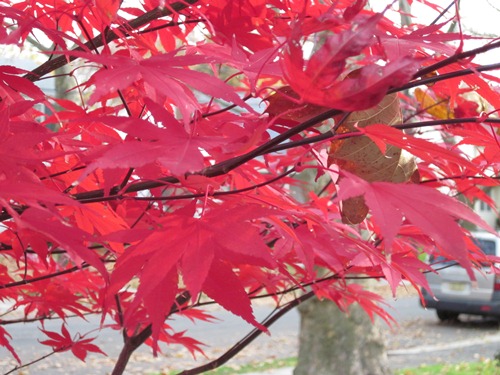
One of my favorite reminders of the coming of fall is a Japanese maple in our front yard. The leaves turn in the fall from a dark green to a glorious blazing red -- a final burst of light before they fall off and the tree sleeps in the winter.
Like Scheherazade we tell stories to keep ourselves alive -- truly alive to the rhythms of Creation of which we are so intimately part of. So I will celebrate Simchat Torah and hear again the chanting of the Creation, look at our tree and pray that the world will come to be what it should be.