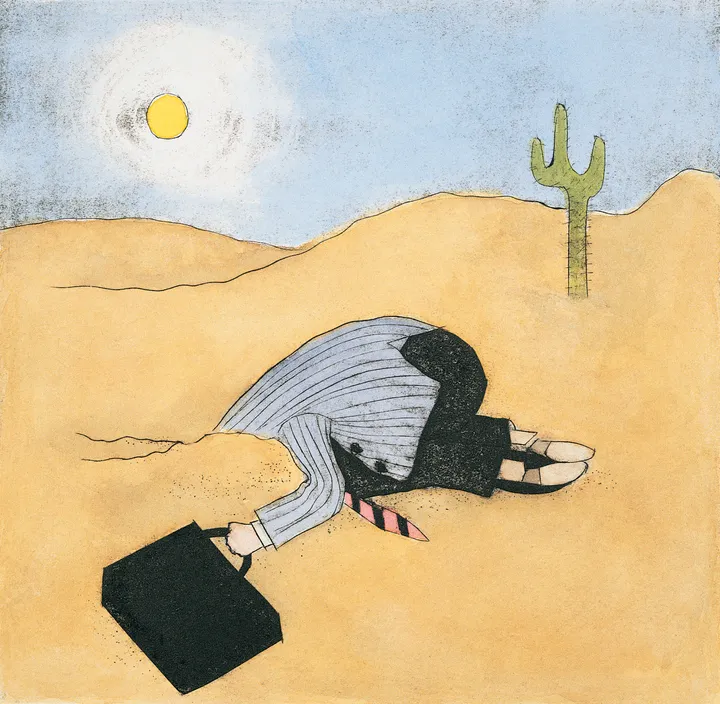
Back in the old country, there was a rabbi who invested his life savings in timber. When a forest fire broke out and his finances literally went up in smoke, the rabbi's friends worried about how to break the devastating news to him. They hemmed and hawed until the rabbi said, "You're afraid to tell me about the fire, aren't you?"
"You know?" they asked surprised.
"I found out about an hour ago."
"And you're not upset?" they asked.
"I was," he answered, "I'm over it now."
"It was only an hour ago!"
"Tell me," said the rabbi, "Didn't you once suffer a loss by fire? Why aren't you distraught about it?"
"My fire was 10 years ago."
"OK, so for you it took 10 years. For me it took an hour. The point is we both got over it."
One of life's great truths is that pain + time = healing. It's not the passage of time itself that heals; it's the perspective that time brings. The longer we live, the more experiences we have and the bigger our world becomes. With perspective, every hurt shrinks to a more manageable size. So the real formula seems to be pain + perspective = healing. If we could get perspective without time, that would work, too. It's just that usually, we need to live longer before we can see things differently.
But, imagine, please, for a moment, what it would be like to have immediate perspective. What if we didn't have to wait for context to come? What if we already had enough room in our minds and our hearts to contextualize pain as it happened? What would life be like then?
I'll tell you how this question has practical implications. It may be true that time heals all wounds, but the healing almost always leaves a scar -- a place where the heart is a bit tougher to make up for past damage and protect itself from future hurt. If only we could more rapidly find space for our pain -- if we could get over in an hour that which normally takes 10 years -- then there would be no scarring. We could learn hard lessons without disillusionment; we could grow wiser without becoming cynical or jaded.
Is it possible to gain a perspective that allows us to contextualize the events of our lives in real time instead of having to wait until we can make a withdrawal from that emotional 401k called hindsight? Is there such thing as the ability to become a "quick healer" from the bangs and bruises of life?
It's a rhetorical question. The answer is "yes," but the best word I have to describe this skill is the same word that a lot of other people use to mean all sorts of crazy things. The word is "faith."
Faith is perspective. What is faith but the ability to sense that there is a reality that lies beyond the horizon of the intellect's farthest gaze? Incidentally, this is precisely why faith, by definition, can only properly begin once critical thinking has run smack up against its outermost limits. To wit, accepting on faith that which can be understood is as unconscionable as using reason to reject something that cannot be understood. The former is laziness, the latter is arrogance. Both are predicated on the misconception rampant among fundamentalist believers and atheists alike that faith and intellect can somehow be used to perform the same function and that the one you choose to favor shows what kind of person you are, as if this were an argument over whether it's better to use a 7-wood or a 3-iron for a chip shot. Alas, faith is no more interchangeable with intellect than breathing is a substitute for eating. We need both, but we cannot replace one with the other.
But I digress. All I wish to make clear is that faith is stacked on top of reason, not overlapping it. Let us return to the main discussion, which was how to handle the hardships of life with more grace and calm.
With faith, our universe instantly expands, we become smaller and so do our troubles.
If one would argue that for the same price you can just "expand" your reality with fantasy, I will concede that it's a valid concern. For many people, their so-called "faith" is just that, and the prevalence of this brand of belief is annoying to those of us who would like to be able to speak about faith without being suspected of being nutjobs or flakes. But what is the difference between fantasy and faith? And how do you know you're involved in one and not the other?
There's a simple litmus test we can use to get clarity. Here it is. Fantasy is an idea we cling to in order to escape reality. Faith is an idea we cling to in order to have that courage to face it. Simple as that.
Incidentally, this is the same difference that there is between "getting out of yourself" and "getting over yourself." People use all types of distractions to "get out of themselves" -- drugs, relationships, sports, religiosity, gossip. These pastimes give us a way to check out of our real lives. Some forms of distraction can even be, on balance, fairly positive and productive, like taking classes or volunteering. At the end of the day, however, when the distracting activities cease, we still have to go back to our own consciousness. In contrast, "getting over yourself" is a truly spiritual skill that entails taking yourself less seriously so that you can fully engage in reality without the need for the buffer of self-stimulation. When you get over yourself, you can experience whatever life has to offer at any given moment, even when it hurts.
The bottom line is this. Being spiritual means having a big enough reality to absorb whatever temporary pain life may bring.
Follow Rabbi Shais Taub on Twitter: www.twitter.com/shaistaub
Rabbi Shais Taub - Pittsburgh, PA - Recovery Rabbis
Rabbi Shais Taub: Was the World Powerless to Stop Amy Winehouse?
god makes no demands. man makes demands. a god made in the image of man makes demands.
the only will man has is to express. within that will to express are choices.
man does not have the freedom not to express. try not expressing. impossible to do.
there is no god separate from man as all is within infinite oneness.
why not then create man as perfect expressions. perfect expressions is no expression just the stillness of perfection. ie perfect awareness.
must be the yin and yang of awareness and consciousness.
The yin and yang is awareness and consciousness. Awareness like Yin is the stillness of observation, while consciousness like Yang is the flow or movement of our thoughts. Awareness and consciousness are co-arising and interdependent, the every definition of yin and yang.
Within every human; awareness and consciousness are mutually arising and mutually dependent, and continuously transforming, one into the other. One cannot exist without the other as each contains the essence of the other.
glad I cleared that up. :-)
Wherefore decry our mythic mother,
The one denominated Eve?
She gave us reason, one another;
And from her act of make believe,
She was responsible for science;
And justified our noncompliance
With what the faithful trust in myth
By making words as does a smith:
Hard hammered on life’s anvil forging
What’s hidden in the life of things;
And ridding us of earthly kings;
And, finally, our own disgorging
Of everything that keeps us awed,
Especially the Bible’s god.
Please see more at http://poemsonaffairsofstate.blogspot.com/
The claim that "we need both" must be an assumption; for no one can truely know another's thoughts. An equal claim could be made: faith is not needed. For some, faith is freedom. For others, faith is imprisonment.
No god is worth enough to justify it's demands.
For what is real faith? Hebrews 11:1/3,5,7,17, 29
1 Faith is the assured expectation of things hoped for, the evident demonstration of realities though not beheld. 2 For by means of this the men of old times had witness borne to them!
3 By faith we perceive that the systems of things were put in order by God’s word, so that what is beheld has come to be out of things that do not appear.
5 By faith E′noch was transferred so as not to see death,
7 By faith Noah, after being given divine warning of things not yet beheld, showed godly fear and constructed an ark for the saving of his household..
17 By faith Abraham, when he was tested, as good as offered up Isaac, and the man that had gladly received the promises attempted to offer up [his] only-begotten [son],
29 By faith Moses led his people through the Red Sea as on dry land, but on venturing out upon it the Egyptians were swallowed up.
And by faith Believers of the God of the Bible and Jesus our Savior will inherit God’s Kingdom!
If you need “faith” to get through life, fine, freedom of religious conviction is one of the wonderful things about our country. I truly wish you success however you find courage, but don't be surprised that atheists reject your dismissal of their philosophy as arrogance, arrogance on your part not theirs.
An atheist philosophy does not necessarily preclude the existence of God; it merely embraces a rational, evidence based view of existence. Ask me if their is a God (let alone which God) and I can honestly reply “I Don't Know”. Therefore, I cannot profess to believe in the unknowable. God may exist and faith may be warranted but that is an individuals choice, your choice, not mine.
When you question the philosophy of others, don't complain when they in turn question your philosophy. As much as it is your right to question statements in this public forum, it is their right as well, including atheists. Freedom to speak, discuss, and choose is another of the wonderful liberties we enjoy in America.
Regarding the term agnostic; either you believe or you don't. If you “don't know” then by definition you don't believe.
many on here have made this above statement.
the unawareness of such a statement by almost always a materialist is an interesting aspect of their beliefs. unawareness comes in many forms and no one is without it. not the rabbi, not the christian, not the materialist, not even me. ok not sure about the me thing. :-)
without our unawareness there is no us just isness, absolute, infinite, whatever. we own our identity to our combo of unawareness and awareness. just saying.
hey you can call that isness god if you want but know that name is going to come with a lot of baggage as god made man in his image and then man returned the favor. twain.
Indeed the atheist fear of admitting that they are a faith based group results in other religious believers being mocked as ridiculous, simple-minded, out-of-touch, and just not as smart as the scientific atheist. I really wish the atheist folks were less preoccupied - obsessed - with others beliefs, and indeed actually comfortable enough in their version of faith to not waste time telling Christians, Moslems, Jews, and others that they are foolish.
The need to continue the badgering and criticism really betrays an uncertainty within the critic., but it also heps bolster the credibility of the 'mocked' - odd how that works. Let us just agree to label the other having as having belief system is that predicated on faulty information, as we wait for that belief system to burn out on its own. Just let it go. Live your beliefs - whatever floats your boat - indeed your beliefs will be judge by how they express themselves in your life - not by how well you badger those of other beliefs.
Interesting that after the notion has been corrected hundreds of times, theists still make the same erroneous claim.
The atheist needs no "faith" that there is no god; he simply sees a lack of evidence for faith in a god.
It is the simple acknowledgment of an unproven claim, just like a finding of "not guilty" makes no actual claim of "innocent".
So, it isn't badgering, it's just simple frustration at the apparent inability of so many to understand such a fundamental concept of critical thinking.
All life forms have intentionality; behave in such a way as to survive and replicate. Yet many life forms have no brain and no consciousness and no "I thinking" being created by that brain as a conscious experience. So it is clear that the intentionality of the life form is beyond the experience of self. We are not animated by our thoughts alone. At a minimum God has that attribute of being the intention beyond our experience.
Certain tenets of the scientific organon appear physically demonstrable such as, perhaps, triangle geometry and gravity. Other tenets appear comprised of logic regarding, and perhaps, combining tenets regarding other physically demonstrable phenomena, such as the impossibility of simultaneously measuring both location and velocity. Belief in God appears to be, in my humble opinion, a tenet belonging in the latter group. I thought “third group” in HuffPostThinker (8/27/2011 10:06 AM), but upon further review, belief in God appears describable as logic about demonstrable phenomena.
These apparently demonstrable phenomena appear to include the concepts of infinity; the apparent theory that, among humans, one might be considered smartest and might possess understanding not possessed by others considered even similarly knowledgeable; the apparent theories concerning constancy of matter; the possibility of infinitely existent matter; and the concept of the source of human thought. These appear in my mind to suggest an entity with all those attributes and maybe even more.
The paragraph that dschiff (8/27/2011 8:26 PM) appears to refer to suggests that belief in God appears to be logical, based upon the apparent demonstrability (via the phenomena listed in the preceding paragraph) of the apparently reported attributes of God.
Brilliant..Kol Hakavod!
Why couldn't it?
If you have faith in something it's usually fantasy since science doesn't need faith...it can usually be proven to be true on not true.
No it is not. This is where a religious leader will try to twist and spin the concept of faith into only being possible with his own definition of "God".
Faith is not perspective. These two concepts are mutually exclusive. The explanation behind the statement is just a dance of words from a person who's well-versed in the ways of persuasion.
In the story, the man may have had faith. But, it was his realization that we all have... "S--T HAPPENS!!".. that allows him to get over it and move on. It's not as eloquent as the long explanation tying faith and perspective away from intellectualism. But, that's the truth. You take another breath and you move forward.
We all go through bad things in life, atheists included. None of us need this faith in "God" to move forward. We do need faith in ourselves and our ability to reorganize and rebuild.