Dear Diana,
I know Teddy is a boy, but I'm sending this pink block because it's my favorite baby toy, and the only one I had left of a stash I'd bought. I really hope he likes it, and that I can visit soon and shake it at him. I can't seem to find them from the place I used to get them, and they've been a big hit with the babies I know, and hope it's okay that I'm sending it. Yes, I feel a little silly sending this, but didn't want you to think I didn't know his gender.
I sent this letter to a friend who just had a baby -- her second, actually, though her first is off to college. I felt like I needed to include a note, lest she think I was color- or gender-blind. I felt a little silly, but also like I couldn't just send the pink Rich Frog Soft Block, which is indeed my favorite baby toy, and say, "Enjoy!" without arousing at the very least suspicion, at most some attempt at feminist brainwashing. I'd bought them in bulk -- that's how much I like them -- but all I had left was pink and I couldn't find them at the same low price I'd previously purchased them for, so I figured I'd give it a shot. It's a tricky topic, all the more so because I thought nothing of giving my friend's baby girl a giant blue Eric Carle stuffed elephant. I would give a baby girl a blue shirt, no problem, but this tripped me up.
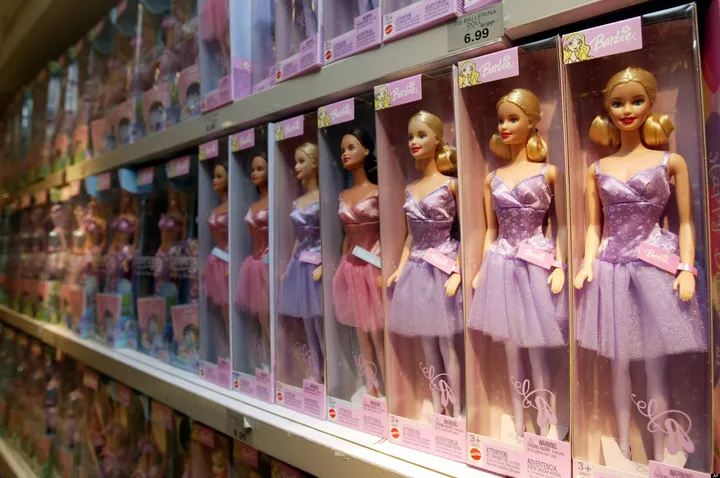
In her upcoming book "Cinderella Ate My Daughter," Peggy Orenstein does an excellent job of unpacking the ways girls are marketed to at a very young age, and the nuances of that gender-based marketing. I think it's interesting that even for me, who's been a feminist since my teens, that the socialization around gender starts so early. At one month, I highly doubt my friend's son will even notice this toy, so it wasn't about him per se, as the reaction of those around him. Would a pink toy be laughed at?
I shouldn't have been surprised that I was in this quandary, because gender is so encoded in our society that it's one of the first things we ask prospective parents. Of course I wasn't so much worried about what the baby himself would think of the toy, if he even processed its existence at all, but what his parents would. According to an article at Dads Today, "Dr. Linda Lindsay, professor of sociology at Maryville University, believes it is nurture that triumphs nature. When children are very young, she says, they are given stuffed animals. As they get older, girls continue to receive stuffed toys, but boys begin to be teased or chided, especially if he plays with the toy in front of others." Marcus Leshock writes about taking his baby daughter out and being deluged by strangers who want to either determine her gender or assume she's a he. Does it matter? To him, yes.
As they get older, it gets more complicated, as mom Christie Haskell writes in "Toys Aren't Sexist Unless You Think They Are," explaining how she feared posing photos of her daughter's traditionally girlie toys for fear of being called sexist. But what struck me was that for all my feminist beliefs (my mom dressed me in a baby Ms. shirt), I struggled with whether or not to send the toy. I wasn't trying to make any kind of political statement, but simply to hear the words that make me so happy: "___ loves the toy you gave him/her!"
I don't have kids (yet), though I hope to someday, and I also hope I'll be open-minded when it comes to the toys they receive. For now, I'm waiting to hear the fate of the pink block.