- BIG NEWS:
- Meet the Press
- |
- Fox News
- |
- MSNBC
- |
- Glenn Beck
- |
What happens when a mobile device combines the capabilities of web browsing along with accurate location awareness? It's bound to create a new medium that will completely transform the way consumers find information and the way businesses interact with their customers.
And it's coming sooner, and faster, than you might imagine.
In the 1990s, the introduction of the World Wide Web forever changed the way we create, access and navigate information. It allowed anyone to publish information for little marginal cost and allowed users to easily consume information from anywhere in the world. This spurred an exponential surge in content, and search engines soon enabled rapid navigation of the massive volume of information flooding online. In the process, many consumer activities and large industries were transformed virtually overnight.
However, the World Wide Web was built for someone sitting behind a computer and as such, it has never really understood or cared too much about where its users were located. With the recent emergence of the iPhone - and now other smartphones - browsing to the World Wide Web from a mobile device is now quite workable, yet most attempts to create local mobile browsing experiences have faltered. This may be explained partially because the technology has only very recently matured sufficiently, but to a large extent, the problem may be more of a classic issue of learning how to unlock the groundbreaking capabilities of a new device experience.
As Joe Wikert has noted, "The first TV shows were basically radio programs on the television -- until someone realized that TV was a whole new medium."
Similarly, at present most mobile sites and iPhone content applications are really just the World Wide Web on your phone, which is very convenient, and in a properly-cached application format, pleasantly quick. Yet it's quickly becoming apparent that location-aware mobile browsing devices will soon offer a new medium of their own.
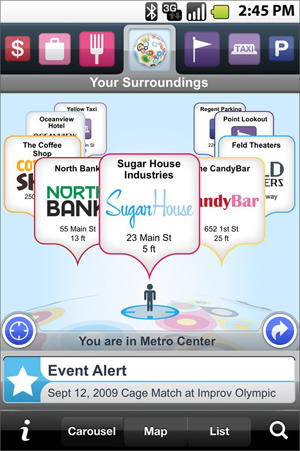
Location technologies on phones that can accurately pinpoint you to within a few feet are starting to enable scenarios unprecedented for an Internet device. Your experience at any location is largely determined by the information available to you while you are there, and correctly architected, services on this medium will help you to discover an almost unimaginable new world of contextually relevant information and experiences.
Imagine the scenarios for various locations. What information would be relevant and useful?
All of this information will be just a click or two away - pre-aggregated, and pre-packaged. No need for the information desk, no finding a display monitor, no searching for flyers, no looking up websites. And beyond the obvious information, a whole new world of details you wouldn't normally think to associate with a location will be revealed:
These scenarios are not science fiction. All the foundational pieces are in place. And very soon businesses and content publishers will start to first subtly and then radically reorganize their information and marketing messages so that they can be discovered contextually by location, time, and even humidity and temperature - a key factor for not only Haagen-Dazs stores' future promotional efforts but also for fire danger level alerts.

The commercial implications of this information will be transformative. The proliferation of location enabled devices such as GPS equipped smart phones provides an opportunity for businesses and organization to dramatically improve the quality of your experience by changing the way their information is created, organized, broadcast, and navigated.
Just as the late 90's created a land rush for business to move onto the World Wide Web, within the next three years every major location-based business will create mobile experiences for their properties. These will be automatically accessed on-site, allowing patrons to navigate all the information relevant to their products and services. Hotels will publish the meetings and the rooms they are in, along with the gym class schedule for the day, and the details on the complementary happy hour event.
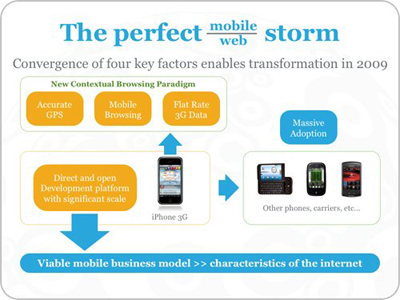
And if it's a major hotel chain, they're not going to stop there. All the information that a concierge normally gives out will be just a couple of clicks away - a special offer at the spa, which just had a few cancellations, will be visible throughout the property. Navigate next door to the convention space, and the schedule, exhibitors, and evening events planned for tomorrow's trade show will also be neatly displayed.
No search needed. No keywords. No typing.
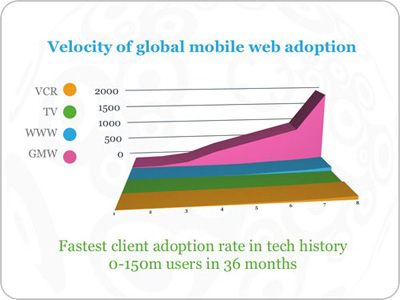
The content will be optimized for this new medium - the "Global Mobile Web", which is destined to accompany the fastest device adoption rate in the history of technology. With growth from effectively zero devices early 2008 to 10 million now to over 100 million in two years - in just the US alone - the impact on society will be far-reaching. It took the World Wide Web almost ten years to see that kind of user adoption.
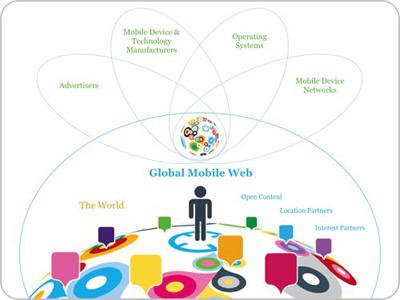
As locations become densely embedded with contextual information, the Global Mobile Web will enable users to move beyond browsing the internet to essentially browsing the real world itself.
And while this Global Mobile Web - that fits comfortably in the palm of your hand - may at first seem small compared to the World Wide Web, it will soon cast a very large net as the majority of internet devices - billions of mobile phones - turn towards it as their primary source for location-aware information.
Want to reply to a comment? Hint: Click "Reply" at the bottom of the comment; after being approved your comment will appear directly underneath the comment you replied to
After reading the article and everyones comments I checked out the website and watched their video. The interface on this thing looks incredible. I have an iphone and haven't seen any app like it. Location based data within your city is fine but the fact that this app is going to give you location based data in malls, themeparks, casiono's ect.. is incredible. That's groundbreaking stuff guys, as in no one has ever done that before. Credit where credit is due.
I think this presents an exciting scenario for smartphone users. I'm sold. I like quality content for little output and effort! How annoying is it to be trying to get info about a place, bar, restaurant, whatever, and have to go to three different websites just to figure out location, hours of operation and get reviews of it just decide if you even want to go?
I really enjoyed reading this article. I agree that the adoption rate will quickly surpass those of the past with regards to TV and VCR.
Unfortunately, Apple and other providers are still marrying proprietary formats to the devices capable of displaying them. This model was used unsuccessfully by record companies who tried to force us to buy music only if it was needlessly embedded in a CD. Ultimately, their lack of vision cost them long-term customer loyalty and it was Apple and Amazon who became the primary distribution points for digital music downloads. The record companies now split their profits with distributors when they could have owned this business.
.aSiteAbou tSomething .com Then ask yourself why Flash player won't run on any of these phones or devices.
Now, Apple with its iPhone and Amazon with Kindle are doing the same thing. Look at the state of E-books and then download one of Richard Geller's desktop eReaders from http://www
When phone manufacturers get smart and open up their technology so that applications can be developed by web dedsigners, we'll truly have the global, mobile internet. Until then, we'll have sub-networks owned by conglomerates who vie to have their proprietary formats accepted. One of the great things about the real web is that anyone can develop anything with the same tools.
There's plenty of profit to be made there without locking out features and other company's customers, but that requires innovation, vision and integrity. How about it?
Your entire response is fundamentally flawed, and surrounds the idea that these proprietary formats prevent the easy adoption by all developers. The truth of the matter is, emerging technologies are going to require a framework that must be learned... and, of course, is going to proprietary in most regards.
Most likely, you access the web through a PC or a Mac - in which case you've jumped onboard using locked-down software to go about your daily needs. In the rare event you're using Linux, then you're using something open-source that requires a unique set of skills to develop on.
The reality is, we're always going to have different devices and platforms. This is a capitalistic society after all, and competition is what has brought us to the point of the web coming directly to us. Even open-source projects like Mozilla, are fueled by a capitalistic desire to remove market share from the other players.
Apple & Google, both top players in the mobile market for these "location based phones" offer a world of tools and resources to learn their development model, and provide an opportunity to publish your work in a new way.
You're always going to be locked into some confined development structure, which you must conform to. The web is just as much owned by conglomerate ISP's under government regulation. You're locked in, no matter which way you put it.
Thanks for the polite challenge.
There will always be proprietary formats and we must pick which conglomerates we "access the world" through. Let's forgo the discussion about where the small auto-makers are who should be rushing to fill the void left by GM collapsing. You are correct that while there are open-source alternatives, it isn't an open-source world.
But I've had a stable, open platform I could develop for since I started building websites in 1995. That's the web's promise - the common man has the power to publish. That promise depends on standardized technology to access that content.
However, to develop for iPhone, I must learn new development technology, do the work and hope that Apple approves it. That's contradictory to what the web has always been about. My open platform is fragmenting.
Anyone should be able to offer proprietary development environments, and intellectual competition drives progress. Beyond my own sour grapes, though, I resent having to submit content for anyone's approval and use a proprietary format because I might otherwise use Flash to compete with the iTunes store. Corporations are deciding what we can and cannot see - not good for society or the internet.
I'm curious to see what happens with devices coming around the corner. Somebody may develop a robust, web-based platform and blow everything open, but today's model is unnecessarily restrictive. Empowering customers and competing with vision is not antithetical to a capitalist mindset. Captive audiences often leave when the doors finally open.
If your thesis is correct, that Apple and Amazon are using DRM in order to lock people into their own ecosystem of devices, then Apple and Amazon would never sell non-DRM content.
The fact that both companies sell non-DRM content (and Apple is on record oposing DRM) invalidates your thesis.
The reality is that the content owners (via the RIAA and the MPAA) are the ones who are shaping the DRM landscape. They are the ones who attempted to break Apple's market share on content by allowing everyone but Apple to carry content without DRM. They are the ones who are suing individual file sharers in court using questionable tactics, not Apple. They are the ones who are demanding the open Internet be closed, regulated and ultimately limited, not Apple.
The poster doth protest too much, methinks, about DRM and about Apple.
I'm not talking about DRM, but you are correct that that is the record industry's doing.
My complaints are against providing content through proprietary channels while existing, open channels are bypassed.
Apple won't allow Flash player on the iPhone because it allows anyone to bypass services like the iTunes store. Flash capabilty would also allow developers to bypass Apple's approval and its app store.
I've been a mac user since 1987, but as a web developer, I don't submit sites to anyone's store for approval. My customers compete by having better websites - not by making those sites available only to viewers with technology X. I'm also an Amazon customer and think its' great that they sell books. I just don't want them owning a major chunk of the Ebook market and deciding what my writing costs or if it gets published.
Amazon's Kindle is a proprietary device that displays simple text files converted to a proprietary format that can then only be bought through their store at their pricing model.
Adobe has demonstrated a working version of Flash on the iPhone, but Apple won't allow it. My iPhone is wonderful, but I can't show people my Flash sites on it. I can't read Geller's E-books on it - and only because Apple is protecting market share at the expense of having a more capable device.
Apple and Amazon are clearly closing, regulating and limiting the internet.
Did anyone mention DRM?
At what point is the net surfing ME?
When my cell phone starts giving away my eight-digit grid coordinates to brothers little AND big, then it is a net I can live without, thanks very much.
what happens is a closed network and telecom dream. nice try aint buying.
You must be logged in to comment. Log in or connect with