iPhone app iPad app Android phone app Android tablet app More

Featuring fresh takes and real-time analysis from HuffPost's signature lineup of contributors
Ramdas Lamb

GET UPDATES FROM Ramdas Lamb
 

Polytheism and Monotheism: A Hindu Perspective

Posted: 03/31/11 10:08 PM ET

Today, the two most popular theological beliefs in the West are monotheism (the belief in a single all-powerful divinity) and atheism (the belief that there is no divine entity). The Abrahamic religions of Judaism, Christianity, and Islam preach the former, while those who base their world view exclusively on material or scientific rationality tend to adhere to the latter. Yet, in much of the rest of the world, polytheism, or a belief in multiple divinities, has been a long held and popular conviction. Atheists and Western monotheists together denigrate polytheists and their beliefs as either ignorant or pagan. The more conservative monotheists even equate them with evil and demonism. Such narrow minded views and biases have hampered many who adhere to western thinking from understanding the value and validity of polytheistic beliefs for the people who hold them. Especially in contemporary times, religious narrow-mindedness is a prevalent and major cause of much of the violence and hatred in the world, and both Western monotheistic and atheistic thinking have been major contributors. The purpose here, then is to make the case for the inclusion of polytheism as a legitimate belief system, for it has animated people throughout the world since ancient times and has often provided an understanding of divinity and reality that is more rational than Abrahamic monotheism and has been the cause of far less violence in the world. Hinduism will be used as a primary example, since it offers a good example of polytheism and how it can be blended with the Hindu understanding of monotheism into a useful and practical theology.

No human has demonstrable or irrefutable proof for or against a belief in a divinity or a lack thereof. All theories regarding the divine are based on faith, supposition, and individual experience. That being the case, we should focus instead on the ramifications and practical usefulness of the various theological conceptualizations on the people who hold them as well as on the rest of the world. Among the most ancient of these concepts is polytheism.

"Polytheism" (from the Greek polutheos, "many gods") denotes a theological system involving a belief in and worship of multiple divinities. The term was first popularized in the writings of eighteenth century European ethnographers as they encountered, then sought to identify and label the religious beliefs of "primitive" peoples they studied. "Polytheism" was used to contrast these beliefs with Judeo-Christian monotheism. Nowadays, the term is essentially used to refer to any belief system in which multiple spirit beings are worshiped. These may include gods, goddesses, semi-divine beings, good or evil spirits, or the spirits of departed ancestors. Depending upon the tradition, there may be an established and recognized hierarchy of worshipped beings or they may be seen to act independently. They may work in conjunction with one another or at cross purposes.

There are several significant characteristics typically found in nearly all polytheistic traditions. Among these are a belief that each divinity or spirit being has a specific function (such as healing, protection in travel, etc.), that it controls a particular realm (such as a spirit realm or a specific location in the physical world), or that it possesses a specific power or range of powers. The latter can include forces of nature, such as rain, thunder, a celestial body, the seasons, or may involve dominion over characteristics of human personality, like love, devotion, compassion, jealousy, revenge, and so forth. Another common belief is that spirits possess or adopt a specific form, often human-like, and are endowed with human-like characteristics, such as love and compassion, but also jealousy and revenge. Other forms that spirits may embody include those of animals, of aspects of nature like a volcano, or a combination of several, thus making reverence toward and worship of both human-like and non-anthropomorphic forms commonplace. Finally, singular devotion to one specific divinity is not necessary. Simultaneous propitiation of several deities tends to be common and accepted. In some cases, this is seen as practical and necessary, since different spirits control different realms or powers.

Reflecting on how this approach can be understood on a human level, it parallels in many ways the functioning of democratic society in which power exists in the hands of various individuals who can be approached in turn or simultaneously for assistance. In conceptualizing such a theology, then, the adherents obviously drew upon their own human experiences. In the Jewish creation story, the gods (elohim) say "Let us make man in our image, in our likeness." What may be more accurate is that humans create the gods in their image and likeness, believing that what happens on earth must be a reflection of what happens in the heavens.

Polytheism, then, often mirrors the human experience of family, village, and state. It is frequently found in cultures with a clearly stratified social and/or political hierarchy, where power is held in the hands of different individuals based on their position within the hierarchy, and that these powers are there to benefit those who approach the various divinities seeking assistance. Different divinities, like different bureaucrats, have different powers. One then approaches and propitiates the being with the requisite power to fulfill his or her needs or desires. Additionally, one can choose to focus exclusively on a divinity who appeals to one's own personality. At the same time, one can choose to ignore all deities. While such individuals are then believed to not receive divine assistance, they are typically not understood to be punished for this choice. Thus, in many ways polytheism is a pragmatic theological view that, as mentioned above, reflects aspects of a democratic style system.

If one looks at the monotheistic concept, in which there is a solitary omnipotent divinity, on the other hand, we find a very different approach to the divine and also to the likely world experience of those who formulated it. In monotheism, especially as expressed in the Abrahamic religions, ultimate power is in the hands of a single male divinity. He is all knowing, all powerful, and ever present. Like with the gods in polytheistic traditions, he has human personality traits. Unlike what is found in most polytheistic traditions, he demands allegiance and punishes those who do not worship him exclusively. On the human level, one typically finds such a being in monarchies, dictatorships, and societies run by a ruling tribal leader or warlord like those currently found in many Middle Eastern countries. While such systems may be comforting to those who "belong" to the right tribe or belief system, a solitary all-powerful ruler is a threat to those who do not. The vast majority of individuals in such societies remain weak and powerless unless they observe strict adherence to the being in power and do whatever they are told. This is seen as the only means of survival.

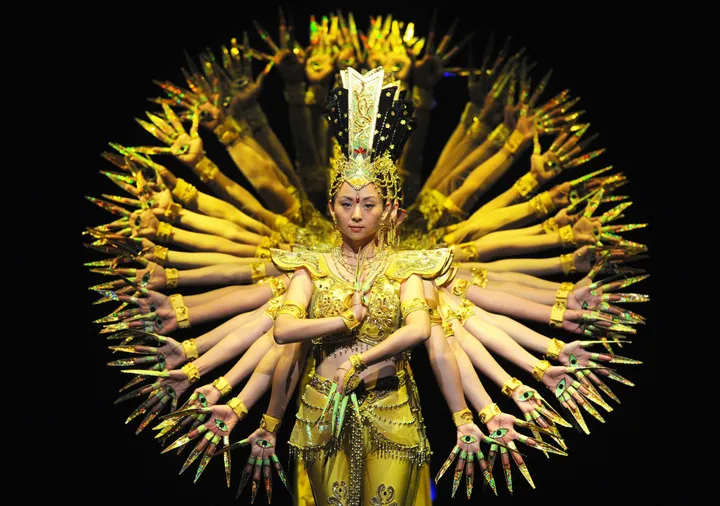
In Hinduism, polytheism and monotheism coexist in a relationship much like the parts of a wheel. The many deities are like the spokes, all of which emanate from the hub and each playing an important role. The more common of these deities to be propitiated by rural agriculturalists Bhudevi (Mother Earth), Surya (the Sun God), Ganesh (Lord of Auspiciousness and Success), regional deities, and various river goddesses. Among the myriad of others who receive attention and reverence are Lakshmi (Goddess of Wealth), Saraswati (Goddess of Knowledge and Learning), and Hanuman (Devotion Incarnate), to name just a few. Countless deities are regularly propitiated, often together.

Then, there is the Hindu form of monotheism, in which the Divine is formally referred to as Brahman (not Brahmin, the priestly caste). It is said to be the source, the hub, from which all deities are manifest. It transcends all attempts at defining or qualifying it. It is not male nor female, has no form or description. It takes on apparent form or characteristics solely to allow humans the ability to relate to it. In that state, it may be called Ram, Krishna, Shiva, Devi, etc. All these names thus refer to a Qualified Absolute that is simultaneously beyond qualifications. For Hindus, this makes total sense. With characteristics, the Divine can love, protect, and show compassion; beyond qualifications, it is all encompassing. It is not only the source and reality of all other deities, but also of all creation, both animate and inanimate. Because of this all encompassing nature, it is the One to whom all prayers are offered. This is why it is commonplace for Hindus to be seen in Buddhist or Jain temples, in Sikh gurudwaras, and in mosques and churches. The deity worshipped in each is seen by Hindus to simply be a different manifestation of the deity they already worship.

In the Brihadaranyaka Upanishad, an important Hindu sacred text, a man asks a great teacher, "How many gods are there?" To this he is told, "Three thousand and three." When he questions this answer, he receives the reply, "There are thirty-three gods." He asks again and is told, "There are six." Not satisfied, he continues to ask and gets the response, "There are only three gods." Again he asks and is told, "One and a half gods." After one final query, the teacher says to him, "There is one god." In the explanation that follows, the teacher tells him that the many are all ultimately manifestations of the one indwelling presence. In the process, he alludes to a concept found in various Upanishads that equates the unchanging reality that exists in each individual with the Supreme Changeless Divinity. In Sanskrit, this concept is "tat tvam asi," which can be translated as "you are that" or "that you are."

The merging of polytheistic and monotheistic concepts in this way is unique to Hinduism. It allows people to believe in and pray to their own conceptualizations of the divine in whatever form they choose, while at the same time elevating all of them to their ultimate reality, which is the singular omnipotent, omnipresent, and omniscient divinity, who demands no allegiance, punishes no one for lack of belief, yet provides wisdom, comfort, compassion, and freedom to those who seek it. All they need to do is look within.

 
Today, the two most popular theological beliefs in the West are monotheism (the belief in a single all-powerful divinity) and atheism (the belief that there is no divine entity). The Abrahamic religi...
 
 
  • Comments
  • 571
  • Pending Comments
  • 0
  • View FAQ
Comments are closed for this entry
View All
Favorites
Bloggers
Recency  | 
Popularity
Page: 1 2 3 4 5  Next ›  Last »  (9 total)
04:42 AM on 05/11/2011
It doesnt matter Hinduism, Buddhism, Christianism, Islamism, all ism are gonna be erased and spirituality established as the New religion with the RESURRECTION of Sathya Sai Baba, He died on April 24 2011 Easter Sunday. Check out my tribute channel with lot of information on Sathya Sai baba at http://www.youtube.com/user/gozeep
12:56 PM on 04/24/2011
There are many similarities from Leviticus to Hinduism

Gen 9:18-19 “Now the sons of Noah who went out of the ark were Shem, Ham, and Japheth. And Ham was the father of Canaan. These three were the sons of Noah, and from these the whole earth was populated.”

Jesus in the Hindu scriptures
http://sites.google.com/site/whoisthisjesus/hinduscriptures
10:28 PM on 04/06/2011
Outstanding article! This clearly articulates spirituality as it should be understood. A must read for those who want to understand pluralism, and how polytheism has been given a bad rap by some.
07:17 AM on 04/05/2011
HCLiberal:

"There is no belief involved in atheism.
An atheist simply says: 'I do not accept any claim of existence of god and supernatur­al entities because there is no evidence or proof, empirical or logical, of such existence AND no logical proof can ever be found'."

There are many things that don't exist in the way we experience them, yet we take them to be "real" and act accordingly because our experience is there to keep us alive. I think there are many people who accept the experience of God because it is a real experience, but who according to your definition might be technical atheists, particularly if by "exist" you mean fill up space in physical scientific reality. Still most of them don't even care about the issue of "existence" and agree not only that it can't be proved one way or the other, but also that it doesn't matter one way or the other. The only people that care are atheists and the kind of religionists who have a vested power interest in the issue.

Most atheists that I have run across are rationalists, who believe that it matters that they know what really exists and knowing it somehow makes them better more moral people. They tend to like to make people wrong for living in their experience and tend to think that life is rational and it matters that one have good reasons for what one wants. Atheism is not a belief, but rationalism is.
08:16 PM on 04/04/2011
Continued.­­.response to Mukunda's post at 10:14 PM yesterday. Please respond to my voxel_mach­ine@yahoo.­com email address if you you want to continue the discussion.

Part 4
=====
6. Finally you say "Hindu doesn't exist before about 1100 CE". I do not know where you came up with that date. Again no reference. More importantly you are getting confused between the word Hind/Hinduism and the schools of philosophy it represents. The time when the word Hinduism was introduced (may be derived from the river Sindhu), does not say anything about the origination of Hindu schools of philosophy. Water as a physical substance existed even before Germanic people started calling it "wasser". Similarly the six Hindu/Vedic/Sanatan Dharma philophies existed even before people started referring to them as "Hindu". In that sense, Hinduism, Vedic and Sanatan Dharma refer to the same core six philosphies and are one and the same.

Best regards
-Voxel.
08:14 PM on 04/04/2011
Continued.­.response to Mukunda's post at 10:14 PM yesterday.

Part 3
======
4. You mentioned "Sankara is known as a pracanna bauddha (hidden buddhist) for a reason. He and Gaudapada basically took the Madhyamika view of Nirvana, Shunya, Paramartha and Vyavahara and imposed them on the Vedanta School". This statement is factually incorrect at several levels. First of all, Shankara is called a crypto-Buddhist by scholars whose hidden agenda is to show that Vedanta is derived from Buddhism. They do not employ any logical arguments to prove their point. Also, Shankara spent considerable time criticizng Buddhist concepts, not "imposing" them on Vedanta. In his work Sutra Bhashya, Shankara rejects the concept of Shunyata whole-heartedly and logically. The bold but erroneous statements you made are somewhat dangerous because they lead newcomers in this field to a wrong start.

5. Previously you mentioned Upanishads are a product of both Vedic and Shramanic Traditions. You gave no reference whatsoever. Ranging from commentaries of Shankara on Upanishads to "Essential Vedanta" by Eliot Deutsch, no where any claim has been made that Upanishads are product of "Shramanic Tradition". These scholars agree that Upanishadic knowledge (Vedanta literally means conclusion of Vedas) is derived solely from Vedas.

Continued in Part 4..
08:12 PM on 04/04/2011
Continued..response to Mukunda's post at 10:14 PM yesterday.

Part 2
======
2. You mentioned "Samkhya says nothing about practice of the Vedas". Most of the Samkhya Concepts have direct analogs to concepts in Vedas. Please refer to Samkhya-Pravachana-Sutram by Vijnana-Bhiksu who showed how Samkhya's core concepts are derived from Vedas.

3. You said "In any Vedic yagna only the Samitha and Brahmanas are used not the Upanishads or Aranyaka". First of all it is "Samhita" not Samitha. Ritualistic aspects like Yagna is one of the many perspectives that Vedas cover. Just because vedic yagnas do not recite Upanishadic sayings, does not mean Upanishdas do not belong to Vedic System. In Vedic Yagnas, they also do not recite ontological knowledge of Ayurveda. That does not mean, Ayurvedic System is not part of the Vedic tradition.

Will continue in Part 3..
02:54 PM on 04/03/2011
"In monotheism, especially as expressed in the Abrahamic religions, ultimate power is in the hands of a single male divinity."

Just this single line shows how this writer is simply an ignorant about Monotheism religion. Just because we refers God as He doesn't mean God is a male!

Who said God is a male ? Where did you found it ?

God, the Eternal Refuge.
He neither begets nor is born,
Nor is there to Him any equivalent,
He neither a male nor a female.
God, Lord of the worlds,
The Entirely Merciful, the Especially Merciful,
Sovereign of the Day of Recompense.
07:39 PM on 04/03/2011
I can't tell if you're being sarcastic or serious?
02:24 PM on 04/11/2011
According to Genesis, God made man in His image, and that man was Adam. It was only later that HE fashioned Eve from Adam's rib.
01:04 PM on 05/21/2011
More accurately, Man made God in his own image, the better to comprehend the incomprehensible.
This user has chosen to opt out of the Badges program
photo
12:50 PM on 04/03/2011
Dharmakirti, a 7th century Buddhist philosopher deeply influenced by cārvāka philosophy, wrote in Pramanvartik:[13]

वेद प्रामाण्यं कस्य चित् कर्तृवादः स्नाने धर्मेच्छा जातिवादाव लेपः|
संतापारंभः पापहानाय चेति ध्वस्तप्रज्ञानां पञ्च लिङगानि जाड्ये||

Believing that the Veda are standard (holy or divine), believing in a Creator for the world,
Bathing in holy waters for gaining punya, having pride (vanity) about one's caste,
Performing penance to absolve sins,
Are the five symptoms of having lost one's sanity.".

From "Atheism in Hinduism"
http://en.wikipedia.org/wiki/Atheism_in_Hinduism
02:53 PM on 04/05/2011
The wiki topic is aptly named as "Atheism in Hinduism". Dharmakriti was not put on a cross and killed in the name of blasphemy. Only in the framework that Hinduism provides, ideas ranging from Advaita Vedanta where each individual is recognized as same as the supreme self to atheism -- all have a place. That's the only equivalent of an open-source movement when it comes to spiritualism. Just like Dharmakriti made comments against the Vedic system, Adi Shankara vigorously defended Advaidic Vedantic view and refuted several streams of Buddhist/Charvaka arguments. In a successful open-source movement, diverse viewpoints are not just anticipated, but are welcome.
01:10 PM on 04/24/2011
http://bit.ly/dSll6z is this wrong?
This user has chosen to opt out of the Badges program
photo
12:36 PM on 04/03/2011
atheism (the belief that there is no divine entity).
---------------
Incorrect representation of atheism.

There is no belief involved in atheism.
An atheist simply says: "I do not accept any claim of existence of god and supernatural entities because there is no evidence or proof, empirical or logical, of such existence AND no logical proof can ever be found".

There is no belief involved.
07:40 PM on 04/03/2011
Thats still believing something.
This user has chosen to opt out of the Badges program
photo
08:03 PM on 04/03/2011
In what?
11:22 PM on 04/03/2011
There is no specific belief. There is only the absence of the belief. You do not believe in something that is nonexistent.
01:19 PM on 04/24/2011
If there is no God, then all that exists is time and chance acting on matter. If this is true then the difference between your thoughts and mine correspond to the difference between shaking up a bottle of Mountain Dew and a bottle of Dr. Pepper. You simply fizz atheistically and I fizz theistically. This means that you do not hold to atheism because it is true , but rather because of a series of chemical reactions… … Morality, tragedy, and sorrow are equally evanescent. They are all empty sensations created by the chemical reactions of the brain, in turn created by too much pizza the night before. If there is no God, then all abstractions are chemical epiphenomena, like swamp gas over fetid water. This means that we have no reason for assigning truth and falsity to the chemical fizz we call reasoning or right and wrong to the irrational reaction we call morality. If no God, mankind is a set of bi-pedal carbon units of mostly water. And nothing else.
Douglas Wilson
09:26 PM on 04/02/2011
Ramdas, I have to disagree that you cannot prove God exists, believe it or not there is a way -- http://geological-proof-of-god.blogspot.com/
photo
HUFFPOST COMMUNITY MODERATOR
Hirnlego
10:14 PM on 04/02/2011
Poe's law?
01:21 PM on 04/24/2011
The theory that thought is merely a movement in the brain is, in my opinion, nonsense; for if so, that theory itself would be merely a movement, an event among atoms, which may have speed and direction but of which it would be meaningless to use the words 'true' or 'false'. C.S. Lewis
photo
Syl 13
We're all mad here
08:15 PM on 04/02/2011
I appreciate the article. The Hindu faith is sensible in it's capacity for monotheism, pantheism, and polytheism to coexist, while Abrahamic faiths, importing the OT God's possessive jealousy, have punished anything looking like polytheism, leaving mankind alone, and forced to attribute all divine activity, positive and negative, to a single God, and thus leaving them confused as to his benevolence and reliability.

Basic problems like evil and suffering make sense when the gods are at odds, or when the sins of past lives carry into this one, or suffering is a basic element of this world of illusion, but not when the only evil force is a rogue creation of the one god who could be willed out of existence by the Almighty with a blink, or when the sin of distant ancestors (who, being free of knowledge of good and evil at the time they sinned, shouldn't be held culpable, let alone their descendant for perpetuity)-is imposed on innocents by a supposedly loving God.
01:23 PM on 04/24/2011
HE is possessive because HE is the only GOD who gave up HIS life for our sins, as also btw required in the vedas. HE is JESUS CHRIST.
photo
HUFFPOST SUPER USER
Allan Richter
06:47 PM on 04/02/2011
Hindu deities are like spokes, all of which emanate from the same divine hub. The source or “hub” transcends all attempts at defining or qualifying. It has no form or description. It takes on apparent form or characteristics solely to allow humans the ability to relate to it. With characteristics, the Divine can love, protect, and show compassion; beyond qualifications, it is all encompassing. It is the source of all creation, both animate and inanimate. (Paraphrase of Ramdas Lamb).

Torah assumes all originally worshiped God. Abraham preached about the Eternal prior to Sinai.
Talmud says that Abraham had a tract dealing with idolatry. There is a Talmudic teaching that Abraham taught the mysteries involving “unclean names” to the children of his concubines¬. Attribution of Sefer Yetzirah, the oldest Kabbalistic text, to Abraham places its origin in the 18th century BCE. The Vedic scriptures (Hindu) date from this period. Abraham was born in Mesopotamia, and also lived in Egypt. (paraphrase Aryeh Kaplan).

The “silk route” (trade) connected India, Mesopotamia, Canaan/Israel and Egypt. Mitanni (Vedic/Hindu) of Indo-Irani¬an origin entered Mesopotami¬a during the 17th Century BCE. Mitanni formed an alliance with Egypt in the 14th century BCE.. Canaanite religion was influenced by its peripheral position between Egypt and Mesopotama.

Kabbalah is “a ‘switching station’ in which the biblical tradition, Near Eastern mysticism, and western philosophy converge.” (Sanford Drob)
06:31 PM on 04/02/2011
There is an interesting story (probably some Purana): An argument broke out between gods on who was most powerful, So they approach Visnu, Shiva and Brahma. But saw that they were also arguing about the same issue. They then decide to approach the ultimate Brahman. When they reach the abode, the Guard Yaksha tell them to wait. Now Vishnu wants to know what could be more important to Brahman. The Yaksha replies that Gods from other worlds had also argued about the same issue and the Brahman had to deal with them as they had come first!
photo
HUFFPOST SUPER USER
metriks
Hillary 2008, 2012, 2016
03:03 PM on 04/02/2011
“Religion is the impotence of the human mind to deal with occurrences it cannot understand.” Marx

He got that right anyway.
This user has chosen to opt out of the Badges program
longtimegone
my micro-bio remains empty
04:13 PM on 04/02/2011
Bravely cherry picking the only aspect of Marx's thought which would not disturb the plutocracy.
photo
HUFFPOST SUPER USER
metriks
Hillary 2008, 2012, 2016
05:07 PM on 04/02/2011
It was a thought more applicable to the specific religious story than some of his others. If you'd like I'll discuss why the nature of his framework was ethically sound, and his criticisms of the bourgeoise and intelligentsia justified, his solution failed to take into account fundamental human nature, expressed in the close-to-being contemporary psychoanalytic treatises. Marx's biggest enemy was not capital-ism, but human nature. I would recommend comparing the personal essays presented in the Marx-Engel's Reader with Freud's Civilization and Its Discontents, second, enhanced edition, with a final paragraph added. But I wasn't sure anyone would be interested.