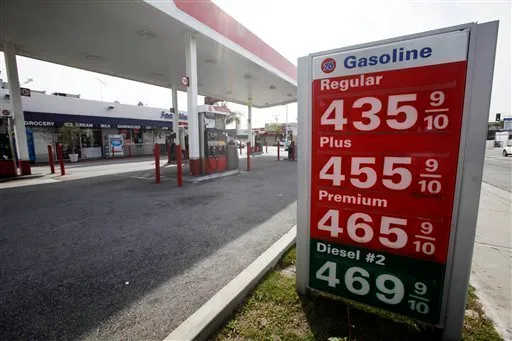
Well finally, finally it has come to pass. After seeing the price of oil skyrocket nearly 300% on his watch from the low $30's/barrel in February 2009 to over $110 a barrel this month and gas prices jumping to $4.00 per gallon, President Obama finally has gotten around to trying to deal with the issue by forming a government financial fraud task force, "The Oil and Gas Price Fraud Working Group" focusing on fraud in the energy markets to monitor the oil and gas markets for potential criminal violation, i.e. price fixing, manipulation, etc.
In essence, it is a call to investigate whether oil prices are a true reflection of market forces or whether they have been impacted by speculation or worse, by manipulation. This, in spite of the fact that this administration's soporific CFTC has allegedly been wrestling with this issue for months, and now years, calling for hearing upon hearing, thereby effectively stonewalling anything close to meaningful action while the house has been burning down.
So here we are with President Obama appointing as his point man on this prodigiously ominous issue that master of insouciance Attorney General Eric Holder (he, who with neither consideration nor regard, militated for terrorist trials to be held in downtown New York without seeming to understand what it would do the disruption of life in a part of the nation that has lived the trauma of the events that would be central to the trial) to organize the investigation. While announcing the formation of the task force meant to expose one of the greatest, most sophisticated rip-offs in history, in almost the same breath Holder squarely placed himself along the side the tooth fairy, opining that there may well be "lawful reasons for increases for increases in gas price, given supply and demand." A bit like J.Edgar Hoover coupling his announcement that he was going after the Mob with, "but I'm sure they're good family guys."
For the Task Force's work to be meaningful, among the issues it needs focus on are:
- Who trades oil/energy (hereafter simply designated as "oil") on the commodity exchanges?
- Are they producers of oil, end users of oil or legitimate hedgers of oil products (i.e. airlines) or simply speculators, and what combination of these?
- If speculators, or whoever, are they privy to information not available to the general public?
- Size of their holdings both nominative and actual.
- Are trades made by speculators for their own accounts or for others -- and for whom?
- What role does arbitrage between world commodity exchanges play in determining price of oil on U.S. exchanges?
- Does the level of transparency in offshore commodity exchanges protect end users?
- What is the level of cooperation extended by offshore exchanges, i.e. London, Singapore, Dubai, etc. to U.S. oversight agencies such as the CFTC, Federal Trade Commission, Justice Department and are they adequate to determine whether trading in oil futures is evenhanded and not manipulated?
- Is their any evidence that producers themselves are using the commodity exchanges to influence the traded price of oil -- that is, using the commodity exchanges not only to hedge their production but to also manipulate the price of their production?
- Is their any evidence (has it ever been investigated) whether OPEC or the Russian oil giants either directly through agents, or indirectly through clandestine agents, influence the price of oil by manipulating exchange traded prices through the allocation of some portion of the billions upon billions of dollars held in their sovereign wealth funds/national treasuries?
- Has a study been made about what the realistic price of oil would be were it traded in actual wet barrels rather than the "virtual/paper barrels" traded on commodity exchanges much in the way, say, iron ore is bought and sold internationally?
- In that the panel is under the auspices of the Justice Department, what would the ramifications have been/would be on the price of oil and on OPEC behavior if a NOPEC law were finally passed? NOPEC, a bill which passed the House overwhelmingly in the George W. Bush years, withdrawing sovereign immunity from OPEC national oil companies and permitting them to be sued in U.S. courts for anti-trust violations etc., targeting companies such as Aramco, the Saudi national oil company or PDVSA ,the Venezuelan national oil company- owners of CITGO with three refineries in the U.S. at Corpus Christie, Tex., Lemont, Ill., and the fifth largest refinery in the U.S, at Lake Charles, La. after Exxon, BP and Marathon. The NOPEC bill died in committee after President Bush threatened to veto the measure.
- To focus on the Strategic Petroleum Reserve (SPR) to determine what impact purchases to fill the SPR have on prices. To determine and set guidelines as to what constitutes an emergency authorizing release from the STP in terms of supply and/or economic harm. Given the Department of Energy's past performance or lack thereof on this issue, their input needs to be held up to particular scrutiny (please see "The Energy Department's Craven Obeisance to the Oil/Gas Gougers," Nov. 14, 2006).
One can only hope the task force will not be lobbied into ineffectuality by the oligopoly and their allies, and that the press will keep an alert and an effective vigil on the Task Force's proceedings.