More

Featuring fresh takes and real-time analysis from HuffPost's signature lineup of contributors
Rebecca Novick

GET UPDATES FROM Rebecca Novick
 

Nepal's Violent Crackdown on Tibetan Anniversary

Posted: 03/18/11 12:22 PM ET

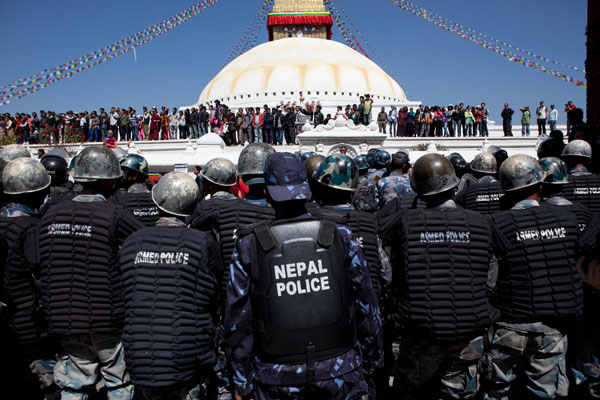
2011-03-18-_MG_1753.jpg PHOTO: Kevin Bubriski

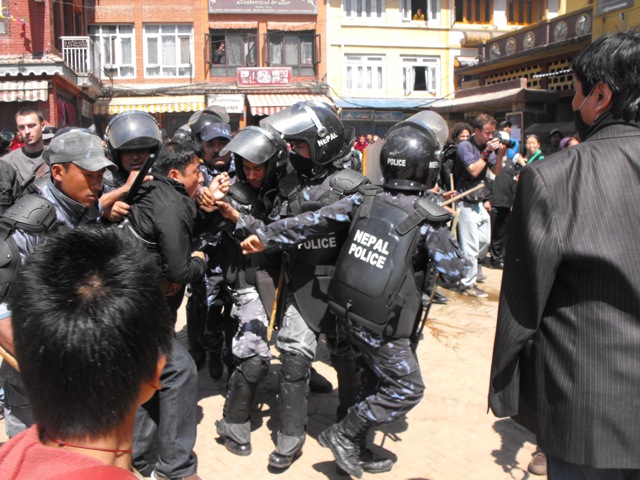
The Boudhanath Stupa in Kathmandu has for centuries been a holy place for Tibetans. It is also where Tibetans in Nepal have often demonstrated against Chinese rule in Tibet. On the morning of March 10, 2011, the 52nd anniversary of the uprising in Lhasa that was thwarted by Chinese Communists, the presence of over 1,000 Nepali police deployed throughout the city sends a strong message to Tibetans who may be thinking of marking the anniversary with protests...

2011-03-18-March10Nepal.jpg PHOTO: Rebecca Novick

Riot police congregate outside the main gate of the Boudhanath Stupa...
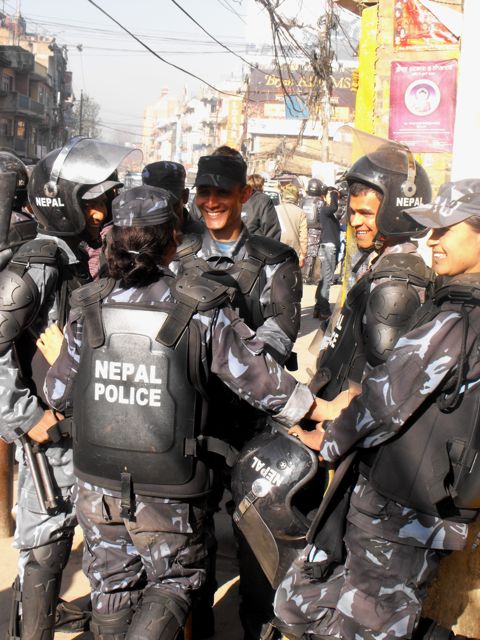
2011-03-18-DSCF1803.jpg PHOTO: Rebecca Novick

Sharing a joke before things turn serious...
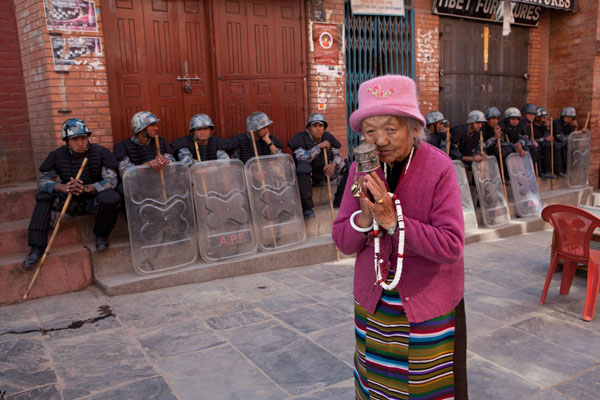
2011-03-18-_MG_15521.jpg PHOTO: Kevin Bubriski

An elderly Tibetan woman circles the stupa chanting prayers as more police converge on the area...
2011-03-18-DSCF1814.jpg PHOTO: Rebecca Novick

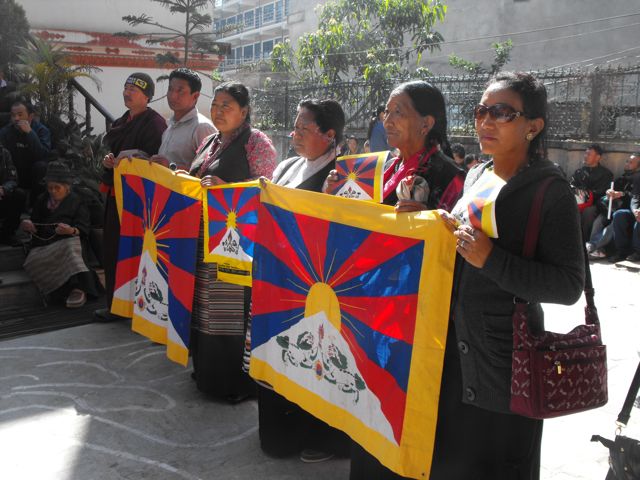
Inside Samteling Monastery, located on a side-street near the stupa, about 1,000 Tibetans have gathered to hear the annual address of the Dalai Lama that is broadcast on loudspeaker from Dharamsala, India. In recent years, as a result of pressure from Beijing, even social and cultural gatherings of Tibetans have been labeled 'anti-China' activities by Nepali authorities.
2011-03-18-DSCF1822.jpg PHOTO: Rebecca Novick

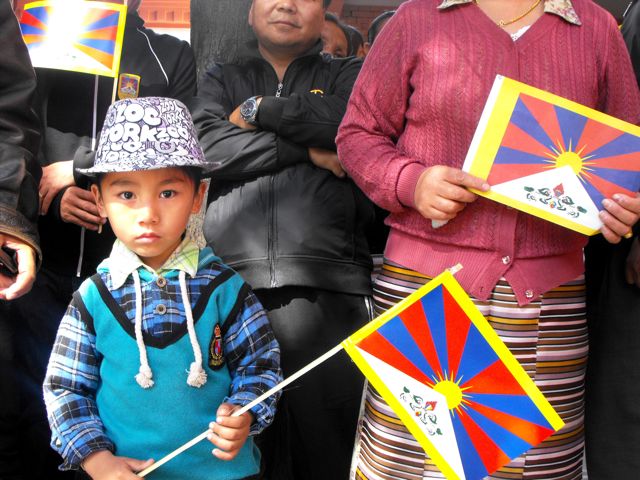
The Tibetan community has been warned that if they take a single Tibetan national flag beyond the monastery gate, there will be trouble...
2011-03-18-DSCF1831.jpg PHOTO: Rebecca Novick

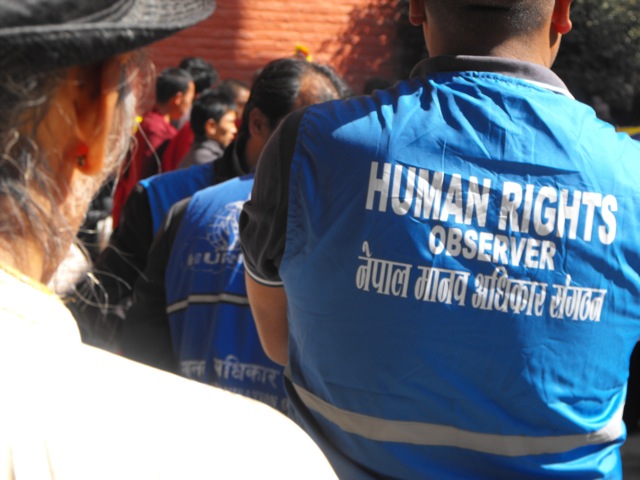
A coalition of international human rights groups are present to monitor the event. Many Nepalis have joined as voluntary observers....
2011-03-18-DSCF1877.jpg PHOTO: Rebecca Novick

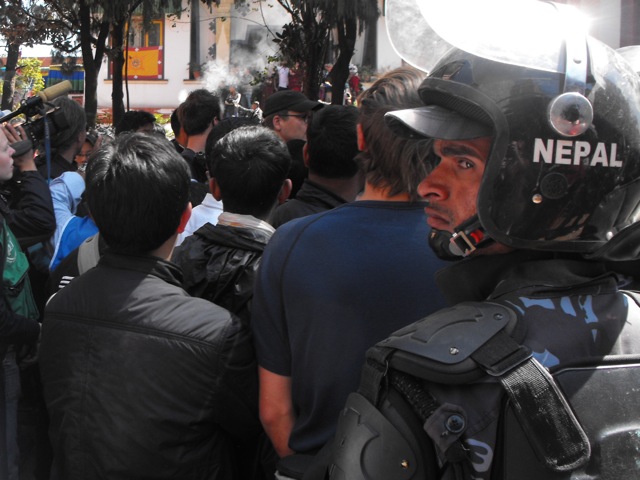
Outside the monastery gate, the tension builds as a police move in. "Should I be worried?" asks a young American tourist.
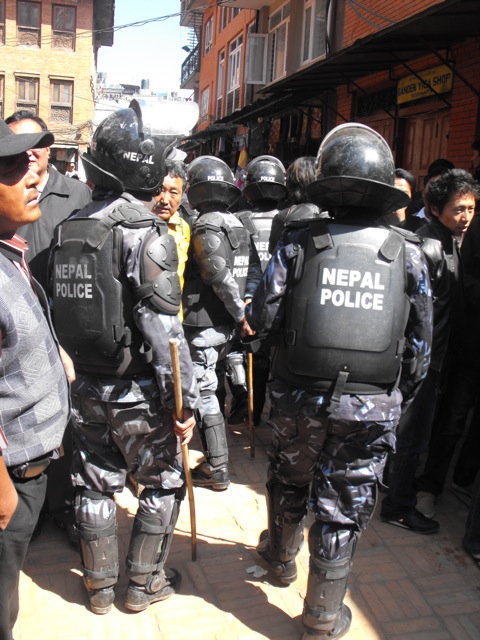
2011-03-18-DSCF1842.jpgPHOTO: Rebecca Novick

The police are armed with lathis, six-foot-long bamboo sticks. A local reporter tells me that their riot gear is a gift from the Chinese Embassy...
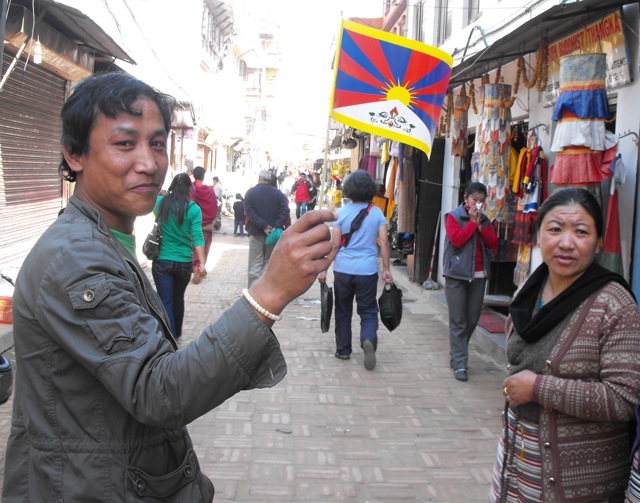
2011-03-18-DSCF1850.jpg PHOTO: Rebecca Novick

A young Tibetan man with a Tibetan flag over his shoulder walks nonchalantly out of the monastery into the street, slipping through the police cordon unnoticed. He saunters alone down the street and poses proudly for this photo. Seconds later, the woman on the right snatches the flag out of his hand. "You're asking for trouble," she scolds.
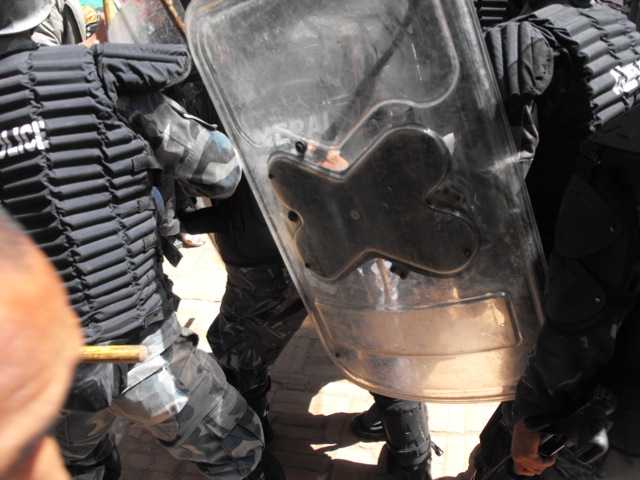
2011-03-18-DSCF1888.jpg PHOTO: Rebecca Novick

Without warning, the police storm the courtyard and begin snatching flags from the Tibetans inside who begin to shout and wail in protest...

2011-03-18-DSCF1896_2.jpg PHOTO: Rebecca Novick

The incursion angers the crowd. People begin pushing their way out of the gate, and through the police line, chanting freedom slogans. Police begin to beat, kick, and punch them indiscriminately, pulling one man along by the prayer beads around his neck. Watch the video from Euronet. And The Telegraph UK.
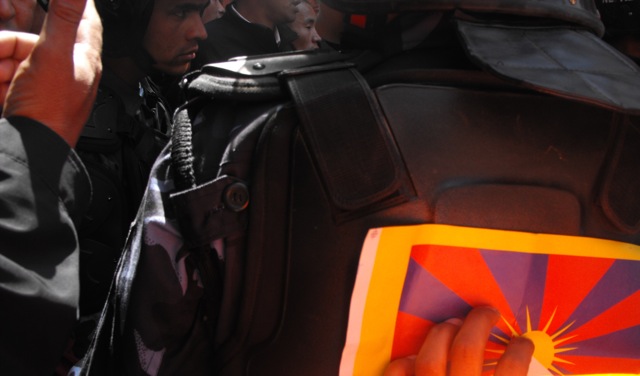
2011-03-18-DSCF1876_2.jpg PHOTO: Rebecca Novick

In a risky move, a Tibetan teenage boy sticks a Tibetan flag onto the back of a police officer. A few seconds later, a Tibetan man rips it off....

2011-03-18-DSCF1892.jpg PHOTO: Rebecca Novick

"What have I done wrong? All I did was lose my country," cries a man wearing a shirt on which he's written: 'Stop Killing in Tibet'...

2011-03-18-DSCF1893.jpg PHOTO: Rebecca Novick

A strange dance ensues as reporters, human rights observers and a few tourists rush to surround people as they're being beaten....
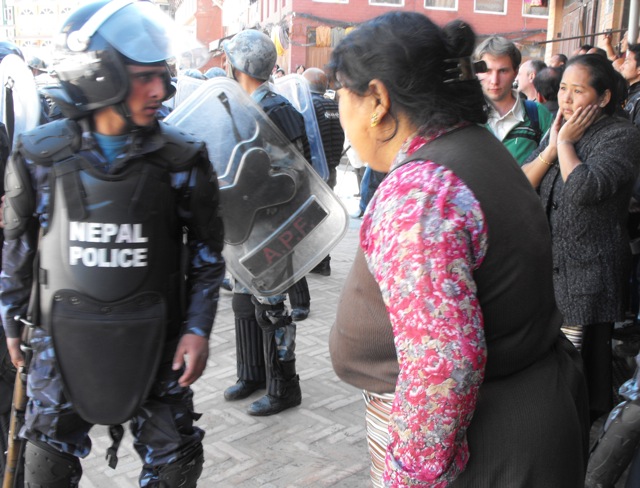
2011-03-18-DSCF1922.jpg PHOTO: Rebecca Novick

A woman looks on in horror as a young police officer moves in to strike a middle-aged Tibetan woman. The police officer raises his stick as she bends her head down before him. "Beat me," she says. She is later arrested...
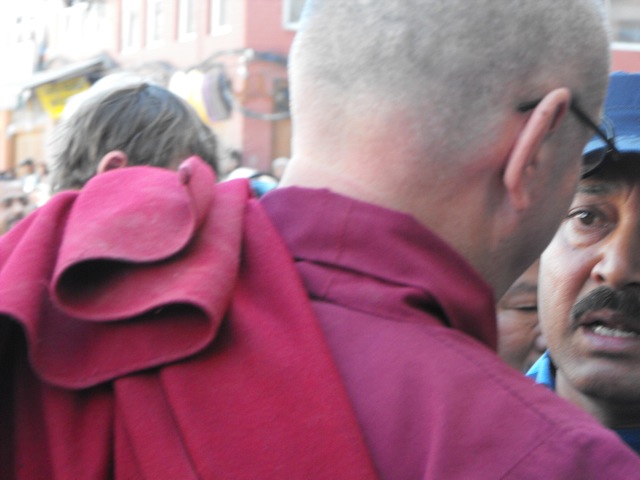
2011-03-18-DSCF1931.jpg PHOTO: Rebecca Novick

A Western monk tries to reason with the Deputy Superintendent of police...
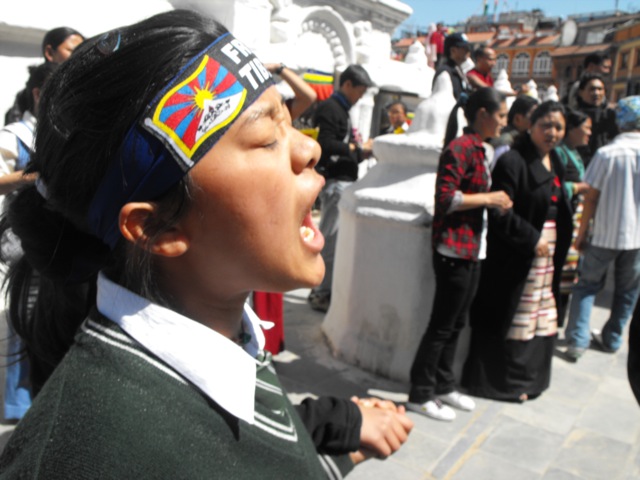
2011-03-18-DSCF1913.jpg PHOTO: Rebecca Novick

Girls from a local school hold hands tightly and shout "We want justice!" just yards away from the skirmish. Earlier, police had visited local Tibetan schools and ordered the children to stay inside...
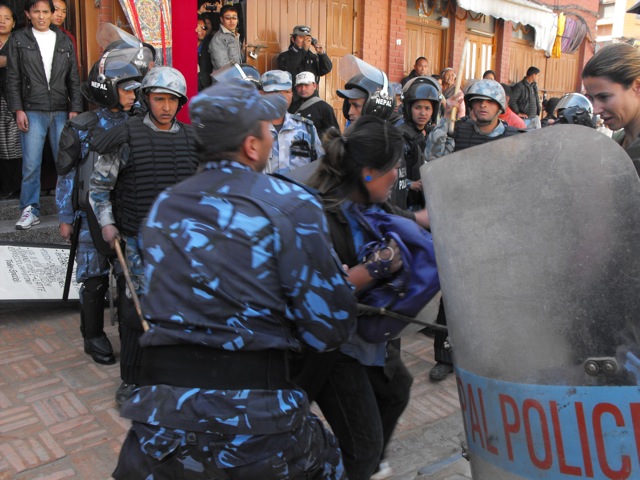
2011-03-18-DSCF1906.jpg PHOTO: Rebecca Novick

2011-03-18-DSCF1940.jpg PHOTO: Rebecca Novick

Four people are arrested at Boudhanath. Seven more are arrested later in the afternoon at a protest near the Chinese Embassy...
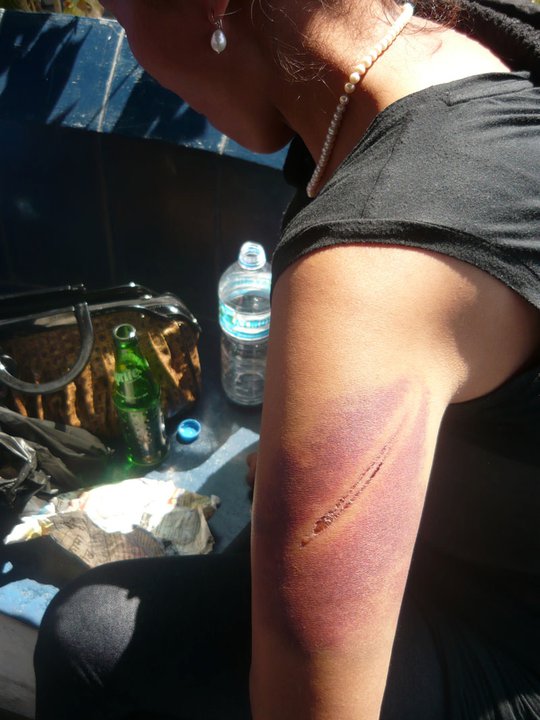
2011-03-18-injury2_march10.jpg PHOTO: Courtesy of Yeshi

A young woman is one of 21 Tibetans injured during the police action...


Follow Rebecca Novick on Twitter: www.twitter.com/RebNov


  • Comments
  • 35
  • Pending Comments
  • 0
  • View FAQ
Comments are closed for this entry
View All
Favorites
Recency  | 
Popularity
photo
HUFFPOST SUPER USER
HanMeiRen
May already be guilty by association...
11:31 AM on 04/01/2011
For an interesting read on how Nepal plays in the Tibetan politics:

http://www.atimes.com/atimes/China/MD02Ad03.html

The article is long but contains many refreshing facts, e.g. how many Tibetans willing return to the "living hell" after a religious or political pilgrimage to Dharamsala.
photo
HUFFPOST SUPER USER
HanMeiRen
May already be guilty by association...
02:15 PM on 03/31/2011
The recently released trip report from staff of the Senate Foreign Committee is an interesting on the ground reality in Tibet:

http://foreign.senate.gov/download/?id=E3A86CB6-499B-4228-9F2F-2B046E0ADE83
photo
HUFFPOST SUPER USER
HanMeiRen
May already be guilty by association...
12:17 AM on 03/31/2011
The author does not really have to travel half a globe to Nepal to report/record confrontation between some of the Free Tibet demonstrators and police.

She can stick around UN headquarter in NYC with video camera ready after coordinating with the Free Tibet people to STAGE a protest there. The confrontation happened once (http://www.youtube.com/watch?v=rae0ufXb9QI) and can happen again.
photo
HUFFPOST SUPER USER
DAE
07:42 PM on 03/29/2011
I know Tibet is a cause celebre but there are many other similar situations in most countries including our own. Nepal is not Tibet. I think the Nepalese have a right to regulate the activity of foreign nationals in their own country. As far as what's depicted I could also document abusive treatment of protesters in the US that would be more graphic than what's shown here. You could make a documentary about life in the US that would be horrendous and show the very worst of everything, strip mining and mountain top removal, pollution of waterways, inner city poverty , drug addiction, homelessness, and on and on. You could paint our country as a horrible hell hole. You can do the same for China, Tibet or Nepal as well. It doesn't tell the whole story.
photo
Pod-gers
Jeremy Lin = Game Change
04:31 PM on 03/29/2011
March 28, 2011, marking the emancipation of the HH's serfs and slaves 52 years after liberation.
http://diggchina.blogspot.com/2011/03/serf-emancipation-day.html

People of Tibet love their freedom!

Thank goodness, China set them free!
04:43 PM on 03/29/2011
All hail the glorious people's repression as we swallow the crassest state lies and confuse an authoritarian occupation with liberation!

Apologists for CCP love their state propaganda!

Thank goodness, China represses them and keeps them safe from self-determination and free speech and other basic human rights!
photo
Pod-gers
Jeremy Lin = Game Change
12:40 PM on 03/28/2011
The article above seems to wildly distort the fact that 52 years ago the serfs and slaves of Old Tibet were emancipated by China. For some reason so called human rights activists play this down, and make excuses for the awful conditions imposed on 95% of people living in Lhasa before 1959.

Here are some super photos, as China marks the 52 Anniversary of Serf Emancipation Day!
http://news.xinhuanet.com/english2010/china/2011-03/28/c_13801677.htm
"The first 50 years of my life were dark and with no dignity," said Tsering Chodron, a former serf. "My life as a human began only after 1959."

She was among up to 1 million serfs that gained freedom thanks to the central government's democratic reform launched in Tibet on March 28, 1959.

On the eve of the anniversary, a group of farmers in Nedong County, Shannan Prefecture, staged a self-directed drama to recount their miserable past.

The drama, named "Tears of the Serfs," tells the tragic life of serf Trinley Dorje and his family. Despite its simple plot, the drama moved many people to tears.

Padma Yonten, 63, cried when he saw Trinley Dorje's preteen son being whipped by a housekeeper at the Khesum Manor where the family of six worked as slaves. "I was like that poor child. All serf children began working at 8 years old, herding or running errands."
02:28 AM on 03/29/2011
"The article above seems to wildly distort the fact that 52 years ago the serfs and slaves of Old Tibet were emancipate­d by China. For some reason so called human rights activists play this down, and make excuses for the awful conditions imposed on 95% of people living in Lhasa before 1959."

The distortion is yours- you've fallen for and repeat ridiculous claims of the Chinese government. Your deluded history matches your monstrosities about the current Chinese repression. Life in old Tibet was no picnic, but wasn't worse than life in China at the time. And "emancipation"?? Do you REALLY think Mao invaded with emancipation on his mind? Back to your 95% distortion, why did Tibetans rise up against the Chinese invasion en masse if *everybody* were serfs and slaves?
photo
Pod-gers
Jeremy Lin = Game Change
04:29 PM on 03/29/2011
>Life in old Tibet was no picnic, but wasn't worse than life in China at the time.<

It was worse in Tibet because the DL told all the serfs and slaves, and women that they deserved the bad treatment and bad life due to traditional Tibetan Buddhist teaching that in their past lives they had been bad people and were now being punished, and that in order to be born to a better life next time they had to submit without complaint.

>Do you REALLY think Mao invaded with emancipati­on on his mind?<

1st, Mao didn't "invade" Tibet, his mother was a Buddhist, and he argued with the soviet educated commies for Autonomy for Tibet. That is why there was a 17 point agreement. All the DL had to do was lead his own people out of the feudal system. But the DL refused, and hooked up with the CIA.

2nd. yes, Mao intended emancipation, and you can see from the notes he kept in his diary during the long march how much he was agrieved at the poverty in that area of China.

>Back to your 95% distortion­, why did Tibetans rise up against the Chinese invasion en masse if *everybody­* were serfs and slaves? <

They didn't rise up enmasse. That is why the CIA instigated "uprising" by the aristocrats failed. The serfs and slaves did not support the continues feudal system in Tibet. They had heard about emancipation from their "brothers" in other provinces.

:)
photo
Pod-gers
Jeremy Lin = Game Change
05:25 PM on 03/22/2011
Next week will be the anniversary of Serf Emancipation Day in China. It is a day to remember so that it never happens again. Many in the so called Free Tibet movement oppose this commemoration of the day when China emancipated the serfs and slaves of the DL's Old Tibet, from a sick and evil feudal system worse even that the dark ages of Europe.

But don't take my word for it, nor the word of Free Tibet activists, let the people of Tibet speak for themselves...
http://www.youtube.com/watch?v=unD3igMFEoE
(3:03)

.
12:39 PM on 03/23/2011
Where have I heard "the troops will be greeted as liberators" before? Your clouded history that sees colonialism as emancipation is completed by the myopia and apologies for current CCP repression.
12:30 PM on 03/20/2011
The Chinese government is pathetic.
photo
Indigo1941
Time Traveler
01:15 PM on 03/19/2011
Nepal has good reason to fear China. The Tibetans have good reason to be upset about the Chinese occupation of Tibet. The situation is at an impasse and it is one that is not easily resolved. We hope for rational behavior from the Nepalese police and we also hope for non-confrontational tactics from the Tibetans in Nepal. There is no easy resolution. Frustrating as that fact is, it is a fact.
photo
HUFFPOST SUPER USER
HanMeiRen
May already be guilty by association...
05:58 AM on 03/19/2011
Before we can start a conversation we must establish the common understanding of terms and definitions.

For example, what is “violence”? What is “nonviolence”?

“nonviolence”, a popular catch phrase of Free Tibet movement, does not have the same definition as we (allow me for my arrogance or using “we” here) typically understand.

According to an official from the Dalai Lama’s Tibetan government-in-exile, Dawa Tsering, the actions of beating people and setting fire to a building with people holed up inside who end up being burnt to death are both scenarios of nonviolence.

Here is an excerpt of an interview with Mr. Dawa Tsering after the 2008 Tibetan riots:

“First of all, I must make it clear that the Tibetan (rioters) has been non-violent throughout (the incident). ...the Tibetans rioters were beating Han Chinese, but only beating took place. After the beating the Han Chinese were free to flee.”

With the definition above I can hardly see any violent crackdown from the Nepal police.
12:30 AM on 03/19/2011
I am from Kathmandu. I do support the demand for Tibetan autonomy. But the seemingly violent crackdown is not actually violent. It is mostly stunts staged by the protesters for international media attention. Many times I have seen them sleeping on the road in areas prohibited for demos, forcing police to drag them, which looks violent and inhumane. Of course, sometimes the protests turn violent for which police alone are not to be blamed.
photo
HUFFPOST SUPER USER
HanMeiRen
May already be guilty by association...
06:22 AM on 03/19/2011
The police’s job is to enforce laws or executive orders, with persuasion usually but with force if necessary. This is true in the US as well as in Nepal.

For the Free Tibet people, they have the wrong target here. Even though it makes a great show they should direct their issue with the Nepal government, not the ordinary police people, for allowing their "Free Tibet" demonstration.
12:27 PM on 03/19/2011
it's ur right to write something on your behalf. But I feel that someone is very selfish here. I feel that we first have to know the true reason behind why these Tibetans protest and not just by you seeing few things. As social beings we must understand and respect the others feeling too. You must have been brought up in Nepal......so i can understand whats ur feeling toward Tibetans Living in Nepal. You know and I know it.
photo
HUFFPOST SUPER USER
MysticInd
11:13 PM on 03/18/2011
How terribly sad; that they can't even walk around with a flag; and that police don't even seem concerned about what they are doing and that it is being filmed and observed. What has happened on this planet, where no one cares anymore.... too sad.
03:13 AM on 03/19/2011
Flags can be potent symbols with deep emotional value. Do you not recall the furor over the Confederate flag being displayed in the South? Ironically enough the Tibetan flag from the theocratic era is also associated with slavery, brutality, and rebellion.

Anyway it's not really surprising that Nepal would care about its relations with its biggest and most powerful neighbor, especially since what the Nepali police are doing is not all that different from what riot police anywhere do. I mean here in Los Angeles the police can get a little rough with protesters, it's not like they're shooting them with live ammunition or anything.
photo
HUFFPOST SUPER USER
MysticInd
04:44 PM on 03/19/2011
Thank you for your eloquent reply; I just wish the Tibetans their freedom.
photo
HUFFPOST SUPER USER
HanMeiRen
May already be guilty by association...
06:40 AM on 03/19/2011
I think the Nepal police are more professional than the Chinese police.

The Nepal police gave clear definitions of what would be allowed and what would not be allowed before hand. The fact that the Free Tibet people ignored the directions of the authority and proceeded as if they are above the police authority led to the forceful actions from police. This is clear from this report, and I thank the author for not hiding the context of the “violent” crackdown.

Would it be OK for anyone in the US, with all his/her righteous beliefs, to disobey the police in action? Granted, in the US we usually do not get into trouble for carrying a flag. But Nepal is not US so you can not apply US standards onto Nepal.

Law and order applies not only to your opponents but also your righteous selves.
photo
HUFFPOST SUPER USER
MysticInd
04:43 PM on 03/19/2011
Thank you for your eloquent reply with facts and information.
01:13 PM on 03/21/2011
You are very right about the good nature of the nepalese police, all they do is follow instructions from the nepali leaders who are influenced by the growing political influence of the chinese goverment in Nepal. Nepalese people are the most kind people i know. In Nepal, Tibetan refugees even if against the law can still protest, this is democracy. A stick or two, a broken hand or leg is not a problem as long as the voices can be heard. Doing something about it is important.
Nepal has no option as it is being crushed by the powerful influence by its two powerful neighbours(india and Chine). But nepal still is a democratic country and tibetans refugees still enjoy right to free trial and justice. There is a life after being caught unlike in Tibet where you are imprisoned for life or tortured.
photo
Pod-gers
Jeremy Lin = Game Change
08:55 PM on 03/18/2011
Personally, I oppose violent protest in the name of hunam rights. Burning five shope girls alive did it for me!

China, progress made during the last 50 years has revolution­­ized life for Tibetans.

Infant mortality has dropped from 430 deaths per 1,000 births, to a range of 6.61 to 24.5 per 1,000 in 2002. Where only 2 percent of school-age children in the 1950s were in school, today the figure is 85.8 percent; however, there is still a need to increase secondary-­­level educationa­­l levels. The region’s 6,348 hospital beds and 8,948 medical personnel exceed China’s national per-capita average. (11)

Before the revolution­­, the masses had no elections or political life. In 1965, the First People’s Congress of Tibet was held, which led to the founding of the Tibetan Autonomous Region and the Regional People’s Government­­. There are 70,000 elected representa­­tives on all levels of government in the TAR.

Beijing is intensifyi­­ng its developmen­­t programs in Tibet, with substantia­­l investment­­s in housing, medical care, infrastruc­­ture and restoratio­­n of cultural sites.

The Ninth People’s Congress of the TAR put forth a housing plan for farmers and herders—th­­e backbone of Tibet’s economy—th­­at will build 52,000 housing units in 2008. By 2010, new housing will have been constructe­­d for 80 percent of farmers’ households­­. (China Radio Internatio­­nal, March 22)

In 2006, the annual income of farmers and herders grew 13.1 percent, the fourth double-dig­­it growth in as many years.

There's been double digit growth everyyear since.
photo
HUFFPOST SUPER USER
Mishal Zeera
01:14 AM on 03/19/2011
Yuck. Lies. Propaganda. More lies.
03:11 AM on 03/19/2011
You disagree with statistics on economic development in Tibet? Even the Dalai Lama agrees since the reintegration Tibet has benefited economically, whatever religious and political problems may exist.
02:51 AM on 03/19/2011
The Mussolini made the trains run on time argument. Thanks for the message from the Ministry of Truth.

"Before the revolution­­­, the masses had no elections or political life."

So a neo-coloni­al landgrab is now a revolution­? What a giveaway that you confuse reaction with revolution, it then makes your posts make sense. Funny how Tibetans rose up en masse to oppose this so-called revolution to fight the Chinese army tooth and nail at great loss of life. To complete your deception, you try to pawn off meaningles­s elections as somehow evidence of political life in Tibet when such elections are simply displays in Chinese hegemony as they curtail speech and press. The USSR had lots of elections as well, you prove nothing as you imply lies to cover the truth. These sham elections aren't evidence of democracy or political life.
shylove2
warfare state is pathological
08:39 PM on 03/18/2011
Does anyone realize that western influences sneaking into Tibet long ago with an anti-communist attitude may have provoked a reaction to what is well know to be the precursor to covert entrance into China for less than friendly reasons... associating with western covert agents is hardly ever healthy for any country... but having a neutral buffer territory between India and China would be healthy for everyone...