The Healthy, Hunger-Free Kids (HHFK) Act, the latest long-overdue reauthorization of the Child Nutrition Programs that provide free or reduced cost breakfasts and lunches for more than 31 million school children, is finally headed for the president's desk to be signed into law. As Rep. John Kline (R-MN) led his party on Wednesday in trying to prevent final passage of the reauthorization, which was actually supposed to take place back in 2009, Rep. George Miller (D-CA) complained that Republicans were resorting to "a political stunt to delay passage ... at the expense of the deserving children who need healthy meals." With due respect for Miller, who has been working to improve the school lunch program for decades, his choice of words reflects the obvious -- as a nation we've yet to agree that every child deserves healthy meals on a regular basis -- no questions asked.
Wednesday's efforts to halt the reauthorization were defeated only because the Senate had already approved the bill in August and House Democrats prevented Kline and his cohorts from inserting amendments that would have required a new vote by the Senate where, as anyone not living under a rock now knows, Republican "leaders" are holding all legislation hostage until they get away with extending tax cuts to the wealthiest Americans. Yes, those same Bush tax cuts that our great, great, great grandchildren will be still be saddled with paying for. That inconsistency did not, however, prevent Rep. Paul Broun (R-GA) from complaining that the school meals reauthorization is "not about child nutrition ... It's about ... borrowing more money and putting our children in greater debt."
HHFK contains some improvements over former authorizations, which come before Congress for renewal and refunding every five years. Perhaps the most significant are provisions of the new law that simplify enrollment and eligibility for school meals, aimed at ensuring that more children most at risk for hunger and malnutrition receive them. The bill also contains a modest funding increase for school meals and some additional funds to improve the nutritional quality of school food. In addition, new national nutrition standards anticipated by the legislation could put an end to the sale of high-fat, high calorie foods sold in many schools. It also includes funding to help schools create gardens and purchase fresh local food for their cafeteria meals.
Some Republicans object to allowing the government to limit the types of foods sold in schools. "This is a debate about spending and the role of government and the size of government," Kline said in explaining his efforts to derail yesterday's vote. If Kline and his party are truly concerned about costs, however, they would be well-advised to find common cause with Miller who, back in 1991, introduced legislation that would have made school meals free for all children.
What! Free food for every kid? It sounds a little nuts, I know, in the context of 2010, when we've become dangerously inured to the obscene excesses of unregulated capitalism. In fact, however, there's a cogent argument that making school meals universally available and free for every child would not only offer a great moral good but is actually a very smart, economical and efficient investment. That argument was made in the past by none other than Rep. Miller as far back as 1991 when he introduced legislation that would have created a universal free school meals program.
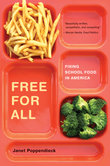
More recently, the argument for universal free school meals has been made by Janet Poppendieck in her book, Free for All: Fixing School Food in America. Published this year, Free for All is based on five years that Poppendieck spent researching, helping prepare and serve food in school cafeterias, and interviewing students, parents, teachers, pediatricians, school food service providers, superintendents, elected officials and advocates.
To read Poppendieck's meticulously recounted story, is to become acquainted with some almost unbelievable facts about what actually goes on in school cafeterias. One small example: The author visited a school system in Mississippi -- the state with, as she points out -- "the highest obesity rate and the second highest diabetes rate in the nation." While there she learned that reviewers from the state's Department of Education had found school meals lacking in sufficient calories. While the school food service director would have liked to offer additional fruit or vegetables to bring the meals up to the one-third of daily calories recommended for lunch, there was no money to buy produce and none available as a subsidized government surplus. Stuck for a solution, the Education Department officials advised the food service director to boost the calorie content of the school's meals by offering more desserts. "Specifically, they recommended a low-fat pudding that would add calories without adding fat. Caught between [prescribed] calorie minimums and fat ceilings, more sugar appeared to be the most affordable fix."
Some of the most telling comments in Free for All come from food service personnel, the people most directly responsible for serving up lunch in the roughly 94,000 schools nationwide that participate in the National School Lunch Program. Consider this. The bill Congress passed yesterday will provide 6 cents more per meal for school lunches nationwide. This is considered a victory by anti-hunger and child nutrition advocates, not least because it is the first non-inflation-adjustment increase provided for school meals in three decades. However, when Poppendieck asked food service providers whether, given a choice, they would prefer a 50 cent increase per meal to do their jobs or the ability to provide free meals to every child without any increase, they unanimously chose the latter.
"In part this is a matter of principle [for the service providers]," she writes, "but they also anticipated enormous savings from removing the burden of determining eligibility, certifying, verifying and counting and claiming."
Government studies have concluded that hundreds of millions of dollars would be saved by eliminating the administrative burden of keeping track of which children are eligible for free and reduced price meals. However, Poppendieck is careful to point out that these savings alone would not pay for the costs of providing free meals to all school children. She does, however, propose a menu of reasonable and pragmatic avenues to pay for such a program.
Some proposals, like a soft drink tax, are hot political issues right now because they dovetail with the gathering momentum in support of public policy to help reverse the nation's childhood obesity crisis. Others will appeal to different constituents, my personal favorite being reducing subsidies for the corn and soy that underpin so many of the cheap, unhealthy products found on supermarket shelves.
Poppendieck also points out that the price tag on the federal bank bailout, about which many more details surfaced just this week, would cover the cost of free universal school meals for more than half a century going forward, as well as the fact that the estimated $12 billion that would be needed each year is roughly the amount we spent each month of last year fighting in Iraq and Afghanistan. Her point, as she put it, is that, "there do seem to be ways of 'finding' money if we really want to." Indeed.
Then, of course, there are the astronomical savings, in both quality of life and billions of public health dollars stretching out to infinity that could be attained simply by serving billions of nutritious meals to the nation's children each year.
When I interviewed Poppendieck last spring, I wanted to learn more about the relationship between school food and U.S. farm subsidies. She graciously took the time to explain how the National School Lunch Program got its start.
Federal participation in school food has really been embroiled with disposal of surpluses. There were school food programs in the United States before the federal government got involved. They go back to the late 1890s and the first decade of the 1900s. They were often started by voluntary associations, particularly women's groups. Federal participation in school feeding started with the Great Depression, with farm surpluses and surplus donations. The whole origins of this idea that farming should be subsidized really goes back to fights of the 1920s.
Those fights originated in the enormous growth in food produced by American farmers during World War I, undertaken at the federal government's urging, and the resulting collapse in prices after the war, when the U.S. stopped subsidizing purchases of U.S. farm exports by the nation's allies. This was followed, during the Depression, by enormous political battles over what to do with surplus wheat and other commodities that the government agreed to purchase to support the prices paid to American farmers who, after the war, had increased production to levels that now outstripped demand, often going into debt to do so. Much of the debate about what to do with government-owned wheat surpluses revolved around whether Americans were actually hungry enough to justify giving them the wheat, which was rotting away in government storehouses, and which had, in fact, been paid for with taxpayer dollars.
"The grain became an issue because people were hungry and here was the federal government with these enormous stored surpluses," Poppendieck told me.
Historians have done a wonderful job of analyzing the enormous unemployment hearings that were taking place at that time, but they never looked at the agriculture hearings. But really, the first federal relief in the Great Depression was the release of the farm board wheat, its donation to the American Red Cross for distribution to feed the unemployed. This came up in the farm board wheat hearing. There were proposals all over the place in the papers for the farm board to release that wheat. Public sentiment was, "It already belongs to the people; it should be released for the relief of their suffering."
There was a big drought in Arkansas and people were really starving and there were proposals to release the farm board wheat to feed the animals because the animals were starving. Then someone proposed allowing some of it to be used for human relief. This engendered huge debate with all the ideologies about why government -- the dole -- would destroy the character of American people and the infrastructure of our communities.
Meanwhile people are starving, the government owns this wheat -- you can kind of picture it. So a lot of the arguments that subsequently took place in the Senate Committee on Labor and Unemployment were argued first in the Agriculture Committee. What all those arguments hinged on, as far as I can see, was the issue of "How hungry are people?" Are they hungry enough that they can consume this surplus without in fact reducing the paid market?
What we do know is that subsidizing corn and soy made them very cheap and when they became very cheap it was an incentive to the food manufacturer and food processing industry to develop products where those were the primary ingredients. So, as a result, there's been a whole flowering of an industry based on artificially cheap ingredients. And now it turns out that that industry tends to produce products that nutritionists would describe as energy dense and nutrient deficient. And you can fortify them and then they have more nutrients but they are still not wholesome foods.
In Free for All Poppendieck quotes Ann Cooper, director of food services for Colorado's Boulder Valley School District and a nationally recognized advocate for improving child nutrition on the relationship between agricultural subsidies and school lunch.
[Y]ou can't be promoting industrial agriculture and school lunch at the same time. Of course, it's a conflict of interest. Why do we have the lobbyists winning? . . . . We need the school lunch program to be a health program, not an agricultural commodity program. . . .
The flowering of this cheap food industry with its roots almost a century old, has led oh-so-logically to our current disconnect between what we know about healthy eating and what winds up on the school lunch tray -- and, of course, what winds up in many of our cupboards at home. In Free for All you will learn a great deal of what is wrong with the industrial food dependent school diet. More essential, however, is Poppendieck's cogent argument -- brilliantly at odds with much current thinking about school lunch reform -- for dismantling the decades old income based system that determines how school food is paid for and by whom. One can only hope that Free for All will be widely read and much discussed before the Child Nutrition reauthorization of 2015.