Community colleges are at the frontlines of education in America.
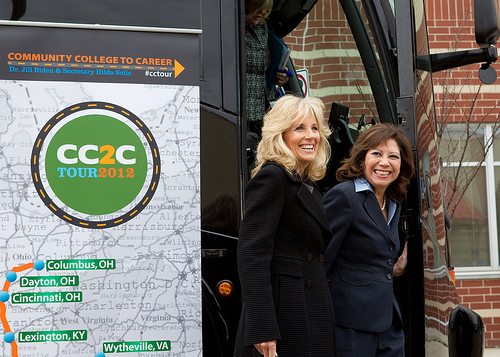
That's the message Dr. Jill Biden and I have been taking across the country this week on our "Community College to Careers" bus tour.
It's also a message that is especially important to the Latino community.
So many Latinos rely on community colleges to pursue their dreams. Roughly half of college-going Latinos are enrolled in community colleges. And most of our Hispanic-Serving Institutions are community colleges.
As Latinos are the fastest growing minority in the U.S., it's critical that we invest in the institutions that are building up this skilled workforce in America.
The first elected office I ever held was as a trustee on the Rio Hondo Community College Board in California. So I know well the value these colleges have for Latinos. In so many ways, they're a perfect fit.
Community colleges are local and flexible. They provide accelerated and translatable degree programs. And they provide training that sets people up for jobs in their community -- all at very low costs.
If we are serious about meeting the challenges of the 21st century global economy, and if the promise of fair access to higher education is to be realized, then it's going to happen at community colleges.
That's exactly what Dr. Biden and I have been hearing on this bus tour through Ohio, Kentucky, Tennessee and Virginia. Workers are telling us how important community colleges have been not only to them, but also to their communities.
Employers are telling us about this, too. In fact, a big reason for our bus tour is to see how businesses are partnering with community colleges to create innovative job training programs.
The idea is simple: community colleges will partner with businesses to develop training programs that match the needs of local job-creators.
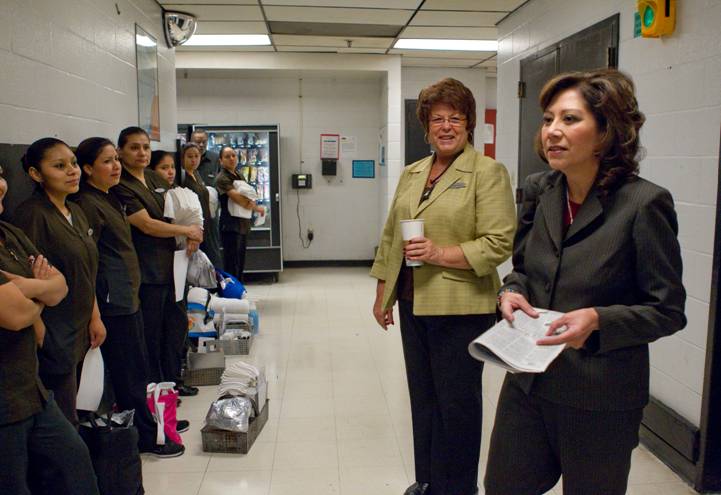
We know that these partnerships are critical to ensuring American workers, and businesses, succeed in the future. That's why President Obama has made them an important centerpiece of his newest initiative to invest in American workers.
It's called the Community College to Career Fund. This $8 billion fund is designed to help workers obtain the skills they need to get job offers in industries that are hiring right now.
The President's plan helps Latinos by:
This last point is particularly important for Latinos. As a community, we are sorely underrepresented in science, technology, engineering and math (STEM).
Take engineering for example. Less than 7 percent of American engineers are Latino.
But over the next decade, there will be 1 million new U.S. job openings in STEM. And college students who study these fields will make a half-million dollars more over their lifetimes than other students.
As a community, it's imperative that we encourage our young Latinos to consider careers in STEM.
That's why President Obama wants to invest $100 million to improve college education in these fields -- with a special focus on community colleges and minority-serving institutions that train many Latinos. And it's why the president is pushing for the creation of more clean energy jobs -- and for the skills training to match them.
America's future will only be as strong as the industries we create and grow, and that means we must support our entrepreneurs, our workers and the institutions that train them.
By making this commitment to education and meaningful skills training for Latinos, we can educate our community, open new career pathways, restore our prosperity and create an America that's truly built to last.
Follow Sec. Hilda Solis on Twitter: www.twitter.com/HildaSolisDOL
The other son chose community college for football reasons, as he didn't want to leave the state to play. Last season he was badly injured...ACL
tear...and the college assumed no liability. Our insurance apparently doesn't believe in physically therapy. Thus, something must be done to mandate community college sports programs to assume liability when asking youngsters to don that school's uniform and risk life and limb...
Community Colleges do not only help Latinos, though the effects are magnanimous for that community. They helped me. I spent my first year of college at Howard Community College in Columbia, MD. I came out of high school without the confidence to take on a four-year institution. Community College helped me build the skills and work ethic necessary for me to move onto the place where I obtained my Bachelors degree. Couldn't have done it without Community College.
The financial effects were excellent as well. Saved me a ton!
I got my 2 year degree at a community college, and I got a pretty good education at an accredited institution, for a fraction of the price it would of cost at the accredited private university.
Yesterday the immigrants came here and assimilated themselves by learning the language and folkways of the USA
Today they expect us to learn their language and folkways -- drain our entitlement programs -- and lobby to legalize illegal acts
Putting more money into poorly run institutions is hardly a solution to the much needed job skills problem
Comparing a CC grad rate to a high school or 4-year college grad rate is comparing apples to oranges.
Hell, I "never graduated" from the CC I attended, and I have a Masters degree.
I think these statistics vary widely with different community colleges.
Also do you count transfer to a 4 year college as a graduation? A lot of these transfer don't get an AA degree, but instead transfer to a four year institution and get a bachelors.
Also plenty of people take classes on and off. I've know some people who got their AA degree in 5 years, because they were working and had to have a light class load. I wonder if people like that are counted against graduation rate.
I would love to see community health and wellness centers built adjacent to CC.
http://www.communitycollegereview.com/articles/291
How many years does it take to teach RED turns the machine on -- GREEN turns it off --
Like it or not the MAJORITY -- THE VAST MAJORITY -- of people are not going to be engineers - lawyers - politicians - doctors etc
Nor are they going to get much practical use out of sociology courses past 101
Better to put the money into schooling that teaches Industrial Arts and the mechanics of that run the word.
Good thing huh? NO! Two separate studies (PPIC and CSUN) have shown that if you look at what happens to Community College students who enroll planning to take a two year degree or transfer to a four year college, only 25% accomplish either goal in SIX years. Why? Because they drop out. Why? Because they are terribly prepared in K-12 to do college level work.
We should not keep blindly pushing Community College. We should, instead, cut back on this system and put the savings back into K-12. There is no way to remediate a poor K-12 education in Community College and it's incredibly expensive to pretend that you can. Just ask Community College professors and gauge how pleased they are with the incompetents they are getting for students!
As a nation, we would be much better off with kids graduating with a good high school education and NO college than what we have now, entire generations with a lousy K-12 education followed by a semester or two of make believe Community College effort at which we have thrown grant and student loan money.,
We need to reboot this whole mess. Solis and Biden need to do some homework.
Community colleges have what is called a "Compass" test which guages your skills in reading, writing, mathematics and so on. Once this assesment is done they add the necessary remedial classes to your desired degree program and those courses must be completed as pre-requisites to the advanced classes needed for graduation. So most students can be brought up to speed by the college itself. In addition, community colleges, unlike universities; have a large portion of part time students who work full time jobs to support themselves and in many cases have children as well. This means that many students are challenged to complete two classes a semester. The combination of remedial catch-up classes, and responsibilities is going to directly affect graduation times for community college.
On a final note, a high school diploma does not have the strength it once had. Almost gone are the days when armed with only a high school diploma a person could secure meaningful employment, raise a family, purchase a home and pursue the American dream. Community colleges are the way in which the poor but determined can secure the skills and trades necessary to lift themselves out of poverty.
Related to your third point, it should be noted that where you've seen areas of growth in the country, it is often underpinned by a good community college system. Whenever North or South Carolina try to attract a major manufacturer to their states, the promise of well trained employees from their community colleges is always a selling point. In fact in North Carolina I believe that's where a lot of their tobacco settlement money went.
K-12 schools are run by individual states. Contrary to popular belief, your state sets curriculum and graduation standards. Ms. Solis has as much control over California's K-12 as she does over Canada's K-12 system.
I'm not sure but I may be in agreement with Kurfco when I say that this doesn't make sense in the 21st Century. I think there should be a, national, core set of knowledge taught in every school, particularly in the STEM areas. This core could be augmented be each state or school board as appropriate. Oh...I know...I can almost hear the screaming about Darwin...
NCLB gave us uniform testing without uniform knowledge.