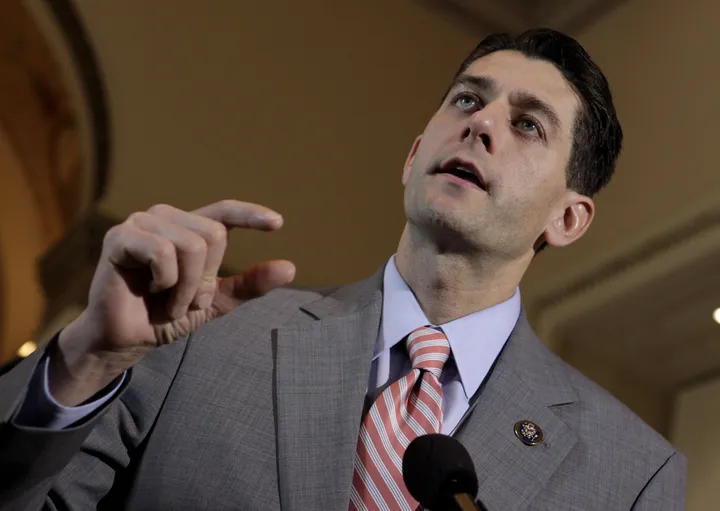
If part of you clings to that vision of an America where opportunity for all is possible or if you believe that it's time to take the somewhat tarnished American Dream out of cold storage, then be prepared to be deeply disappointed -- frightened even -- by Republican Representative Paul Ryan's response to President Obama's State of the Union Address. Ryan is the newly crowned Chairman of the House Budget Committee who was given control over how the House of Representatives allocates funding. His Republican colleagues voted in January to give him unilateral, unprecedented authority to set spending limits for everything from defense to education.
I served with Rep. Ryan on the 18 member Commission on Fiscal Responsibility and Reform, and learned firsthand from the personally congenial Ryan just how dark his vision of America's future is for all but the super-rich.
There is no disagreement over the fact that our economy is still a mess, and though the signs of recovery are hopeful, too many friends and family members are out of work, losing their homes to foreclosure, and feeling insecure about the future.
Many people are mad about finding themselves in such uncomfortable circumstances, and who can blame them? They didn't make the mess, after all. They didn't spend our country into record deficits. They didn't start two wars on borrowed money, and they didn't decide to give huge tax cuts to the already hugely rich. They aren't Wall Street tycoons who gambled billions of dollars on bets that caused the near collapse of our economy. And they aren't Wall Street tycoons who are still raking in the unimaginably massive paychecks and bonuses, after being bailed out by the taxpayers.
We don't know exactly what Ryan will say in his response to the president. But we do know plenty about what this self-proclaimed budget hawk has already said. He laid it all out in a document he calls "A Roadmap for America's Future." In it was his simple plan for health care reform: destroy Medicare as we know it by giving seniors a fixed dollar voucher and sending them off to find an insurance company that will cover them. That's after raising the age of Medicare eligibility. He also revives the discredited idea of privatizing Social Security and raising the retirement age. Good luck, Grandma!
He enthusiastically joined every Republican to vote to repeal the health care bill, despite the independent, non-partisan Congressional Budget Office declaring that repeal adds $230 Billion more to the deficit. "The CBO is entitled to its opinion," declared Speaker John Boehner. Dismissing the CBO is equivalent to throwing the umpire out of the baseball game and replacing him with your team's coach. But that's just exactly what the new Republican rules allow -- if they disagree with the CBO, they simply throw out the call.
Ryan and the Republicans have announced their plans to slash the budget by reducing all non-defense discretionary spending back to 2008 levels -- at best. At worst, many Republicans want to go back to 2006 levels - Bush's last budget. The Washington Post calculated that 2008 spending levels mean a 16% cut for the FBI, 13% for national parks, and more than a $1,000 cut in college Pell Grants from the current $5,500 maximum grants. My state of Illinois, according to the Center for Budget and Policy Priorities, could see a $1.3 billion cut in federal support, forcing state and local government to lay off teachers and police and firefighters.
There are big winners in Paul Ryan's "Roadmap" and you can guess who they are. He would cut taxes for the wealthy, completely eliminate the corporate income tax, and create a value added tax. According to the Tax Policy Center, his plan would raise taxes for the bottom 95 percent of American wage earners and cut taxes for the top five percent. The top 0.1 percent would see an average tax cut of $1.7 million -- every year!
In case you haven't noticed, the same big winners have been stuffing themselves with cash for the last two decades while the rest of America has been barely holding its own. The top 1 percent of Americans control 34 percent of the wealth while the bottom 90 percent (almost everyone -- get it?) control 29 percent. There is greater income inequality in the United States than in any other industrialized country. Yes, the debt is a problem that must be dealt with. To me, however, the disappearing middle class is even worse -- bad for our economy and really bad for our democracy.
Considering his zeal for propping up the super rich, I wasn't surprised when the Washington Post revealed that Budget Chairman Paul Ryan "has taken $1.4 million from banks, hedge funds, investment houses and other financial services companies." It's a two-way street between Ryan and his Wall Street pals -- but the shrinking middle class, the poor, and others who benefit from bedrock American support programs including seniors and those with disabilities just keep hitting road blocks.
The Republicans led by Ryan are determined to keep serving only their wealthy constituency and push the rest of America down a dangerous road that threatens what has long been a consensus vision of our country as the land of opportunity for all.
Follow Rep. Jan Schakowsky on Twitter: www.twitter.com/janschakowsky
(Cause they know the gig's up, and the people know who openly lied to them and stole from them.)
(second more civil try)
Thank you for your very interesting article.
Considering that you hail from Illinois, which has a poor record of fiscal responsibility, I am surprised at your strong opinions regarding fiscal probity with respect to the Commission on Fiscal Responsibility and Reform. Illinois is, afterall, the exemplar of fiscal imprudence that has resulted in a sclerotic business environment that has left it in a parlous economic state. This despite all the federal favoritism that it has received over the last few years, at the taxpayer’s expense.
I know that you do not like budget plan that Congressman Ryan has put forward. But these are awful times and it takes a grown up to admit that we have a spending problem, not a taxation/revenue problem, that need needs to be addressed. Blaming the fiscal problems we have now on the rich does not address the real problem, which is our addiction to borrowing and spending. Until we address the spending side of the equation we will never get out of this mess, even if that means that Illinois can no longer gorge itself on $1.3Bn at the federal trough.
Perhaps Illinois might try something that has proven to work in creating jobs and economic activity: reducing the footprint of government, lowering taxes, and creating regulations that promote open markets and business growth. Perhaps then advocates of more spending would not need to take money out of other people’s (taxpayers) wallets, leaving them poor.
Kai
Thank you for your response.
1) Though I disagree with you on the cause of the financial mess, I will not address that here since this is a post on Budgets, specifically deficits. Other than to state that, we had big budget deficits and bloated run away programs, many of them unfunded to an amount of over $100Tn, before the crisis occurred gives some credence that the crash on wall street did not cause our bloated budgets, though they certainly added to them.
2) Glass-Steagall (you may want to spell it correctly since you claim to be a ‘student of history’) did not cause this. Loose monetary policy and perverse housing and finance regulation did. The fact that many commercial banks, those without an investment banking division went under in droves, shows that even with glass-steagall in place, this would have happened, again for the reasons I posit above.
3) Phil Grahm? Elaborate please.
(cont..)
5) Open markets have not caused jobs to ship overseas. Tariffs on many products that manufacturers use, steel, magnesium, etc, high labor costs, punitive taxation, obstructive legislation, and aggressive EPA legislation moved jobs overseas. All those are fixable. Anyway, technology is the reason for much of the job loss. Become a luddite if you have a problem with that.
6) Who is repeating talking points? You seem to list them all without any supporting documentation.
Kai
On Jan 21, three Republican members of the Colorado Joint Budget Committee, voted unanimously to cease funding for a program that provided breakfasts to kids that come to school hungry. It costs 30 CENTS per child per day. $125,000 was needed for it's continuance to the end of the school year. One Representative explained to the press that it was a hard decision to de-fund it, but the state is in a financial bind, and we simply can't afford it.
In the same room, on the same day, these same three legislators voted unanimously to extend tax breaks to the largest workers comp. insurance company in the state. Tax breaks amounting to over 3 million dollars a year. The management of that insurance company was recently featured in the local news for having spent $318,000 to send top management members and select members of the board on a 5 day golf junket to California.
Where is the logic in that decision?
Is this the new fiscal conservatism?
Is this the Republican vision for America's future?
Is this what Americans want?
- Martin Luther King Jr.
Wow, its somewhat startling to find a congressional representative who sounds something like ME instead of like a K Street lobbyist. Ms. Schakowsky may be only one of 441 but its enough to give me hope.
In fact, a sane prosperous future can only be achieved by international and internal co-operation. "Win the Future" at worst is a cynical xenophobic ploy. And our kids are supposed to do what? Sleep on boards and study calculus 15 hours a day? Is that their new world? I'm not interested in slight divergences about the best way to make Chinese-type proletarians out of free Americans for the further benefit of Goldman-Sachs.
he has already got 1.4 million.
he acts like a prostitute. selling his pen /law/bill for money.
ahe sevices the rich.
Here's the truth and some comment on the likely consequences: The U.S. economy continues to grow and hiring is likely to accelerate in the months and quarters ahead. The uncomfortable truth for both the left and right is that in two years, it is quite possible that America will be in a much better economic place.
The numbers are out there, if you are willing to suspend partisan concerns and simply look at the business cycle for what it is - a human condition that can be influenced by fiscal and monetary policy, but not controlled by it despite what the politicians and media commentators might tell you otherwise.
Do you want the data? Here it is: http://jviser.blogspot.com/2011/01/republican-candidate-for-president-is.html.
At this time, I am not sure what the policy prescription is. Maybe it is to do nothing and let the so-called QE2 monetary stimulus work its way through the economy and allow the Tea Party candidates to restrain some measure of federal spending. In my view, the most constructive role of government would be to employ policies that encourage and facilitate workers moving from lagging economic sectors into those that are growing and need workers.
Perhaps the real issue isn't whether the rich get richer, maybe it is how can we close the gap between rich and poor without using the tax code as a means to redistribute income?
At what wage?
People will apply for jobs, and be offered jobs at a fraction of what they should be making for the work they are doing and considerinÂg the profits the company will be making off the product.
The mentality will be this: 'Half a loaf is better than none - If you don't take what is offered, somebody else will'.
Economic indicators will scream America's prosperityÂ, whilst the working people crowd into old McMansionsÂ, one family to a bedroom.
If you want a dose of reality, get some copies of the old TV series The Wonder Years, and watch it. Forget the story line. Note the houses, and how the families lived. Note what they had, the vacations they took. Pay attention to what they worried about. Kevin's father was lower management in a furniture factory (if I recall correctly)Â. Kevin's mother didn't work. She didn't have to.
I'm Kevin's age. I remember that long-gone America. Do you?
That is an entirely different subject and posting. The benefits of globalization have accrued primarily to stockholders and executives. That doesn't mean globalization is all bad, however, because it does lead to a raising of living standards in other parts of the world.
In the industries that are growing, I am hearing anecdotal evidence of the best employees receiving raises and better job offers from competing firms. Granted, that's not everyone, but the cycle is turning and that is good for both employers seeing sales increase and for workers who have more opportunities and are pushing back on forced overtime.
That said, we also know that one of the reasons the post-WWII economy in the U.S. supported higher wages was because America didn't have much competition. Most of the industrial capacity outside the U.S. was destroyed during the war, leaving America just about the only game in town for manufacturing. Now, we have many competitors all vying for the same corporate investment dollars and resulting jobs.
At this time, most Americans believe greater balance is needed in terms of the benefits of globalization, although we differ in what that means as a policy matter. I am sensitive to your point and it deserves a more comprehensive post in the future.
Thanks for your comments, you gave me a new idea.