The midterm elections in the United States and our roles as citizens got me thinking about Ronald A. Heifetz's (co-director, the Center for Public Leadership at the Harvard's Kennedy School of Government), Leadership Without Easy Answers (Belknap Press, 1994).
I know that "followers" often expect solutions from their leaders. People want comfort and stability -- even when they vote for change. With clear goals for a next chapter and new leadership with marching orders for change, people still resist change.
Heifetz taught me that a true leader sees the responsibility of leadership as asking hard questions and forcing people out of their comfort zone. Change rarely comes easily or willingly to individuals or organizations, corporations or not-for-profits, governments or families.
To effect adaptive change, as Heifetz calls it, leaders must invite people into new ways of being -- the opposite of business as usual -- and then facilitate the management of the distress that is inevitable in such radically altered environments. Make no mistake about it: creating such environments is not easy. Managing through the resultant distress is disorienting for all, often including the leader.
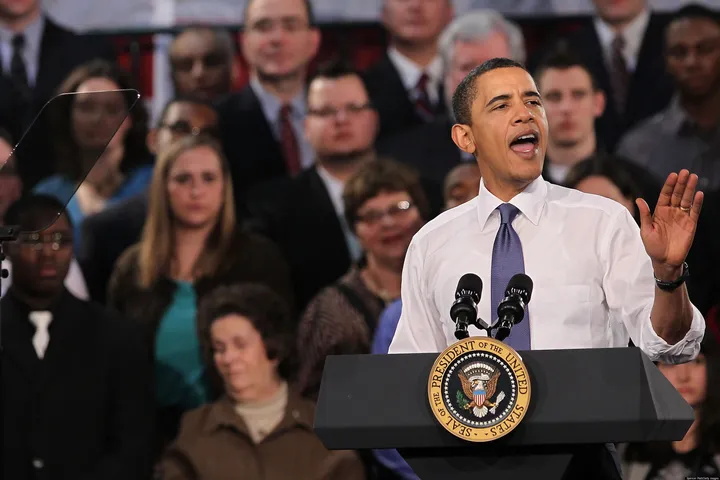
President Obama spoke candidly about our impatience about the economy getting better despite our knowing how bad things were and how much worse they could have been. As a leader, he told the truth, exposing painful realities and setting out realistic and sustainable goals. Complex problems require much more than simplicity and unbridled optimism or false assurance.
Will such a challenge that insists that we can and will do better draw the best out of us as citizens? Or will we revert to the myth that the leader has or should have the answers?
Here's where Heifetz was most helpful to me as a leader: Because adaptive problems are often systemic problems with no ready answers, Heifetz teaches that leaders have to break with their own pattern of acting as if they can provide solutions and that they must refocus responsibility for problem solving on the people.
That kind of group-centered leadership creates a different type of buy-in, when, as adaptive change becomes distressing for the people going through it, people develop the capacity to take on new roles, new relationships, new values, new behaviors and new sustainable approaches to solving root problems.
The leader's tough questions motivate people to address the real causes of a complex problem (like how to "fix healthcare"), which we know is the only way really to avoid failure or defeat. Heifetz reminded me that it is the pinch of reality that stimulates the necessary adaptations and real change, for individuals and systems. That's why he says that only when the leader is willing to disorient the followers can such new relationships and capacities develop.
Rolling Stone's Jann S. Wenner wrote in "Obama in Command" (9/28/10) that the President said before the election, "We have to get folks off the sidelines. People need to shake off this lethargy, people need to buck up. Bringing about change is hard -- that's what I said during the campaign. It has been hard, and we've got some lumps to show for it. But if people now want to take their ball and go home, that tells me folks weren't serious in the first place." The day after the election, President Obama said, "It was a tough night ... I don't think we should sugarcoat it." The President asserted that the electorate was frustrated and that the election results did not mean that people do not want change: "We just gotta work harder to deliver the change the American people want."
Heifetz says that leaders must step back and get a new perspective on an adaptive challenge, what he calls stepping onto the balcony. The President will need to modify his responses to the emerging political landscape in Congress and with the general electorate. More treacherous for managing change is the data that independent voters have shifted their positions for the third consecutive election cycle.
But is the most important question, "Does the President get it?" I suspect the biggest danger will be if we keep the focus on our leaders and forget that the problems we face are complex and that the answers are not easy. We also need to get on the balcony to see clearly as citizens that going through significant discomfort will be the only path to the change we deserve and need as a country.