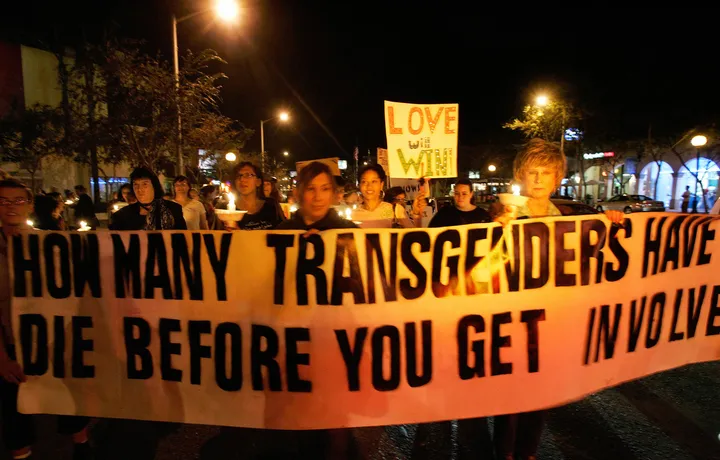
It's heartbreaking to read the many reports of teens and young adults considering or committing suicide, or our young people bullied and victimized for being different. Many of these teens are struggling with sexuality and gender identity in a society that's not always accepting. With Transgender Day of Remembrance on November 20th, we remember all those lives who were brutalized or murdered for their difference. Since this is literally a life and death matter, as a religious people we ought to feel compelled to deepen our understanding of the causes of such pain.
Transgender and Gender Queer youth and young adults -- whether gay, lesbian or heterosexual -- are sometimes gripped in a vice that pressures them to conform to both sexuality standards as well as gender norms. This results in far higher than average rates of homelessness and suicide in our young people who identify as Transgender.
Transgender identities often elicit reactions of confusion, judgment and dismissal, even from progressive liberals. We sometimes hear people say that individuals undergoing these sorts of physical changes are dealing more with psychological problems than hormonal. That most of us have clear sexes, so we can have clear genders. That pushing the stereotypes around clothing, work and relationships are one thing, but pushing the boundaries around bodies are another. I will say to this that I have heard all of it before referring to gay and lesbian men and women. I have been told that my love for another man is a psychological problem -- that my hormones are not the real issue.
I imagine that most women may have heard the same sorts of things regarding their lives, their careers, their families. They are willful for seeking that job, or that position, or that relationship. They are disrespecting their family or their culture when they delay marriage, or move in with a lover before marriage, or postpone having children in favor of their career. Although some men certainly do hear the same sorts of critiques, I find that most males have another set of guidelines to live up to. Simply put, the rules are different for different genders. And while the situation is all the more confusing when gender isn't clear, we can choose to go a little deeper and find the commonalities to which each of us can relate.
Every generation has seen the gender line blur and break a little more. It is my hope and prayer that we've pushed against it hard enough that not only have glass ceilings started to crack, but also that our children are starting to grow up knowing that their gender or sex need not determine the scope of their dreams or the breadth of their lives, loves and hopes. Maybe we've finally reached a point where our own actions, responses and inclinations have ceased to place limits on one another.
But that's simply not true. Not yet. I'm not going to appear before my congregation in a skirt and blouse. Not only because it's not my style, but also because it would signal that somehow I'm less, or a freak, or that I've lost power. My ego couldn't handle it. Our identity as a religious community would feel shaken, and most of us still believe women's clothing diminishes men in a way that men's clothing doesn't lessen women but lifts them up. It's a shallow marker but a clear one for the malady that continues to plague us. It's a starting point for understanding why violence against Transgender communities continues.
I believe that American culture has been trumping our religious values of compassion and love. Transgender identity scares us because it suggests that maybe we've got it all wrong. Maybe women are just as good as men. Maybe relationships are defined by the horizon of our love. Maybe people ought to have agency over their own bodies. Maybe the world isn't all that clear right from birth. Maybe the phrase "men and women" is still leaving someone out.
Not fully understanding someone who is different from us isn't an excuse for denigration. My Unitarian Universalist faith tradition values personal human experience and reminds us that every soul has inherent worth and dignity. When we lack an understanding of another, it is a religious practice to seek to deepen our ties. It is a call to stretch our experience, widen our vision, and embrace our whole human family. In so doing, we reflect our own dignity and worth. This discipline speaks directly to the message of all religious scriptures - love is at the core of faith. When we know that cultural practices of dismissal foster environments where our young people feel unsafe and unloved, and we know that many of our youth are dying because of this, we are morally obligated to directly challenge attitudes, words, and actions that denigrate. Faith requires us to prioritize the safety of our young people over our opinions.
Follow Rev. G. Jude Geiger on Twitter: www.twitter.com/revjudegeiger
Idit Klein: Transgender Jews: Breaking Down One Wall, Praying At Another
No. It's not. Tribalism, willful ignorance, and fear are at the core of faith.
Try reality, it better fits your world view than this disease called faith that you are manipulating in unseemly ways to fit your liberal sensibility.
Precisely. And that has indeed been the 'excuse' for so many small-minded people for millenia for all varieties of big.otry - homophobia, misogyny, xenophobia, rac.ism, along with good old fashioned religious hat.red.
Thanks Rev. for an excellent, thought-provoking piece.
The fact that it needs to be discussed at all is the issue. Religion is a crutch for many who depend on it to make sense of the world and how to move through it. As the world changes and our knowlege expands, the world will have less and less use for the restrictive religions, and gain an affinity for the churches who embrace those changes.
You seem offended by the transgender person who feels they're in the wrong body, as if god made a mistake. Is a tumor a mistake? Do we leave it there because god doesn't make mistakes? Do we leave crooked teeth or ignore diabetes? What are their purpose?
More acceptence of people who struggle with these issues is needed.
Trans people have long been honored and considered sacred and talented by religions and cultures that *don't* limit "God" so by their own dogmas.
In fact, they're well-known to be talented shamanically and as spiritual helpers and functionaries probably precisely *because* they're less 'conformed to the mundane world,' ...Especially one so narrowly-defined by trying to make everyone the *same* that you're actually *threatened* by the mere *existence* of anyone not obeying your little monolithic model of humanity there.
*You're* the one insisting *your* God's 'design' is that trans people don't exist and should be scorned and made to suffer. There's sure a 'mistake' in that scheme somewhere: but maybe it's *your* definitions.
Blaming trans people for living doesn't resolve your 'mistake.' If you think binary sex and sexuality are so sacred, maybe you should look at what *humans* do to the very systems that usually-but-not-always *make* fairly-binary sexes: The same people who push homophobia and transphobia keep wanting to fill our lives with EDCs like bisphenols and hormones and such that we *know darn well* trigger more of the same things in animals as trans people relate. Their brains are actually *different.* It's been observed.
Maybe God/dess just births a lot of kinds of people. And cause and effect exists. You're the one with issues about 'design' and 'mistakes.
Yep, now that gay folks are actually becoming popular and finally getting a few of their rights codified, trans folks (and atheists) are the only ones left that it seems okay to hate. And many of the religious and political beliefs in this country seem hell-bent on continuing the hate. We need to demand equal human rights for everybody. Anything less is, well, un-American.
His message comes across as a call for internal reflection by people, rather than condemnation or rejection when deeply seated personal beliefs as "gender" is challenged.
I think the trans-community needs studied outsiders, especially in positions of influence, that help bridge the gaps in understanding and responses by members of society. And since many people go to church to have their preceptions to life events and confusions explored to gain some clariety and direction in life....a pastor may make for a powerful ally to the cause.
Note that a number of denominations have "reconciling" programs that attempt to welcome gay and trans persons into the church community. If you're a believer who feels ostracized then reaching back into welcoming churches is a good way to help such lessons "take" in a church body. And if not so much...then you still might find the kind of personal support that will increase your faith and help you through tough times.
On the other hand, make sure their GLB or T program is not just a cover for a politicial group, especially when they use the conglomerated GLBT label.
So either an open trans-person becomes a gay-follower and supporter or they are often cut out from recieving prayer and support from the church body, especially when the GLBT group is actually a Gay-Straight Alliance in disguise (usually so the church doesn't get heat from being in a direct alliance with gays) especially when the official church denomination stance is anti-gay. Politics on top of politics.
The best suggestion I believe for trans-persons joining a church, without wanting to play political games or be a slave to the gay agenda, is to be stealth. Second best is to find in-church and between church trans-religious groups, and avoid any GLBT labeled groups.
But all too often gays talk trash about trans-persons and out them when it suites their goals.. Seen this happen all too often. Then trans-members leave the church is disgust.
To me, GLBT mixed groups doesn't belong in churches.
I consider it a given that all individuals, regardless of sex, sexuality, ethnicity, religion or lack thereof etc. possess the same rights to life, liberty and the pursuit of happiness. The problem, however, does not lie in something so varied as American culture. Rather, it is the religious ideologies of those who uncritically take their instructions for life from ancient religious texts. There lies the basis of the dislike of even hatred many Americans harbor towards those who do not conform to their narrow definition of what a human being should be.
Reason, not religious values of compassion and love, is the tool that has the potential to bring about positive change. In a secular society based on individual rights, no religious argument should be allowed to stand in a political context. Those who believe those passages of their religious texts that condemn anyone but our most typical citizens need to be reminded that their religious beliefs have no bearing on the rights of others in a secular society.
Understanding and compassion are also desirable but they are no substitute for the recognition that all citizens, regardless, possess equal rights. Those who still refuse to recognize these rights must be compelled to do so.
I hope that, over time, we see a pattern where both transgendered persons and non-transgendered persons speak up about accepting people regardless of their gender identity/expression. In the meantime, I'll support the idea of tollerance, regardless of who the speaker is.
I doubt that the Religion section would only have an article written by White Allies on Martin Luther King Day.
Speaking out for toleration can become paternalistic and marginalizing when those of us in the actual community are not allowed to speak for ourselves.
All too true. I work in the field of civil rights and anti-discrimination, and a few years ago I made the comment that while I am 100% supportive of civil rights protections on the basis of gender identity, it is the one facet of diversity where I would have a hard time dealing with it if it was my own child.
Meaning that if my child wanted to engage in a cross-race or cross-religion marriage, absolutely no problem. If my child came out as homosexual, in my heart there would be no problem. But if my child expressed questions of gender identity, I'd need a time out to review how I want to proceed in good conscience.
My mental barrier lies in the element of body alteration. I feel that there are risks involved, and a degree of permancy that goes beyond anything I've ever personally identified with.
Recognizing my own difficulty with this topic makes me even more interested in seeing people protected from discrimination on this basis. I don't want to change people's hearts or make them artificially understand what they're not yet prepared for. But I don't want the mental blocks of me or anyone else to ever cause hurt to someone who hasn't done anything to hurt someone else.
As things stand commonly, a lot of transwomen have to take a lot of damage and then try and readjust later in life. Passing years are pretty permanent, too, and all. People's peers don't get any more flexible as they age, either. Kids, for the most part, are much more able to 'cope' with it. It's the adults that have the problems.