
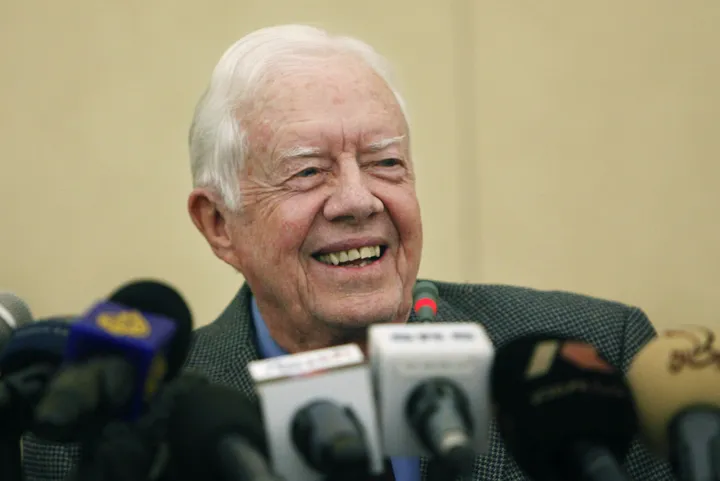
As host of the weekly, nationally syndicated radio program "Day 1," I work with a diverse array of church leaders from the mainline denominations. Most are pastors or seminary professors, but occasionally we have a layperson as our featured speaker. Recently I was privileged to record one rather well known layperson: former President Jimmy Carter.
Early on a recent Friday morning, our crew set up video and audio equipment in a meeting room at The Carter Center in Atlanta. We had been allocated a very brief window in the former president's jam-packed schedule, between a major policy meeting and a magazine photo shoot. Former President Carter couldn't have been more cordial and professional as he presented his address, and while answering my interview questions about how faith has influenced his life as a politician and as a humanitarian.
In his message, which will be broadcast Sept. 12 over our 200-station network, President Carter had this to say:
All people of faith who take the Bible seriously -- both the New Testament and the Hebrew text--very much agree that God's heart is with the poor and the vulnerable. Jesus proclaimed at the beginning of his early ministry that he had come to "bring good news to the poor." The Bible includes several thousand verses on the poor and on God's response to injustice.
This eminent Sunday school teacher (he still teaches two or three Sundays a month at Maranatha Baptist Church in Plains, Ga.) is the special capstone speaker for our "Day 1" series on "Faith & Global Hunger." The first four episodes in the series aired on consecutive Sundays from June 13-July 4 (for transcripts, audio, and video of the series, visit http://hunger.day1.org).
This series features notable church leaders discussing the issue of global poverty and how the United Nations' Millennium Development Goals (MGD) can address that issue:
- Dr. Hodding Carter, Assistant Secretary of State for Public Affairs and State Department spokesman under President Carter, journalist, author, and professor of Leadership and Public Policy at the University of North Carolina at Chapel Hill, spoke on the scope of the problem of world hunger today. In his message, "Who Is My Neighbor?" Hodding Carter said:
Ours is a world of extraordinary abundance conjoined with abject poverty. It is an abundance of such magnitude that it could easily feed all those who share earth's air and water and land. On this there is no real argument. The responsibility for making good on these [Millennium Development] Goals, for ending hunger and poverty, rests with governments, legally speaking. The real responsibility is ours, arising from the answer to all the familiar questions: Who is my neighbor? Am I my neighbor's keeper?
- The Rev. Dr. Barbara K. Lundblad, the Joe R. Engle Professor of Preaching at Union Theological Seminary in New York, focused on the biblical foundation for serving the poor. In her sermon "Closing the Great Chasm," based on the parable of the rich man and Lazarus (Luke 16:19-31), Lundblad said:
Jesus didn't tell this parable to scare the hell out of us. Jesus told this parable to change the way we are living this side of heaven. We're feasting sumptuously and Lazarus is still hungry. Of course, there isn't only one man named Lazarus; there are millions of men, women, and children who long for even a crumb from our tables. Many of them are far beyond our gates or our front doors--we will never even know their names.... There is a great chasm between us and the millions of people who are starving.
- The Rev. Dr. David Beckmann, President of Bread for the World since 1991, former World Bank economist, and winner of the 2010 World Food Prize, addressed specific ways of addressing the problem of poverty and hunger through the Millennium Development Goals.
All the nations of the world have agreed on what are called the Millennium Development Goals -- specific targets to reduce hunger, poverty, and disease. And we've made some headway; it is quite possible that the world will cut poverty in half between 1990 and 2015. I have come to see this as a great exodus in our time: hundreds of millions of people escaping from hunger, poverty, and disease. It's like the biblical exodus, but on a much larger scale. This is God moving in our time.
- The Right Rev. Michael Curry, Bishop of the Episcopal Diocese of North Carolina, issued a passionate call to serve the poor individually and corporately in his sermon "Can I Get a Witness?" .
Participation by people of faith in the work to abolish poverty and hunger through the accomplishment of the Millennium Development Goals is...a witness to the gospel. This is not a utopian fantasy or a vain hope. For if the nations of the world, religious communities and peoples of the earth of goodwill would truly commit to using 0.7% of our financial resources to support international development, the numbers of people suffering...could be drastically reduced to the point that poverty itself would be on the endangered species list. Poverty, as U2's Bono often says, could become history.
The idea for the "Faith & Global Hunger" series came from a regular listener in Chapel Hill, N.C. Charles Browning heard Dr. Lundblad say in a "Day 1" sermon in 2009 that "Jesus knew long ago what economists and hunger activists tell us now: we have everything we need to end world hunger."
Browning, a retired farmer, and his wife, Margaret Knoerr, a librarian, were inspired to do something in response. He contacted us to suggest the idea of the series to raise awareness and encourage listener response to the problem -- particularly through the MDG effort. Charlie, Margaret, and project coordinator Dr. Joseph Mosnier, have been working closely with us to bring this project to fruition.
In 2000, 189 world leaders met at the United Nations Millennium Summit and issued the Millennium Declaration, in which rich and poor countries recognized a mutual responsibility to end poverty and its root causes, and resolved as the world community to achieve significant improvements in the lives of the world's poorest people by 2015 through the Millennium Development Goals. The eight MDGs target global hunger, universal education, gender equity, child health, maternal health, combating HIV/AIDS and other disease, environmental sustainability, and comprehensive development planning.
Today, ten years after the Millennium Declaration, substantial progress has been made toward the realization of these goals. The UN member states will assess progress and accelerate achievement at the High-Level MDG Review Summit, scheduled for Sept. 20-23 at the United Nations as part of the 65th UN General Assembly.
All people of faith are encouraged to participate in this process, specifically through the "Stand Up and Take Action" initiative of the United Nations Millennium Campaign during the weekend of Sept. 17-19. This interfaith effort is designed to bring attention to the need to renew the world's resolve to achieve these goals. For specific ways you and your congregation can participate, visit the EndPoverty2015.org website.
Now is the time for all people of faith to insist that their elected representatives take concrete action to support and fund the MDG effort. As President Carter says in his "Day 1" message,
When we confront the scale of human need and know that we have the tools to make a difference, our obligation to do justice is all the more clear. We should feel a joyful resolve to press ahead. I have never been more optimistic about our ability to lift up our brothers and sisters and to change the world at long last.
Amen.