More

Featuring fresh takes and real-time analysis from HuffPost's signature lineup of contributors
Rhiana Maidenberg

GET UPDATES FROM Rhiana Maidenberg
 

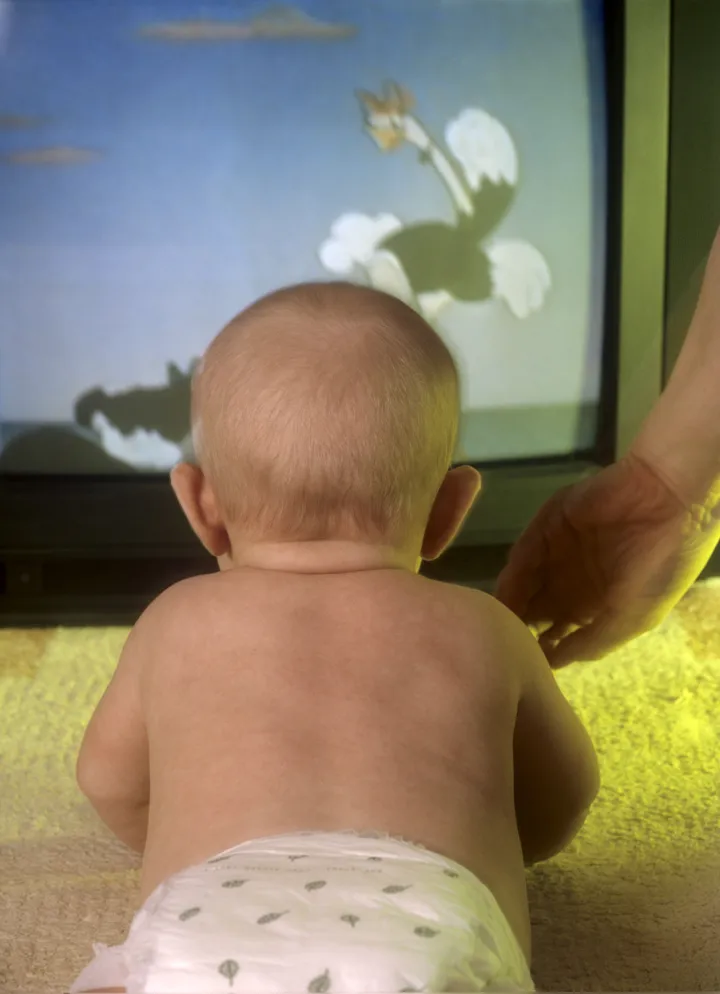
Why It's Really Not So Terrible To Let Your Toddler Watch TV

Posted: 10/20/2011 6:12 pm

On Tuesday the American Academy of Pediatrics updated it's screen-time recommendations for those under two-years of age. When they first released a statement about television and screen time, in 1999, the AAP urged parents to ban all use of this type of entertainment for a child's first two years. This week, they modified their stance to strictly limit all passive screen time.

For the last few years I've been waiting patiently for an article to be published that sings the praises of television and toddlers, or at the very least pronounces that I'm not rotting my daughters' brains every time I turn on "Dora the Explorer." However, I am beginning to realize that this article may never be written. So I decided to do what any good journalist/mommy blogger would do, I decided to write it myself.

As I expected, I've had difficulty finding experts to back my pro-television stance. I am not pretending that "Baby Einstein" is going to make my child smarter. In fact, there is no evidence that these videos help improve a child's IQ or vocabulary. They may be making them stupider (or is it more stupid?). Two professors at the University of Washington found that babies actually learned six to eight fewer words for each hour per day spent watching these types of programs. Moreover the age with the strongest harmful effects on language is 8-16 months.

According to researcher Dimitri A Christakis, Professor of Pediatrics at the University of Washington School of Medicine, a toddler who watches three hours of television per day is 30% more likely to have attention problems in school. There appears to be a definite link between infant television watching and ADHD by the age of seven. Christakis maintains that there are a few factors that may be contributing to the attention problems. First, the baby/toddler brain is developing every moment of these first few years. Television watching is a very passive activity that does not allow for this brain to grow. The second factor is that the super fast, ever-changing pace of television shows is unnatural and the child may begin to see this rate as normal, which can cause quandaries when trying to encourage the child to sit still for a half-hour lesson on the letter "K".

Even more unfortunate is that the adult shows that we actually prefer to watch with our children, such as "The Real Housewives of New Jersey" and "Sports Center" are even worse for babies than mainstream children's programming. This is presumably because these shows demand more of the parent's attention than "The Backyardigans," meaning that we are even less likely to interact with our babes during this period. In addition, adult shows use words and situations far beyond the child's comprehension. All the times that my husband sat with our infant daughters watching the Cubs lose yet another season, the most the girls got from this was visual over-stimulation and pretty colors flashing on the screen. And even though one of Elana's first phrases was "Go Cubbies", I highly doubt she learned any new vocabulary from Chicago's WGN.

When I gave birth to my first child, four and a half years ago, I followed the AAP guidelines as though they were written in stone by Moses himself. Elana was sheltered from almost all screen time, with the slight exception of the occasional "Sesame Street" five minute pod cast while I answered a few emails.

Once the second daughter was born, two years later, I realized the value of a thirty-minute cartoon. My realization began when the baby was a few months old and I was attempting to get her to nap in her own crib. Elana was nearly two-and-a-half and in her first month of potty training. Every time I would leave Elana to play by herself in her room while I soothed the baby to sleep, Elana would pee all over the floor. Then she would scamper into Maisy's room and happily share the news. The next day I began letting Elana watch "Curious George" while I swaddled the baby.

Unfortunately, my second child has not been raised with the same principles. Her first words were indeed "Elmo" and "Why" ("why" was not in the traditional inquisitive toddler form, but as an abbreviation for PBS's "Super Why!").

I understand that parents have been raising children for generations without television or computers, but back in the olden' days parents were also allowed to tie their children to a rope in the front yard while they were off tending the fields. And, after that became socially inappropriate, they were at least able to use playpens to keep the young children corralled while the moms made dinner. Neither of these tactics, however sane they may seem, mesh with the modern parenting movement.

What's more is that we are now spending loads more time actively interacting with our children: Playing with them, reading to them, and even talking with them. Just yesterday I was on the floor of our garage for 45 minutes painting pictures with finger paint and molding animals out of clay. This was on top of reading countless stories on princesses, taking the girls to the playground, and helping them dress their baby dolls. After all that intellectual and creative stimulation, we all needed thirty minutes of Sprout rest time. Thirty years ago parents didn't have the time, nor the sense of parental responsibility, to do any of this. With the ever-increasing expectations placed on parents, maybe we also need to allow for some latitude when it comes to giving parents the occasional break.

Even though it seems quite evident that the toddler and television combination does not have a lot of supporters, there are plenty of reasons why a bit of screen time may be an important part of a family's day. Here are my top five.

After all, life is about moderation, right?


Follow Rhiana Maidenberg on Twitter: www.twitter.com/marriedwtoddler

On Tuesday the American Academy of Pediatrics updated it's screen-time recommendations for those under two-years of age. When they first released a statement about television and screen time, in 1999,...
 
 
  • Comments
  • 90
  • Pending Comments
  • 0
  • View FAQ
Comments are closed for this entry
View All
Favorites
Recency  | 
Popularity
Page: 1 2 3 4  Next ›  Last »  (4 total)
03:42 PM on 11/22/2011
My babe watches TV (Thomas the Train, Calliou, Elmo) and knew his entire alphabet at 21 months. He can recognize each letter, upper and lower case at random. He also counts from 1-6. TV does not make children "stupid." I actually think he learned his letters so well from TV and my iPhone alphabet puzzles. He picked it all up on his own! GO TV!!!!
04:06 PM on 11/05/2011
And when you are at the end of your rope (as I frequently am with my 1 y.o old twins and 3 y.o boy), what is better - a half hour of Elmo or 2 hours of continuous timeouts and breaking up cage matches between the three? My vote is for Elmo. And yes, unfortunately for the twins, whose brother watched almost no TV until they were born, "Elmo" was among their first words.
04:13 PM on 11/03/2011
Gosh, somehow I managed to get through my kids' childhoods without them watching any TV, and now the same for my grandchildren. I didn't think it was so hard.
photo
HUFFPOST SUPER USER
marianproletarian
04:53 PM on 10/27/2011
Having a 4-year-old boy, and having allowed him to watch DVDs since he first showed interest in the TV screen (maybe 2?), I can tell you that with some children, there just is no "passive time" in front of the TV. The only time he has ever sat still and watched more than 5 minutes of TV is when he is very, very tired, even at age 4.5. He tends to play with blocks, action figures, play doh, etc. all the while chattering away while his movie is on. Hm, maybe he's already ADHD.
02:07 AM on 10/26/2011
I have a 20 yr old who just made the Dean's list in college and a 17 year old who is ranked 11 in his class of 723 and they were both in the gifted program throughout their school years. I brought them up on Nick Jr and Disney Videos! Their tv habits were not limited in quantity, just quality, and they don't have ADD or lazy habits.
I now have a 3 yr old, from a second marriage who started the Your Baby can Read program and he does read. He reads everything he can on signs, in books, etc. and he understands most of it. He also watches PBS kids shows like Super Why and Word World and Disney Videos (he loves Jeopardy and Wheel of Fortune)he LOVES learning and he learns fast. He can count to over 100. He craves the learning. He is trying to add. He also loves play doh and fingerpainting and playing with cars and his tricycle. TV has not been a problem. If anything, I think the right type of programming is helpful and stimulating to a child's brain.
05:27 PM on 10/25/2011
A shot of whiskey in their formula bottle at bedtime isn't so bad, either. In moderation, of course, so no more than three or four times a week, okay?
05:27 PM on 10/25/2011
LOL, reason #5 makes all the sense in the world :)
photo
hawaiianstile
all hail the balance of nature.
05:41 AM on 10/25/2011
i plan on drastically limitting my childrens TV watching. there is hardly a second that passes on TV. without propaganda and other such messages i dont need my kids exposed to (when i have kids at some time in the future. besides there will hardly be time for them to watch TV, since i plan on actually paranting them correctly.
wordsalad12
Control over Congress is essential, not just WH
12:37 AM on 10/25/2011
I think kids overexposed to TV or any electronic media aren't the ones addicted, its the parents who insist on watching child-inappropriate shows, the TV blaring in the background for significant portions of the day. By the same token, its ridiculous to put a couple of hours of PBS (spread through the day) or educational DVDs in the same basket as ad-filled cable channels. Not all TV, or parents or kids are alike. Should we protect them from unreasonable viewing? of course. its not a substitute for parent-child time, but very few parents can manage a day without doing anything other than caring for the toddler/preschooler and their development - even the basic chores around the house need a little kid-free effort. I commend those who find a fulfilling life completely free of TV, but i really have to ask just how honest they are with themselves about how things get done in their home.
11:55 PM on 10/24/2011
love it! i let my 2 year old watch up to two hours of "tv" (we dont have cable,we just have dvds) a day...i split it up through out the day..30mins after breakfast...30mins after her nap..30mins-1hour after dinner...some days she will get the full 2 hours but most days she just watches around 1-1/2 hours..its great cause im able to clean up during that time and relax for a bit...im a stay at home mom and when i get sick sometimes she watches more than 2 hours of tv...but that hardly happens..i think toddlers watching tv is ok with moderation...my daughter loves playing outside..she would chose playing outside than watching TV any day! rain or shine she loves the out doors..when i close our tv armoire doors she doesnt freak out..she says "the end" and goes and does something else
05:44 PM on 10/25/2011
Have you considered meaningful work for toddlers? Google it. You'd be surprised how much she can do.

http://theparentingpassageway.com/2011/06/28/guest-post-meaningful-work-for-toddlers/
03:22 PM on 10/24/2011
Very brave of you! The AAP's edict doesn't take into account that a correlation is not a cause-and-effect relationship, nor does it acknowledge that for more than sixty years, older siblings have turned on the boob tube while their toddler sibling hangs out nearby. It doesn't acknowledge that parents and kids talk over the television and take their eyes off of it, or that a parent may be using a television in the way we used to use radios--to listen to a talk show while going about chores, with our children within earshot, surely bored by the talking heads sitting at a table. I'm glad someone's looking at this with a wry sense of humor!
photo
HUFFPOST SUPER USER
NeldaDee
02:24 PM on 10/24/2011
If you can balance 'educational' TV, kid-appropriate computer time and iPad WITH finger painting, school, playgroups, reading real books with paper pages (but I have to say that the iBooks app on the iPad is pretty spectacular) then you're not doing anything wrong. I have one child with autism (but his IQ is off the charts) and one child who is extremely gifted. They play sports, are in Girl Scouts and Boy Scouts, play an instrument, and are happy and fulfilled in every way. And... we have the TV on constantly. But I'll be darned if they actually watch it for more than 10 minutes. I try and MAKE them watch sometimes - they need some down time. I've been to other people's houses and I have literally done jumping jacks in between the kids and the TV and they don't blink. They just move their heads to the side so they can see the screen. If you've got those kids (the ones who are so sucked in it's ridiculous) then maybe limiting TV isn't a horrible idea. Everyone's different. Adjust accordingly.
05:39 AM on 10/23/2011
Nothing wrong with letting kids watch TV, as long as the programming is appropriate.
photo
HUFFPOST SUPER USER
charleyvldm9
He thinks outside the box.
10:36 AM on 10/22/2011
Once they dont watch America's stupid sports,(bigmen in shorts running up and down to throw a ball in a basket ) or hitting a round ball with a round bat then running, or butting a guy in his gut,grab a ball ,then run away.Your kids would be ok just watching cartoons.
photo
HUFFPOST SUPER USER
kbeth
Dear Jesus, Save us from the Christians. Amen
08:37 AM on 10/22/2011
I spent hours doing art and crafts, playing ball, exploring the woods around our house, reading and watching tv and movies with my daughter from the time she was very small, TV is a powerful teaching tool and provides so many opportunities to discuss things like fairness, empathy, right and wrong as well as learning facts and information.