
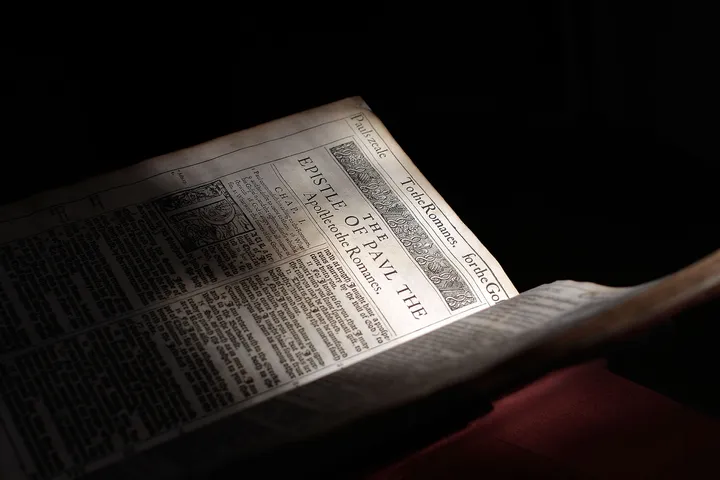
Both read the bible day and night; but you read black where I read white. --William Blake
No man ever believes that the Bible means what it says: He is always convinced that it says what he means. --George Bernard Shaw
More than 20 centuries after the Bible's production, people still bring it to bear on practically every important social and political issue in the Western world (and much of the Eastern world). In the 18th and 19th centuries, both proponents and opponents of African slavery quoted chapters and verses to support their positions. In the 20th and 21st centuries, all sides of every hot issue, from stem cell research to homosexual marriage, include Bible interpretation to back up their stance. How is it possible that those who are pro-choice and those who are anti-abortion can both point to the same text to support their arguments? How can some Jews and Christians use the Bible to justify the subordination of women while other Jews and Christians base feminist reforms and the emancipation -- and even ordination -- of women on the very same Scripture?
Sometimes the Bible says what people think it does. Often it does not. Sometimes it presents multiple perspectives on the same issue. And on some issues it says nothing at all. The Bible is frequently mistranslated, misquoted and misunderstood. Why? For one thing, people usually read it in translations, and without knowledge of its original literary or historical context. And they rarely read it in its entirety, so they end up pulling out small pieces: quotations and passages that seem to say what they want them to. Sometimes they are well-meaning. Sometimes their motives are not so pure.
But this does not mean that we can't use the Bible. It doesn't mean that we can't find what it has to say about the big issues. The Bible's value, above all, is as a guide to lives. And we mean to all of our lives, whether one is religious or not, whether one is Christian, Jewish, or from another religion or no religion. Some people think of fundamentalist Christians and Orthodox Jews as the ones who connect their decisions to the words of the Bible. But that is not correct. One finds scholars, clergy and just folks, from all across the religious spectrum, who read, study and care about what the Bible says on things that matter to them. And one finds many who have never read or studied the Bible who still share a cultural sense of its importance as a foundation for morality and virtue.
The Bible is a source of human experience and of wisdom, and wisdom is something we need. We can argue about which biblical passages are historically accurate, but, still, it is the first history writing on earth.The Bible's oldest prose was written when Herodotus's great-grandmother was not yet in preschool. We can question the morality of any given story or law, but still the Bible is an extraordinary repository of remarkable stories, exquisite writing and revolutionary laws. Indeed, when we argue about these things, we are participating in a 2,000-year-old process that the Bible itself started us doing. You may say, "But there have been times in history (and the present) when people used the Bible for harm: burning 'witches,' attacking 'infidels,' defending slavery." True, but that, precisely, proves that we cannot ignore it. The fact that it has both inspired people to do great good and been used by people to do great harm means that it is really important for us to pay attention to it -- and to get it right.
So we wrote a book ("The Bible Now," Oxford University Press, 2011) designed to help people understand the Bible's place on five major issues of our time: homosexuality, abortion, women, the death penalty and the earth.
We use historical-critical methods, philological and literary analyses, text criticism, source criticism, redaction criticism, anthropological perspectives, archaeology and ancient languages (Hebrew, Greek, Akkadian, Ugaritic, Aramaic) -- the variety of tools of our trade -- to address these questions. We are not doing this out of some antiquarian curiosity with ancient things. As much as the Bible is an ancient artifact, it is also a present one. The Bible matters to people. Biblical scholars are thus in the position of treating a classical text with tools and skills like those of a scholar of Homer or Aristotle but at the same time dealing with immediate, relevant issues like those in each morning's news.
We were both trained in critical biblical scholarship, but that does not mean that we cannot write for orthodox and fundamentalist readers with courtesy and respect. And as long as we keep to the facts and to honest method, what we have to share from our research should be useful to both traditional and critical, religious and not-religious, readers.
We're using this post (and future posts) on HuffPost Religion to help us reach an audience that is engaged with these issues. We want you to see how the Bible actually treats them, so we'll be raising issues from our book here over the next several weeks.
We also want to learn from you; to get your feedback on these and other issues. You may be surprised by what the Bible actually says -- or doesn't say. Our job is only to present the information, not to persuade you to be for or against abortion, for example. But whatever position you take on abortion, you should be better informed of the evidence. And you should be able to explain your position to yourself and others. And you should be able to defend your position in arguments better. You may change your mind. You may not. But our goal is to give you as much good information as possible. You can do with it what you will.
We'll start in our next post with a point on the topic of abortion.