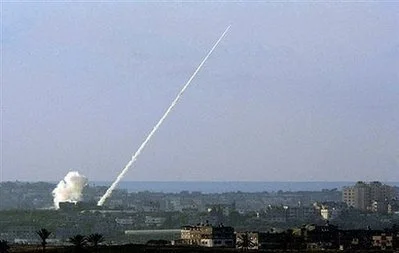
For eighteen months the entire 1.5 million people of Gaza experienced a punishing blockade imposed by Israel, and a variety of traumatizing challenges to the normalcy of daily life. A flicker of hope emerged some six months ago when an Egyptian arranged truce produced an effective ceasefire that cut Israeli casualties to zero despite the cross-border periodic firing of homemade rockets that fell harmlessly on nearby Israeli territory, and undoubtedly caused anxiety in the border town of Sderot. During the ceasefire the Hamas leadership in Gaza repeatedly offered to extend the truce, even proposing a ten-year period and claimed a receptivity to a political solution based on acceptance of Israel's 1967 borders. Israel ignored these diplomatic initiatives, and failed to carry out its side of the ceasefire agreement that involved some easing of the blockade that had been restricting the entry to Gaza of food, medicine, and fuel to a trickle.
Israel also refused exit permits to students with foreign fellowship awards and to Gazan journalists and respected NGO representatives. At the same time, it made it increasingly difficult for journalists to enter, and I was myself expelled from Israel a couple of weeks ago when I tried to enter to carry out my UN job of monitoring respect for human rights in occupied Palestine, that is, in the West Bank and East Jerusalem, as well as Gaza. Clearly, prior to the current crisis, Israel used its authority to prevent credible observers from giving accurate and truthful accounts of the dire humanitarian situation that had been already documented as producing severe declines in the physical condition and mental health of the Gazan population, especially noting malnutrition among children and the absence of treatment facilities for those suffering from a variety of diseases. The Israeli attacks were directed against a society already in grave condition after a blockade maintained during the prior 18 months.
As always in relation to the underlying conflict, some facts bearing on this latest crisis are murky and contested, although the American public in particular gets 99% of its information filtered through an exceedingly pro-Israeli media lens. Hamas is blamed for the breakdown of the truce by its supposed unwillingness to renew it, and by the alleged increased incidence of rocket attacks. But the reality is more clouded. There was no substantial rocket fire from Gaza during the ceasefire until Israel launched an attack last November 4th directed at what it claimed were Palestinian militants in Gaza, killing several Palestinians. It was at this point that rocket fire from Gaza intensified. Also, it was Hamas that on numerous public occasions called for extending the truce, with its calls never acknowledged, much less acted upon, by Israeli officialdom. Beyond this, attributing all the rockets to Hamas is not convincing either. A variety of independent militia groups operate in Gaza, some such as the Fatah-backed al-Aqsa Martyrs' Brigade are anti-Hamas, and may even be sending rockets to provoke or justify Israeli retaliation. It is well confirmed that when US-supported Fatah controlled Gaza's governing structure it was unable to stop rocket attacks despite a concerted effort to do so.
What this background suggests strongly is that Israel launched its devastating attacks, starting on December 27, not simply to stop the rockets or in retaliation, but also for a series of unacknowledged reasons. It was evident for several weeks prior to the Israeli attacks that the Israeli military and political leaders were preparing the public for large-scale military operations against the Hamas. The timing of the attacks seemed prompted by a series of considerations: most of all, the interest of political contenders, the Defense Minister Ehud Barak and the Foreign Minister Tzipi Livni, in demonstrating their toughness prior to national elections scheduled for February, but now possibly postponed until military operations cease. Such Israeli shows of force have been a feature of past Israeli election campaigns, and on this occasion especially, the current government was being successfully challenged by Israel's notoriously militarist politician, Benjamin Netanyahu, for its supposed failures to uphold security. Reinforcing these electoral motivations was the little concealed pressure from the Israeli military commanders to seize the opportunity in Gaza to erase the memories of their failure to destroy Hezbollah in the devastating Lebanon War of 2006 that both tarnished Israel's reputation as a military power and led to widespread international condemnation of Israel for the heavy bombardment of undefended Lebanese villages, disproportionate force, and extensive use of cluster bombs against heavily populated areas.
Respected and conservative Israeli commentators go further. For instance, the prominent historian, Benny Morris writing in the New York Times a few days ago, relates the campaign in Gaza to a deeper set of forebodings in Israel that he compares to the dark mood of the public that preceded the 1967 War when Israelis felt deeply threatened by Arab mobilizations on their borders. Morris insists that despite Israeli prosperity of recent years, and relative security, several factors have led Israel to act boldly in Gaza: the perceived continuing refusal of the Arab world to accept the existence of Israel as an established reality; the inflammatory threats voiced by Mahmoud Ahmadinejad together with Iran's supposed push to acquire nuclear weapons, the fading memory of the Holocaust combined with growing sympathy in the West with the Palestinian plight, and the radicalization of political movements on Israel's borders in the form of Hezbollah and Hamas. In effect, Morris argues that Israel is trying via the crushing of Hamas in Gaza to send a wider message to the region that it will stop at nothing to uphold its claims of sovereignty and security.
There are two conclusions that emerge: the people of Gaza are being severely victimized for reasons remote from the rockets and border security concerns, but seemingly to improve election prospects of current leaders now facing defeat, and to warn others in the region that Israel will use overwhelming force whenever its interests are at stake. That such a human catastrophe can happen with minimal outside interference also shows the weakness of international law and the United Nations, as well as the geopolitical priorities of the important players. The passive support of the United States government for whatever Israel does is again the critical factor, as it was in 2006 when it launched its aggressive war against Lebanon. What is less evident is that the main Arab neighbors, Egypt, Jordan, and Saudi Arabia, with their extreme hostility toward Hamas that is viewed as backed by Iran, their main regional rival, were also willing to stand aside while Gaza was being so brutally attacked, with some Arab diplomats even blaming the attacks on Palestinian disunity or on the refusal of Hamas to accept the leadership of Mamoud Abbas, President of the Palestinian Authority.
The people of Gaza are victims of geopolitics at its inhumane worst: producing what Israel itself calls a 'total war' against an essentially defenseless society that lacks any defensive military capability whatsoever and is completely vulnerable to Israeli attacks mounted by F-16 bombers and Apache helicopters. What this also means is that the flagrant violation of international humanitarian law, as set forth in the Geneva Conventions, is quietly set aside while the carnage continues and the bodies pile up. It additionally means that the UN is once more revealed to be impotent when its main members deprive it of the political will to protect a people subject to unlawful uses of force on a large scale. Finally, this means that the public can shriek and march all over the world, but that the killing will go on as if nothing is happening. The picture being painted day by day in Gaza is one that begs for renewed commitment to international law and the authority of the UN Charter, starting here in the United States, especially with a new leadership that promised its citizens change, including a less militarist approach to diplomatic leadership.