More

Featuring fresh takes and real-time analysis from HuffPost's signature lineup of contributors
Richard Kirsch

GET UPDATES FROM Richard Kirsch
 

What's Wrong with the Obama Administration's Cuts to Medicaid

Posted: 07/06/11 04:54 PM ET

richard-kirsch-100

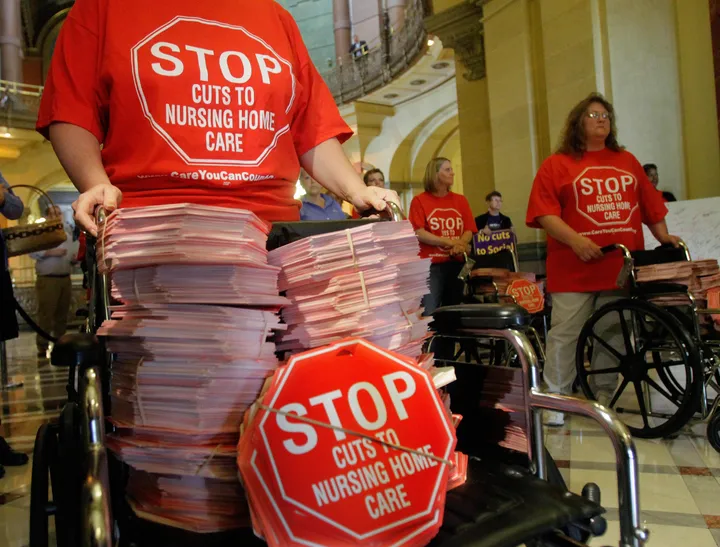
While the public debate about the Republican budget focused on the sharp reactions against Paul Ryan's Medicare privatization scheme, the other big "M" in health care, Medicaid, hasn't received the attention it deserves. As a result, the Obama administration has proposed cuts in Medicaid. These will undermine the achievements of its own historic health care law and harm access to health care for tens of millions of women, children and seniors.

Unlike Medicare, our national health insurance program for seniors and the disabled, Medicaid comprises 51 different state programs (including Washington DC) operating under a set of federal rules, financed by both the federal and state governments. As a result, it's much harder for the feds to control Medicaid costs through policy changes. The Ryan/Republican budget doesn't even try; it simply limits the amount that the federal government will spend on Medicaid and shifts the rest of the costs to the states, while weakening the rules so that states can dump people out of the program.

Unfortunately, most of the proposals that have been made by President Obama in the debt-ceiling negotiations are a kinder and gentler version of the same wrong-headed policy of shifting costs to states, and through them to American families, rather than dealing with the underlying reasons that Medicaid costs are rising.

It's true that Medicaid costs are increasing, but that's not because Medicaid has done a poor job of controlling health care costs, at least compared with the rest of the nation's health care system. For example, from 2000 to 2009 private health insurance companies spending per person increased by 7.7% each year while Medicaid spending on acute care health services -- doctor, hospital, prescriptions, tests, mental health -- increased by 5.6% a year. Medicaid did an even better job controlling spending on long term care, which went up an average of just 3% a year per beneficiary, the same rate at which the economy grew and lower that the overall rate of medical inflation (4.1%).

To really see where Medicaid spends it money, you only need to look at the 5% of Medicaid beneficiaries who are responsible for more than 50% of the costs. These are people with very serious, chronic health conditions and serious disabilities. President Obama knows this -- in fact, he raised the issue at the National Governor's Association in February.

The other major factor in Medicaid spending is increased enrollment -- particularly when the economy tanks. For example, enrollment of families was flat from 2004-2007 but spiked sharply once the recession began. Enrollment jumped by three million from June 2008 to June 2009 alone, the biggest increase since the early day of the program.

Rather than dealing with the root causes of high Medicaid spending, the Obama administration proposes to cut $100 billion from Medicaid over the next decade, mostly by changing the way it pays states for the program. The biggest change would be to reimburse states at the same rate for all their Medicaid patients, unlike now, where states get a different rate for different populations, such as children or seniors. The new so-called "blended rate" would be set at a lower amount than current health spending. Like the Ryan plan, the proposal is simply a cut to states, albeit a much smaller one than Ryan proposed and without the loosening of rules on who and what to cover included in the Republican budget. States would still cut back on who and what it covers, if only to the extent allowed within the current rules. States would also cut payments to providers, which in many cases -- particularly physicians, dentists and hospitals in some states -- would make it harder for patients to get needed medical care.

The "blended rate" proposal also strikes a blow at the Affordable Care Act, which is counting on Medicaid to provide care to more than half of the 33 million uninsured who will be covered under the new law. Under the Affordable Care Act, the federal government will reimburse states 100% of the cost of these new enrollees for the first three years and gradually reduce that to 90%. Compare that to the average 57% now that the federal government pays as its share of Medicaid. The blended rate would result in states having to pay a lot more for people who become eligible for Medicaid under the Affordable Care Act. As a result, states will throw up more barriers to enroll these working families and will scream more loudly about how the ACA is hurting their budgets. That later charge has almost no basis in fact now, but will become true under the blended rate proposal.

A second Obama administration proposal would close off one source that states now use to finance Medicaid, taxes on health care providers. Since states would be reluctant to replace these taxes with other taxes, they would also cut their spending on Medicaid, lowering federal spending.

In fact, only 10% to 15% of the cuts in Medicaid spending in the Obama proposal would come from rational savings in the system -- increased efficiencies in providing medical equipment and prescription drugs -- as opposed to simply giving states less money and making it harder for them to raise money for Medicaid.

The Affordable Care Act was a huge step toward a more rational health system, but the Obama proposals for Medicaid in the budget take us backward. Instead, the President should accelerate reforms that focus on the handful of high cost patients that drive most of the costs, by requiring states to implement care coordination programs which provide systems and incentives for health care providers to improve the care of the chronically.

Early this June, Senator Jay Rockefeller announced that 41 Democrats had pledged to "stand united against any efforts to slash Medicaid." Their action was aimed at the debt-ceiling and budget talks. Unfortunately, their resolve will be tested soon, in the Medicaid proposal made by their Democratic President.

Richard Kirsch is a Senior Fellow at the Roosevelt Institute, whose book on the campaign to win reform will be published in 2012. He was National Campaign Manager of Health Care for America Now during the legislative battle to pass reform. This post has been re-posted from newdeal20.org.

 
While the public debate about the Republican budget focused on the sharp reactions against Paul Ryan's Medicare privatization scheme, the other big "M" in health care, Medicaid, hasn't received the ...
 
 
  • Comments
  • 25
  • Pending Comments
  • 0
  • View FAQ
Comments are closed for this entry
View All
Favorites
Recency  | 
Popularity
photo
HUFFPOST PUNDIT
den1953
The best politicians are for free!
10:30 AM on 07/07/2011
If they cut fraud waste and abuse go for it, it is the number one reason to cut certain Medicare issues, to many repetitive testing drugs that aren't necessary and over billing for services not rendered!
08:10 AM on 07/07/2011
It is the goal of the GOP Tea Party to make Obama a one term President. Their plan is to incrimentally weaken the coalition that elected him President in 2008. His offer to cut Medicare and Medicaid just might be interpreted as an abandonment of the poor and the middle class. Sad.

In all likelihood, the whole 'budget talk thing' will fail, and Obama will have to resort to "The Constitutional solution" on the debt ceiling. These offers of compromise may be interpreted by the progressives as "throwing Medicare and Medicaid under the bus". More right wing crapola to divert us from real solutions. We hop from crisis to crisis.
photo
UsedtobeAlongst
Correcting the Left's hypocrisy
03:00 PM on 07/07/2011
Obama is failing quite nicely on his own, especially with his poorly thought out Healthcare plan.
photo
HUFFPOST SUPER USER
shelbyanne
the unseen eye is watching you
05:17 AM on 07/07/2011
Just the facts, ma'am.Obama care opens medicare up to anyone who cannot afford insurance. It does not cut benefits. It is too bad the republicans didn't participate in making it better. I guess they want paid for doing nothing. GOP, stop campaigning, and do your job! We passed heath care, what? a year ago. Where were the republicans? Too white to work with a black man? Too busy harassing seniors at town hall meetings on health care? Obama tried to get both sides to work on health care. Where were the republicans, on vacation?
photo
UsedtobeAlongst
Correcting the Left's hypocrisy
10:37 PM on 07/06/2011
The biggest cost of Medicaid is that there are absolutely no constraints on those who use it. To go to any doctor or hospital is FREE. Unlimited visits for FREE. There is no cost or limitation of how often you use it. No copay ever. Your child has a piece of popcorn stuck in it's tooth ? Call an ambulance- IT"S FREE !! Had athlete's foot for a year and go to the ER ? IT'S FREE !
Cost control will occur once someone makes the people on it realize that nothing is endlessly free. Pay for one child to be delivered- you want more kids, YOU pay !
Food stamp programs are heavily abused - so are Medicaid cards.
Stop the abuse and you will control costs.
01:52 PM on 07/07/2011
Yes a handfull abuse the system, just as a handfull abuse their private insurance,most fraud is done by dishonest Drs.though.
Genders
Love, Tolerance, Enlightenment
08:20 PM on 07/06/2011
Stop being surprised. Yes Obama and the DLC democrats are better than the GOP, but not enough better.

Vote for the Progressive Caucus folks in the primaries and the Dems in the general.
http://en.wikipedia.org/wiki/Democratic_Leadership_Council
http://www.dlc.org/

Versus the Real Progressives, the Liberals, the Progressive Caucus
http://cpc.grijalva.house.gov/
Read their budget! It's the only one that solves the problems.
This user has chosen to opt out of the Badges program
photo
LI2USsomemore
my dog has midriff bULGe
12:12 AM on 07/07/2011
The last link was a good read. Thanks.

But the devil's in the details, and we seem so far away from being a Progressive nation. What we invariably elect is the status quo.
Genders
Love, Tolerance, Enlightenment
12:48 AM on 07/07/2011
-Oddly, we are a progressive nation if you go by the values and agenda pols. 80% Americans want to tax the rich ti fix the debt, they want to end the wars, cut the military, they don't believe corporations are persons or that money is free speech. Politicians lie. The whole DLC sellouts try and claim they are progressives, they are not. The voters need to see through the lies, to their own research and vote the agenda, but the MSM the MIC all propagandizes the people with Beck and Rush. They are taught to ridicule Kucinich and the good guys as not "pragmatic" ie, not sold out.
bluejaykira
Vote Democrat to SAVE the American Dream
01:52 AM on 07/07/2011
I believe you may be right Genders! Obama is the better of two evils and I like him because he is a very compassionate and caring man. But he is failing the American people miserably by refusing to stand up to those Republican barbarians and do what is right rather than what is easier! He is giving away all of our entitlements and is caving in to the fierce stubbornness of the GOP Klan, so I see no point in re-electing a Republican slave! I wish Nancy Pelosi were running for President, at least she stands up against injustice!!
Genders
Love, Tolerance, Enlightenment
09:56 PM on 07/07/2011
FF. Nancy is similarly weak, though not DLC complicit. Kucinich, Wiener, Bernie, they stand up, and are cut down.
HUFFPOST SUPER USER
cydRN
07:41 PM on 07/06/2011
I work in a "safety net" hospital, one of the top five in the country. We've been doing the Toyota Lean Project stuff for years and are saving money. But after many years of this, we're seeing that you can, indeed, become "too lean". Medicine cannot be based soley on a business model. People are not automobiles and they present an awful lot more variables in their needs.

If we could rein in the bean counters and put some common sense bedside providers in charge, we'd see vast improvement. The problem as I see it is that we have a zillion people making decisions that haven't been at the bedside in decades, if ever.

In closing, let me say that I love my job. I love my patients and I love helping train new doctors and nurses!
07:20 PM on 07/06/2011
The current debate about "cutting" health care programs like Medicare and Medicade exasperates me to no end. Exploding health delivery costs, driven largely by profit seekers, is, in my opinion, what is pricing health care away from people today. This applies across the board. It is entrepreneurial chaos! We have thousands of entrepreneurial providers in health care, largely unchecked in their pricing and inefficiencies, that are destroying affordability and access. These "Monopolies" or "Sphincters" in the system begins with medical schools, research centers, wasteful and unverified billings by hospital and price gouging by device and implement makers. I favor a single-payer system because only Government can cut through the many Gordian knots and powerful market monopolies slowly strangling the Nation's ability to provide health care to everyone. To talk about cuts only, is to ignore the problem, which is sooner or later going to have to be dealt with. What is so ironic is that other nations have dealt successfully with this issue. Only in the USA, with its freewheeling, capitalist approach to providing essential health care services to people, have we refused to deal with the entrenched interest. We will continue to pay a steep price for this shortsidhtedness.
HUFFPOST SUPER USER
rtx47
10:22 PM on 07/06/2011
You make excellent points and I agree with your analysis.
The main issue is how does one shake-up the many entrenched systems currently in place?

While govt has the power to do it, elected politicians lack political will given the lobbying power (and money) of the many entrenched groups. Thus in many cases, various govt agencies are part of the problem.

Talking of cuts is aimed to "Starve the Beast" forcing the entrenched parties led by doctors and hospitals to reform themselves in a quality-cost-efficient manner. This needds to be done ASAP given the difficult fiscal straits the govt (federal, state, cities and counties) and various private corporations; that pay their workers' health insurance.

Govt can force parties to reform using credentialling bodies as a tool; which closely evaluates the leadership and monitoring of the hospitals' Quality Improvement and Utilization Review Committees and holds the hospitals' Medical Director the point person to bring about the changes and efficiencies.

Hospitals are the main "sphincter" where high cost care is delivered; and where one can obtain maximum "Bang for the buck".
This user has chosen to opt out of the Badges program
photo
LI2USsomemore
my dog has midriff bULGe
12:19 AM on 07/07/2011
"elected politician­s lack political will given the lobbying power (and money) of the many entrenched groups."

"When they own the news they can bend it all they want." Jon Mayer
bluejaykira
Vote Democrat to SAVE the American Dream
01:59 AM on 07/07/2011
You are so right! We need to vote special interest politicians out of office and look hard and carefully at those people who we do elect to office and be sure they stand for what we value and desire in our country. The insurance and pharmaceutical industries, just to name a few, have been buying off politicians and running the country for far too long now and this needs to change, along with most of the politicians now in office! It is up to the people to vote for who and what we feel we deserve as a nation.
HUFFPOST SUPER USER
rtx47
06:25 PM on 07/06/2011
So where is the healthcare dollar spent?

Several reports show, 75% of cost is spent on chronic illnesses which accounts for 70% of deaths. More than half of these chronic illnesses are preventable. Thus their costs could be saved with preventive care with diet,exerciss, stop smoking etc, which prevents overweight, diabetes, COPD, etc and their complications.

30% of healthcare costs are spent in the last few months of life.
15% of cost is spent on unnecessary emergency room visits; instead of accessing healthcare through the Primary Care Provider (PCP).
10% of cost is spent on medical malpractice, including the practice of defensive medicine.
40% of costs is for over-treatment, under-treatment and in-appropriate treatment.

Yet, these costs are higher in some states than in others; and are higher in some hospitals than others (within the same state). Cost per medicare enrolee in Northeast states is twice that in Midwest and Southern states. There is no evidence there is difference in quality of care or longevity of enrolee. Many studies show "high cost" hospitals do not deliver better care than "low cost" hospitals. This includes studies at premier hospitals like Mayo Clinic and Cleveland Clinic. This discounts claims that high technology, aging population and immigrants are causes of high costs.
04:54 PM on 07/06/2011
Agree that shifting costs to the states, who are by and large in a fiscal mess due to the recession, is ill advised. States will just cut back on the benefits paid to the Medicaid enrollees and raise the bar for eligibility. This is already done frequently by the states and probably accounts for one of the major reasons that Medicaid spending did not rise as rapidly as as costs associated with a private health insurer. Health insurance companies can raise premiums to cover the cost of care, Medicaid cannot. However, as requests for Medicaid enrollment increased as people lost jobs and health insurance, states were forced to eventually cut back on benefits and then limit enrollment.


Health care ping pong at its finest. Until this health care mess is resolved, Congress should be forced to give up their health insurance (probably the finest in the world), and live under their state's Medicaid plan...each with their own coverage and benefit plan. and none of it very satisfactory. Those who don't know can never understand the inequity in health care.
missprissanna
the weight of the news nearly broke my back
07:58 PM on 07/06/2011
I just have to fan you for your last sentence.
08:54 PM on 07/06/2011
Much appreciated. Medicaid tries to do what is right, but under the existing frame work that it has to operate under, it cannot meet most people's medical needs. A very sad truth for patients who are chronically ill and without other recourse.