iPhone app iPad app Android phone app Android tablet app More

Featuring fresh takes and real-time analysis from HuffPost's signature lineup of contributors
Riva Greenberg

GET UPDATES FROM Riva Greenberg
 

4 Habits That Revolutionize a Doctor's Visit

Posted: 09/30/10 09:00 AM ET

A patient, Sharon, went to a breast surgeon with a small blemish on her breast. It turned out to be nothing, but during her examination the surgeon discovered, in a totally different part of Sharon's breast, a suspicious lump and advised surgery.

Sharon, an intelligent, articulate woman, believes that physical ailments can be overcome by healing energy. So she decided to defer surgery for two months and first try herbs and alternative therapies.

Before leaving the surgeon's office, however, Sharon asked, "Doctor, what was that blemish that brought me here in the first place?

The surgeon, who six months ago would have told Sharon, "That blemish was merely a pigmented epithelial lesion of no mitotic potential, of no clinical importance," instead told Sharon, "That blemish was your very own angel giving you a wake-up call."

Sharon had surgery the next morning. The diagnosis was cancer. Sharon's surgeon's skill as a communicator, as much as her surgical skills, saved Sharon's life.

Sharon's surgeon is one of the thousands of physicians who have been trained on Kaiser Permanente's Four Habits Model, a communication-skills framework.

In my last article I wrote about improving the patient-doctor visit through mindful awareness. Kaiser Permanente (KP), one of the nation's largest not-for-profit health care providers, is doing just that.

KP is training clinicians to be more fully present and engaged with patients through transforming the long-held, but poorly-used, office visit staple -- the medical interview. Kaiser Permanente is teaching physicians communication skills.

Medical Interviewing
Kaiser Permanente newly-hired and long-standing clinicians have the opportunity to experience the Four Habits Model in a half-day, one-day or four-day intensive workshop.

The model teaches four key habits, or behaviors: 1) Invest in the beginning of the visit and build rapport, 2) Elicit the patient's perspective, 3) Demonstrate empathy and 4) Involve patients at the end of the visit in designing a treatment plan. The pay off: physicians become more effective and successful in their work and patients get better health outcomes.

On average, physicians conduct 120,000 to 160,000 medical interviews -- the conversation that takes place during an office visit -- in their practice lifetime. Yet often physicians don't think to ask questions beyond the scope of a patient's immediate problem. The medical interview is primarily task-oriented.

As a result patients often don't think to offer, or may feel too intimidated to volunteer, sometimes-critical information. The very information that creates more accurate diagnoses and more effective treatment plans.
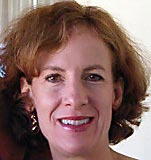
2010-09-29-terrystein.jpg
In 1990, Terry Stein, (pictured) an Internal Medicine physician at Kaiser Permanente in Northern California, led the effort to create a one-day workshop that offered physicians training and tools to specifically deal with patients who were angry or wanted tests or treatments the physician felt were not in their patient's best interest. It struck a chord. Over the next few years Stein and her colleagues crafted a practical approach to help physicians use the skills they were learning consistently. That resulted in the Four Habits Model.

Dr. Stein, now Director of Clinician-Patient Communication for The Permanente Medical Group, shared her motivation. "Early in my career I saw that I needed a repertoire of skills beyond my medical know-how to do a good job. We all need to recognize each other as people and be sensitive to our patients. Sometimes it's not easy given the number of tasks and many aspects of a patient's health we want to address during a visit. Sometimes we have to be reminded."

The Four Habits Model is based on a high-quality conversation and a collaborative partnership. "Just one simple lesson of the model," Stein says, "is reminding clinicians of the importance to talk to patients in their own terms, not in our medical jargon.

"The result," Stein says, "is the quality of diagnosis goes up, which impacts first-time right treatment, which impacts health outcomes, and also helps to deepen the trust between patient and physician."

Another result is patients feel seen and heard.

The Four Habits Model
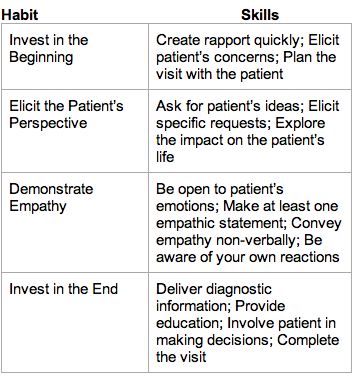
2010-09-29-TableKP.jpg
©2003 by The Permanente Medical Group, Inc., Physician Education and Development

Given the time constraints many physicians feel they don't have time to conduct visits this way. Yet a research study by the University of Western Ontario shows that physicians who are sensitive to, and explore patients' emotional concerns, on average take one minute longer to complete visits.

Another impediment Stein remarked is, "Medical training tends to emphasize biomedical knowledge. What's clear from our research, as well as practical experience, is that a physician's interpersonal skills need to be as strong as their technical expertise. We've noticed that the Four Habits Model plays a very important, and sometimes missing, educational role in professional development."

Tracking results in patient satisfaction for more than 10 years, Kaiser Permanente has seen a significant rise in patient satisfaction among patients who see physicians trained in the four-day intensive workshop. Also, patients who see physicians who haven't been exposed to the Four Habits Model, but display similar behaviors, are more satisfied than patients who see more task-oriented physicians.

Physicians Report Effectiveness of the Model
A Kaiser Permanente physician who uses the Four Habits Model in her obstetrics and gynecology practice says, "It's the best way to get at the patient's real reason for a visit, which sometimes never surfaces because a patient doesn't know how to say something, and the doctor hasn't built the trust for her to feel it's OK to try." When this physician saw a new patient who was complaining of vague abdominal distress, she used her training and made certain the patient recognized her concern and empathy. The patient then volunteered she had an abusive spouse.*

"Unlike many doctors in primary care, I now look forward to seeing patients whom I know are angry," says a behavioral pediatrician. "When a medical assistant gives me the "heads up" that a parent is upset, I actually look forward to the challenge. I approach them with concern, really try to connect with them, and make sure they know I understand why they are upset and how I can help within my role. Almost without exception, they feel relieved that they are noticed and immediately calm down."

A physician says, "Before the Four Habits model I was much more defensive when patients would be angry, especially when it was about problems with a previous doctor. I thought I could just make them understand what that doctor was doing. But after the Model I understood patients need to feel that I understand what they've been through, and that regardless of the previous provider's intentions, that visit was lacking. Now I explicitly let the patient/family know that I will really try to make this interaction meet their needs."

The Quiet Revolution
Dr. Stein's quiet communication revolution that began 20 years ago has only gained increasing support within Kaiser Permanente. Over the past five to 10 years KP has held communication programs for all of its doctors in Northern California and an adapted version of the Four Habits Model is part of leadership training and graduate medical education for residents.

Over the past year and a half Kaiser Permanente has also been using the model's principles among its Northern California medical staff employees -- doctors and support staff -- to help them work together as a team and treat each other with greater empathy.

The Four Habits Model has been taught by numerous other organizations including the Cleveland Clinic and Indiana University School of Medicine and made its way to Europe in Norway and Germany. Remarkably, no money has exchanged hands, just a sharing of the model.

Given the following:

  • Clinicians who've taken the four-day intensive workshop report that they are more confident, more fulfilled, experience greater professional satisfaction and are less stressed by using the skills of the model.

  • Improved health outcomes are associated with behaviors consistent with the Four Habits Model.

  • Most patients report knowing their doctor cares is as important to them as what their doctor knows.


I am left wondering. Why aren't more organizations doing something similar?

One last thought. As chronic illness in particular increases in America, how patients are treated is, and will be, as important as the treatment itself.

*Story derived from The Wall Street Journal.com, "Teaching Doctors How to Interview" by Laura Landro, September 21, 2005

Neither Dr. Stein nor anyone at Kaiser Permanente has asked me to write this article.


Follow Riva Greenberg on Twitter: www.twitter.com/diabetesmyths

A patient, Sharon, went to a breast surgeon with a small blemish on her breast. It turned out to be nothing, but during her examination the surgeon discovered, in a totally different part of Sharon's ...
 
 
  • Comments
  • 20
  • Pending Comments
  • 0
  • View FAQ
Comments are closed for this entry
View All
Favorites
Bloggers
Recency  | 
Popularity
09:01 PM on 11/13/2010
Excellent article and extremely useful information although in reality the pressures placed on Physicians by Insurance Companies makes the Physician-Patient interaction more like a “Confrontation” as opposed to a true “Consultation.” As someone who has suffered with chronic illness for 25+ years (i.e. Crohn’s Disease, 150+ Hospitalizations, many surgeries, etc.) and written a critically-acclaimed Book about my experiences, I can relate to the NEED and EFFECTIVENESS of the approach you outline above but unfortunately I must prepare for each Physician interaction in a manner that makes things as easy as possible for the Physician because I know what they are up against. Perhaps through awareness efforts we will get to this true “Physician-Patient Consultation” but until then Patients must:

Write down Succinct Questions in a logical fashion;
List ALL Medications to refresh the Physician’s mind;
List all Diagnostic Tests taken or planned to refresh the Physician’s mind;
Seek a DIAGNOSIS after ALL Symptoms are communicated;
Seek a Short-term AND a Long-Term “Treatment Plan;” and
Devise a Follow-up Schedule that works for BOTH Patient and Physician.

Michael A. Weiss
“Confessions of a Professional Hospital Patient”
www.hospitalpatient.com
http://www.youtube.com/HealthCareReality
photo
CoastalNC
Good thoughts create good things
03:08 PM on 10/04/2010
I've actually had one doctor in my 56 years that was great!!! His secret?! He treated his patients like they were equals and like they were people and he sat and talked to you so you didn't feel he was racing to get out and on to the next. Everybody loved him....unfortunately he was killed in a plane crash and took his wonderful self away from us far to soon.
03:59 PM on 10/02/2010
Following Kaiser Permanente's step physicians become more effective and successful in their work and patients get better health outcomes, I am also wondering, Why aren't more organizations doing something similar?
This user has chosen to opt out of the Badges program
photo
HUFFPOST BLOGGER
Gary Liberson
10:23 AM on 10/02/2010
I have had a chronic disease for the last 40 years. From time to time it has tried to kill me. It has not. I have gone through a fair number of doctors who were all smart but lacked and communication skills. I now have doctor who are great. Some of the commenters who speak of never going ro the doctor have a luxury (or lthe illusion of a luxury) that I have never had. Given my experience, I see a common thread among all my doctors - time management. They have their offices in order. They have staff to do things they should not be doing. So they have the rime to work with their patient.
85Percent
Southern Liberal & Michigander
10:25 PM on 10/01/2010
I just wish more doctors would try to dig for the right diagnosis. Most want to throw at you the first thing that comes into their heads. I had a particularly bad visit with a PA a few weeks back when I was very sick and had to take whoever was available. Boy, did that guy need this program. Nah, I'm afraid he was hopeless.
HUFFPOST SUPER USER
Boston Doc
MD in private practice
03:10 AM on 10/03/2010
PAs are not doctors.

Communication is important, for some specialties more than for others. But KP's method is hardly new--I have had similar training during my first and second year of medschool.
85Percent
Southern Liberal & Michigander
10:32 AM on 10/03/2010
I did wonder about this "new" training, because it sounded so obvious. Even lowly PA's can learn to listen. While we like to say that fifty percent of doctors graduated in the lower half of their class, those are not necessarily the ones who don't listen to patients just as well. However, those should not start arguing with a well-informed patient and show how dumb they are, either. Glad you were listening in medschool when they taught listening to patients.
photo
redsquirell
red squire LL
03:05 PM on 10/01/2010
So, you can teach someone who doesn't care about others to care for others in four hours? Most doctors don't talk too much out of fear of admitting they are a bunch of "snake oil" salesmen for the drug companies. Ask your doctor to show you the prescription drugs he takes; they know better. So much of medicine is simular to the priests of long ago; baby is sick, go give all your possessions to the shaman, and they do their thing and baby either dies or doesn't. (sorry no refunds). How many doctors give out medications they know are ineffective or even dangerous? Know any kids taking antibiotics for a virus? They are in business and their customers want drugs for everything. Seldom does a doctor give sensible advice that does not involve taking a drug. Much like law enforcement. many of the best have left, unwilling to participate in this crime against the people.
HUFFPOST SUPER USER
booki
02:40 PM on 10/01/2010
i have not been to a dr since my 12 year old daughter was born.
i hate having to put the gown on. i would rather just pull my pants down or be naked..
01:16 PM on 10/01/2010
What I see in the 4 Habits is a simplfied coaching model. As an executive coach that teaches coaching skills, I have seen this model of communication work well for physicians, executives and anyone that wants to build relationships and at the same time get good results. What works about the model is helping the patient speak up about what is important to them. Then you can get to their real concern more quickly. A respectful strategy that works. Busy physician or busy mother, we all need a simple model in our heads that helps us get the results we really want. Thanks for sharing the tool.
11:50 AM on 10/01/2010
We have all experienced cracks, large and small, including some fissures, in our current health care system. We have also all experienced doctors who display their humanity and those who don't. But this is about a company working toward aiding physicians in their interactions with patients to make the outcome more successful for both. The recognition that physicians often need help with their interpersonal skills, and the effort to provide it, is commendable. riva
09:08 AM on 10/01/2010
Another great post Riva ...thank you. In regards to the comments thus far...you can transform this fine article by using the 4 habits to create your own 4habits that you present to the intake personnel (PA, NP, etc) where you might list is very succinct, typed bullet point fashion:
1. Your chief concerns
2. The action steps you'd like to see happen in the visit w/ specific requests
3. The top 2 emotions you are bringing with you (fear: no $, frustration: past 3 docs didn't listen; etc)
4. That as you leave you want resources where you can learn more as you decide among the options that will have been presented to you.

Keep it short, clearly written and less than a half sheet of paper....and see what happens next visit...most healthcare practitioners are exhausted people in a broken system who really do just want to care for others...not evil money grubbing droids....
photo
HUFFPOST SUPER USER
olivine
11:56 PM on 09/30/2010
Doctors are scientists, not social workers,and somewhat egotistical..... i.e..trained to believe that they need no sleep to function optimally (unlike the rest of the human race) ... thus they.need all the help they can get in order to relate to us lesser beings.
HUFFPOST SUPER USER
spinner49
11:12 PM on 09/30/2010
Boy, if there's any institution that needs improvement it's Kaiser! If they are anything like they were when I was a patient there several years ago it's a wonder that Sharon there didn't die waiting to be referred to a specialist. Both my daughter and I have lingering health problems due to lack of timely care from Kaiser. Waiting on hold for 45 minutes to make a simple appointment and waiting six to eight months for a specialist referral was pretty standard. Tendon problems that can usually be cleared up in a few weeks of PT if treated quickly have become chronic and constantly painful years later because it took more than six months to get an appointment with an orthopedist. Horrible medicine, just horrible.
photo
HUFFPOST SUPER USER
olivine
11:57 PM on 09/30/2010
I have heard this same thing about Kaiser...over and over. A nightmare.
12:19 PM on 09/30/2010
"Dr. Stein's quiet communication revolution that began 20 years ago has only gained increasing support within Kaiser Permanente. Over the past five to 10 years KP has held communication programs for all of its doctors in Northern California and an adapted version of the Four Habits Model is part of leadership training and graduate medical education for residents."

Living in NorCal, having visited many different specialists, GPs, Internists, I have not seen evidence of the above. If this is making the impact that the author cites, it's hodgepodge at best. My experience has been that the "time is money" ethos trumps everything, and most critically, trumps a patient's care.

As I said, my experience has left me little confidence of both the quality and motivation of the medical profession to actually serve the best interests of the people who come to see them for medical advice and help. And I'm not alone in such an attitude. Many friends, relatives, and colleagues are experiencing the same malaise with the medical establishment, having similar experiences as my own. It would be refreshing if this were the standard, but I fear and have witnessed that it clearly and most certainly, is not.
photo
HUFFPOST SUPER USER
olivine
11:57 PM on 09/30/2010
Agree.
photo
CoastalNC
Good thoughts create good things
03:12 PM on 10/04/2010
I agree, I don't go to a doctor unless I have a symptom that I feel needs a doctor and they can possibly help me...like a cyst or carpal tunnel, etc. I don't get sick very often and when I do I let time and my body take care of it usually, so far that has worked better for me than going to the doctor.
photo
HUFFPOST SUPER USER
Lisa Shields
Poet & Advocate For Special Needs Children
12:08 PM on 09/30/2010
All this is very nice...but it is assuming the doctor is actually LISTENING.

I hate going to the doctor.
I drag my feet, and delay it as much as possible.
So when I do show up, it means something is not working.
I try not to waste their time, but most visits i feel like they are examining with one eye on a pock t watch. Three to five minutes, and they are out of there.

Worse...they are letting the insurance companies dictate how patients are treated. I saw on specialist last year...stomach pain. He did an endoscopy, called me to his office to tell me he found nothing, and collected a $40.00 co pay. The test cost me $1000 after the insurance, and now instead of occasional pain, it's pretty much 24/7.

I have a new specialist, and now am having other tests done---but I resent feeling like the ball was dropped. I specifically asked the doctor why my stomach was hurting, if the test was clear. He simply shrugged. And he was the chief of his specialty at the local hospital.

I can see why some people think American Health Care is the best...NOT.
photo
CoastalNC
Good thoughts create good things
03:14 PM on 10/04/2010
My grandfather was a doctor, he use to say that it was just an educated guess....apparently he was right and I figure if I go on line and read up I can make educated guesses myself most of the time. Sorry they haven't helped you yet with you stomach.