On Feb. 18 I moderated the Juvenile Diabetes Research Foundation Capitol Chapter's second annual Research Summit on Type 1 Diabetes.
My first question when I got the call to moderate was, "Why me?" (Not unlike the response I had to my diagnosis of Type 1 diabetes 40 years ago.) And I wasn't just fishing for compliments.
Most of my work in diabetes is in building emotional resilience and behavior change. Science? Beta Cells? Islet infusions? I don't even wear an insulin pump and I tried a continuous glucose monitor for only 10 days. I'm an old-fashioned girl.
"That's why we want you," said Elna, who had the onerous task of calling me. Well, she didn't say that exactly. She said something about my spunk or zest. So OK, I said yes. Maybe I'll learn something and meet some interesting people. I did.
What I, and more than 600 attendees with Type 1 diabetes, family members, health care providers and industry representatives, learned in a nutshell is what blogger Bennet Dunlap put so well, "I don't see a magic bullet coming but I do see different approaches to tackling things that will count as a cure. Those will happen like everything does in increments. Along that journey we'll see better care before cures. So prevention may come before restoration of beta cell function, that's cool, steps matter."
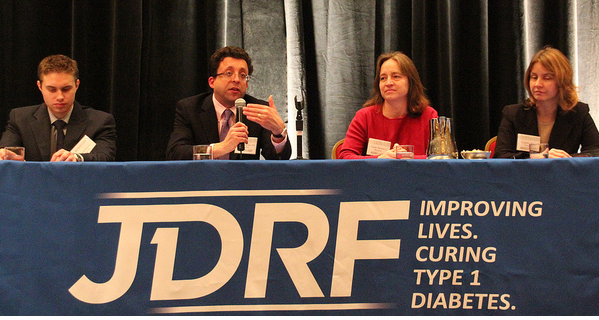
Here's a recap of the day's highlights. You can view eight of the nine presentations that were given here.
Growing Incidence of Type 1 Diabetes
Type 1 diabetes is increasing around the world by a rate of 3 percent every year. Finland has the highest rate of Type 1 diabetes, 1 in 123 children. In the U.S. one in 300 Americans get Type 1 diabetes a year. That's twice as much as it was just a few decades ago. That's not OK.
Diabetes Management Strategies
Current cure-targeted strategies are the artificial pancreas (insulin pump + continuous glucose monitor (CGM) + control algorithm), immune therapeutics, islet and pancreas transplantation and beta cell regeneration. You'll find a comprehensive report on these in "Targeting a Cure for Type 1 Diabetes."
Artificial Pancreas
The current "best model" is Medtronic's closed-loop system. Studies show the closed loop system increased patients' time in their target blood glucose range overnight and with reduced hypoglycemia. Increased continuous glucose sensor use also shows A1C reduction. Patients who used sensors more than 81 percent of the time reduced their A1C by 1.2 percent at 1-year baseline.
Without a closed-loop system people with Type 1 diabetes are found to be in the optimal American Diabetes Association glycemic zone, an A1C < 7 percent, only 28 percent of the time, spending two hours a day in hypoglycemia. At 66 leading diabetes centers the average A1C of Type 1 patients is 8.5 percent.
Stem Cell Research
Pancreatic cells have limitations for use largely due to immunosupression and the small quantities available. Embryonic and adult stem cells, however, show promise. Embryonic cells show the greatest promise as they are plentiful from many sources such as bone marrow, umbilical cord and cord blood and fat, they are easy to expand and can be derived from the recipient. You can expect talks soon with the FDA for clinical trials.
Advocacy
On Dec. 1, 2011, the FDA released artificial pancreas guidelines, and the Juvenile Diabetes Research Foundation (JDRF) is leading a broad effort working in concert with Congress, regulatory agencies, health care companies, industry and clinicians to accelerate an artificial pancreas coming to market.
A new social media community, part of the Helmsley Trust T1D Exchange, is being launched just for Type 1s called Glu.
More people are needed for research studies. If you have Type 1 diabetes, or it's in your family, presenters urged people to participate in a TrialNet study.
What we Still Need to Learn
· How to take what we know to prevent and cure the disease
· Whether beta cells can replicate
· When animal models benefit studies and when they don't
· Why beta cells get destroyed
· How many types of Type 1 diabetes there are
· Identify influencing environmental agents
· Why 85 percent of new patients have no relative with Type 1 diabetes
· Why Type 1 diabetes is increasing so quickly in youth and why we're seeing a dramatic increase of Type 1 diabetes in almost every country
· When does the process of Type 1 diabetes begin?
· How to overcome the limitations of pancreas transplants: small availability of cadaver donors, quality and quantity of islets, immunosuppresion drugs, rejection, auto-immune beta cell destruction
· How to get insulin to work faster
Studies and What We Can Look Forward To
Many studies are currently going on. Here are two: seeing via a closed-loop system whether Symlin reduces post-meal glucose spikes, and seeing if a closed-loop system used by newly-diagnosed Type 1 kids preserves beta cell function.
We can look forward to faster insulins, increasing use of other hormones besides insulin to control blood sugar like amylin, GLP-1s, metformin and insulin "cocktails, better CGMs and a fully automated closed-loop system with insulin and glucagon on board.
If you were diagnosed more than a decade ago, like me, you heard that there would be a cure in five to 10 years. We're still searching, but we've probably made more progress in the last 10 years than the last 40.
So the day was about science, but at the day's close I found my hope rekindled. Each day an army of incredibly determined and smart people are looking for a cure and easier and less invasive ways to live with Type 1 diabetes, as if their life depended on it. My thanks to each and every one.
Summit Presenters
Dr. Juan Dominguez-Bendala, Director of Stem Cell Development at the Diabetes Research Institute in Miami
Adam Brown, Senior Associate at Close Concerns
Dr. Mark Atkinson, Co-Director for the Diabetes Center of Excellence at the University of Florida
Dr. Desmond Schatz, Professor and Associate Chairman of Pediatrics at the University of Florida, Gainesville
Sarah Howard, National Coordinator for the Collaborative on Health and Environment
Dr. Stuart Weinzimer, Associate Professor of Pediatrics at the Yale School of Medicine
Cynthia Rice, Vice President of Government Relations for JDRF
Marie Schiller, Partner and Managing Director of Health Advances and Co-Founder of the T1D Exchange
Gary Scheiner, CDE, Founder of Integrated Diabetes Services and Type 1 University and author of "Think Like a Pancreas"
Riva speaks to patients and health care providers about flourishing with diabetes and is the author of "50 Diabetes Myths That Can Ruin Your Life and the 50 Diabetes Truths That Can Save It" and "The ABC's Of Loving Yourself With Diabetes." Visit her website DiabetesStories.com.
For more by Riva Greenberg, click here.
For more on diabetes, click here.