
iPhone app iPad app Android phone app Android tablet app More

Featuring fresh takes and real-time analysis from HuffPost's signature lineup of contributors
Richard (RJ) Eskow

Richard (RJ) Eskow

Posted: June 15, 2010 12:39 AM

Big Banks vs. American Businesses: "Section 716" Forces Congress to Choose

What's Your Reaction:

It can be hard to grasp all the details of Section 716, the Senate provision that would force big banks to spin off their swap desks, but the principle isn't that complicated: Banks that get access to discounted money from the Federal Reserve, or federally-guaranteed deposit insurance, shouldn't be able to gamble with them. And the four huge institutions that dominate the derivatives market shouldn't use the implicit guarantee of a taxpayer bailout as a license to act recklessly. Instead they should use that money, and that guarantee, to lend to the businesses that can get our economy moving again.

In this new, inverted political world, the "progressive" position is actually conservative, as in the dictionary definition of "conservative": "Favoring traditional views and values; tending to oppose change." Section 716 is a return to the old way of doing business. In the old days, banks got low-interest money from the Fed and lent it at somewhat higher rates. They earned the difference by assuming the risk of default and by lending the money wisely. The Fed "discount window" was never supposed to be a betting window, and the Federal Reserve chair wasn't supposed to be underwriting bets. Banks weren't gamblers, they were responsible lenders who knew their borrowers. (Think Jimmy Stewart in "It's a Wonderful Life.")

The old left/right idea of "business" vs. "populism" doesn't really apply when it comes to this aspect of financial reform. The question is now, will Congress be pro-business ... or pro-big bank? With provisions like Section 716 you can be one or the other, but not both. If they're pro-business, which ironically has become the "populist" position, they'll insist that the big banks stop gambling with the public's money and start lending it to the businesses that account for most new jobs in this country.

As the Americans for Financial Reform website explains, Section 716 "will require, inter alia, the five largest swaps dealer banks to sever their swaps desks from the bank holding corporate structure." They can own subsidiaries that handle swaps - the sort of derivatives that wrecked the economy last time around - but they have to keep them separate from banking operations.

The top five banks dominate the derivatives market, with the top four holding the lion's share. We developed this chart for an earlier post, based on the overall derivatives market:
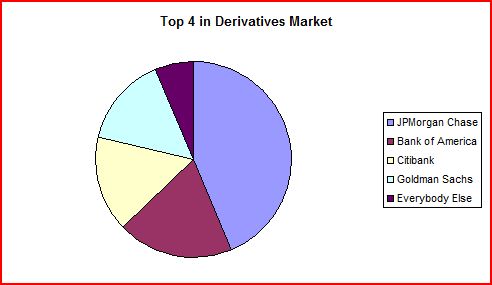
2010-06-15-Top4inDerivativesMarket.JPG

The trading operations for these four banks didn't lose money for even a single day last quarter. This round of financial reform won't break up this cartel or end the rigged casino - but Section 716 would ensure that they we don't stake them the money.

As an example, how did Goldman Sachs' trading arm do? According to their own earnings statement, Goldman's Trading and Principal Investments group earned $10.25 billion in the first quarter of 2010, up 43% from a year earlier and 60% higher than its earnings in the previous quarter. Data are harder to break out for the other banks, but we can rest assured they did well.

Nobody who's winning big in the casino wants to bother lending money to entrepreneurs. From April through October of 2009, overall bank lending to small businesses dropped by $11.6 billion. The Treasury Department's monthly report on bank lending indicated a further drop in January. Renewals of business accounts decreased 47% that month while total new loan commitments decreased 20%.

Treasury responded decisively to its own January figures - by deciding it wasn't going to release any more of these monthly reports. Not meaningful, they said.

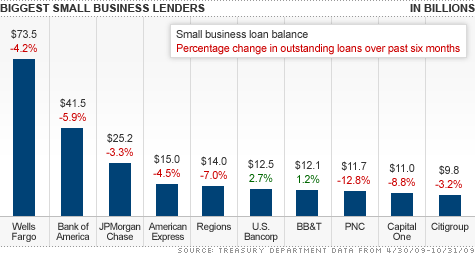
Our four big derivative speculators were part of the overall freeze out on business lending in 2009, as this chart shows:
2010-06-15-smallbizlendingoct09.gif

And, as CNN reported, the 22 banks that got the most help from the American taxpayer slashed their small business lending by $10.4 million.

The trend had begun a year earlier, at least for the mid-sized loans that often support new hiring. An SBA study shows that loans in the critical $100,000-$1,000,000 range, typically provided to those mid-ranged businesses that drive job growth, were already down 23.3 percent from June 2007 to June 2008. While demand also affects loan volume, the larger trends toward tight credit suggest an overall pattern.

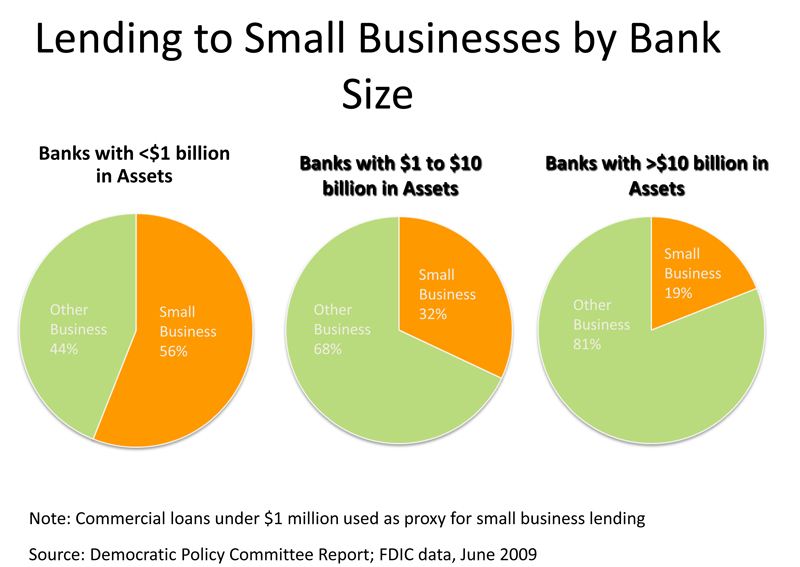
Which banks are the least likely to lend money to smaller businesses? You guessed it: the large ones:
2010-06-15-lendingtosmallbizbybanksize.jpg

Big follows big, apparently. During the same period that lending plunged for mid-sized business (2007-2008), the same SBA study showed that volume on business loans of more than a million dollars continued to soar. These larger loans grew 12.2 percent during that period, after increasing by more than 11 percent the year before.

Owning a small business has becoming an increasingly difficult way to make money in this country. A Small Business Administration study concluded that households owning a small business (as opposed to several businesses) fell behind in the last couple of decades, unable to grow as quickly as other types of households. The study adds that these businesses "may be adversely affected by further concentration in commercial banking and less relationship lending at the local level." In other words, mega-banks don't know their borrowers and don't help them start businesses. (There's Jimmy Stewart again ...)

Make no mistake: Section 716 doesn't end "too big to fail." The Senate already killed that possibility when it voted down the Brown/Kaufman SAFE Act. But it would force banks to create and fund subsidiaries to handle derivatives, preventing them from co-mingling speculative capital with money they've been lent for genuine banking purposes. It would prevent the Federal Deposit Insurance Corporation (FDIC) from providing guarantees for dealing and trading derivatives. And now that Section 716's been changed to meet Paul Volcker's concerns, chances of its passage look even better.

The Section 716 debate has become a proxy fight that pits Main Street American businesses - the engines of economic growth - against the megabank lenders who have been using publicly provided discounts to make out like bandits.

______________________________

Richard (RJ) Eskow, a consultant and writer (and former insurance/finance executive), is a Senior Fellow with the Campaign for America's Future. This post was produced as part of the Curbing Wall Street project. Richard also blogs at A Night Light.

He can be reached at "rjeskow@ourfuture.org."

Website: Eskow and Associates


Follow Richard (RJ) Eskow on Twitter: www.twitter.com/rjeskow


  • Comments
  • 9
  • Pending Comments
  • 0
  • View FAQ
Comments are closed for this entry
View All
Recency  | 
Popularity
HUFFPOST SUPER USER
wollstonecraft
Self-described liberal, and proud of it.
12:22 PM on 06/15/2010
We're in a depression. No one will admit it.
This user has chosen to opt out of the Badges program
09:18 PM on 06/21/2010
if we're not the new austerity measures will do it for sure, but there is a painless way out of all this, but the banksters will kick and scream, so we know it's good for us! get the dvd at secretofoz.org or just read all the essays at monetary.org ; also see newdeal20.org and Soros's new baby at ineteconomics.org and pass these on, we have to take our country back from the banksters
This user has chosen to opt out of the Badges program
10:48 AM on 06/15/2010
I submit for your consideration the allegory of "banking is a three-legged stool."

A three-legged stool is the most solid foundation possible: a tripod. But only if all three legs are in place. Without any of the three, it cannot stand at all. If you happen to be sitting on it at the time, you're going to fall on your (!).

The three legs are: finance, insurance, and banking. Each of these pursuits champions one goal at the expense of the other two. Tied together, they incessantly pull the system toward the center; toward stability. As the winds of fate opportunity and change pull against the system externally, the three legs naturally exert their own respective pulls, and the system remains stable.

The Glass-Steagall Act was not only good regulation: it was good business.

When the Act was removed, the three legs no longer pulled against one another. And so, now we have an inherently unstable system that continually flings itself off of first one cliff and then another, even as it proves itself unable to meet any of its business objectives.

We need banking. We need finance. And, we need insurance. But, because we do not have Glass-Steagall, we do not have any of the three.

This is a classic case where the force of human greed =prevents= success. ONLY the firm check of law-enforcement will keep the three legs firmly anchored, and the resulting system, stable.
09:50 AM on 06/15/2010
Looking more like south America everyday. Banks are transforming the US governemnt into a subservient corporation.

Government is collecting taxes but will eventually have to pay much of that to the banks.
Instead of a political organization with duties to perform upholding the civil, business and human rights, our government is quickly becoming the repo man for the debt and bond holders.

Big banks v. business and the miracle on 34th street? More like banks making everybody else more like South Americans' poor servicing interest and past due fees.

Congress and our government is in the position of being blackmailed because of the spending spree of the republicans starting with Regan. Now they want to break all the contracts 'costs' like social security so the big boys can take the tax revenues.
This user has chosen to opt out of the Badges program
09:16 PM on 06/21/2010
it started long before Raygun; get the dvd at secretofoz.org or just read all the essays at monetary.org ; also see newdeal20.org and Soros's new baby at ineteconomics.org and pass these on, we have to take our country back from the banksters
10:20 PM on 06/21/2010
Thanks for the links.
09:44 AM on 06/15/2010
< It can be hard to grasp all the details of Section 716, the Senate provision that would force big banks to spin off their swap desks, but the principle isn't that complicated: Banks that get access to DISCOUNTED MONEY from the Federal Reserve, or federally-guaranteed deposit insurance, SHOULDN'T BE ABLE TO GAMBLE with them. The four huge institutions that DOMINATE the DERIVATIVES market shouldn't use the implicit guarantee of a taxpayer bailout as a LICENSE to act recklessly. >

Excellent comment, Mr. Eskow. Max Keiser (& his many reknown guests) has become the most on-point, forceful, & informed commentator on America's premeditated & ENGINEERED FINANCIAL DESTRUCTION
("FINANCIAL TERRORISTS," "suicide bankers," FIXED markets, & the "gulag casino gambling economy" are some of his harder-hitting terms)
(eg. Golddamn Sachs SELLING PENSION FUNDS "securities" they created, KNOWING they would BLOW UP - selling sheer crap that would not only blow up an individual "security" issue, but, over the long term, would destroy ENTIRE PENSION FUNDS)
(see his latest, "Economic DEATH SQUAD Leader, TIM GEITHNER") -
http://maxkeiser.com/2010/06/12/ote58-on-the-edge-with-david-degraw-economic-death-squad-leader-timothy-geithner/

but as insightful as Mr. Keiser is, from his years working as a trader on Wall Street, even he does not quite get that the FIAT MONEY - created out of THIN AIR by the member/OWNER banks of the FEDERAL RESERVE very PRIVATELY OWNED banking cabal - EMPOWERS the Big Banks to go on a LOOTING & EXTORTION SPREE across the world.
10:15 AM on 06/15/2010
While Mr. Keiser UNDERSTATES the impact of Fed Reserve FREE or 'fiat' MONEY to CONNECTED member/OWNER banksters of the Fed Banking cabal, he is quite excellent at outlining the many other tactics & strategies the Big Financial Operators use to LOOT & GUT (real) finanical assets worldwide:
- CREDIT RATING AGENCIES (moody's, standard & poors) IN BED with the FinanicalOperators...
- "wolfpack" CURRENCY SPECULATORS ATTACKING otherwise viable currencies
- using NAKED SHORT SELLING, which, in the quantities used by the above currency speculating syndicates (like GEORGE SOROS in his infamous attack on the English pound years ago) - is effectively the MOMENTARY COUNTERFEITING of shares THAT SIMPLY DO NOT EXIST (to shove down the price of existing shares)
- the TAXPAYER SUBSIDIZED "OUTSOURCING" of American industries!
- government Guarantees & "backstops" of PRIVATE loans, which ENCOURAGE FRAUD
http://abcnews.go.com/Blotter/story?id=6201900&page=1


and of course the ability of the banksters, through SHEER BRIBERY & INTIMIDATION of congress (AND presidents), to REFUSE TO release top-to-bottom AUDITS!

Given that we are GIVING TRILLIONS to FAILED, BANKRUPT BANKS, it is COMPLETELY INSANE of the American public (and their BRIBED & BULLIED congress-critters) to TOLERATE
__NOT KNOWING__ just HOW MUCH __MORE DEBT__ (those damn "derivatives" & CDO swaps) the damn "Suicide Bankers" have on their books!!!!

These above tactics, ARE IN ADDTION TO the "FREE MONEY" that allows Connected Banksters to go on an LBO, "LEVERAGED BUYOUTS" spree, STEALING REAL ASSETS from those who built them, using FIAT Fed dollars

(in ECONOMIC HIT MAN style).
This user has chosen to opt out of the Badges program
09:17 PM on 06/21/2010
"engineered destruction" gets you fanned!
get the dvd at secretofoz.org or just read all the essays at monetary.org ; also see newdeal20.org and Soros's new baby at ineteconomics.org and pass these on, we have to take our country back from the banksters