
Last Friday the White House partied like it was 1999. It was fascinating to see Bill Clinton back at the podium, and it's always a pleasure to see a master of the medium at work. But the Administration's latest moves raise serious concerns about the future of Obama's Presidency. Clinton played the "centrist" angle brilliantly in the 1990s, artfully fusing Republican and Democratic positions and rescuing his own political fortunes. But times have changed, even if Washington's illusions have not.
Today the country's real center -- the commonly-held set of goals and aspirations shared by Democrats, Republicans, and independents alike -- has never been farther from the narrow right-leaning viewpoint that's still being peddled as a "centrism." If the White House and other Democrats buy into that illusion, as they seem to be doing, they'll lose the country.
The Third Way Fallacy
Politicians and journalists in Washington cling to the belief that there's a better way to run government, one that dispenses with the messy process of debate and disagreement. Call it "the Third Way Fallacy." It suggests that all will be well if we just stop all the partisan "bickering" -- "bickering" being a pejorative word for the political discourse that permits voters to distinguish one politician's views from another and vote accordingly. The Third Way approach would replace the quarrelsome democratic process with a system in which powerful people from both parties sit down amicably to "work things out," presumably in quiet -- and private -- places.
This elusive dream is revived every couple of years by some well-funded publicity campaign, and this year is no exception. Like its predecessors, this year's model assumes there's a political spectrum represented by Democrats on the left and Republicans on the right. If they meet in the middle, the fallacy goes, we will have found the "center."
But if we look at the public's opinions issue by issue we see that the opinions of this so-called "center" -- the points on which so many Washington-based Republicans, Democrats, and journalists agree -- is wildly out of step with Americans of all political affiliations. The nation's center is not the Beltway's center.
Truth in labelling
There's a reason why we have laws requiring labels. Without them people can get sold a bill of goods. Consider the latest PR campaign for the right-wing Washington consensus, "No Labels": Its "founding leaders" include two key members of George W. Bush's political team, several mid-level figures from the rightmost spectrum of the Democratic Party, and two career "centrists" (including Jon Cowan, whose organization "Third Way" provided the name for this new fallacy). The reason this group isn't labelled is because a label would read as follows: "A center-right to far-right group that reflects the worldview of powerful Washington insiders from both parties."
I feel safe in predicting that "No Labels" will revolutionize American politics every bit as much as Unity08 did. That is, it's going to be announced with great fanfare -- fanfare that's generated by the highly-paid efforts of Washington publicists. It will then be received enthusiastically by the David Broder crowd, and nobody else. Within six months it will have been forgotten by the few people who had ever even heard of it in the first place.
"No Labels" is the latest reflection of a deep-seated yearning among Washington insiders: the yearning to fuse the leadership of both parties into a unitary political order, one that can dispense with bothersome chores like justifying your actions to the public. Washington "centrists" are the One Worlders of American politics, dreaming of a Utopia governed by a Council of Elders.
Except that these Elders rose to power in the rough-and-tumble world of partisan campaigns funded by influential donors. They're not going to suddenly turn into a wise and kindly ruling body likes the ones that govern peaceful forest planets on old Star Trek episodes. If they're given free reign to cut secret deals behind closed doors, the result won't be Utopia.
Washington 'Bipartisanship' vs. Public Opinion
Some of the Administration's comments imply they've interpreted this election as a mandate to pursue precisely this form of centrism, and the President has often indicated that this is how he would prefer to govern. What have we seen so far, as the result of horse-trading conducted by party leaders along a narrow political spectrum?
- Social Security benefit cuts appear to be a real possibility, despite the fact that a vast majority of the country opposes them -- including 76% to 77% of independents, Republicans, and Tea Party supporters.
- The financial reform bill was largely negotiated behind closed doors, out of the public eye. As a result, we'll never know which politicians undercut some of that bill's most urgently needed provisions. That kind of secrecy that undermines democracy and public accountability, especially when most Americans want stronger bank regulations. That's an option that the bipartisan "consensus" has agreed is not on the table.
- One financial reform measure rejected by the "bipartisans" -- a limitation on bonuses for bankers we've rescued -- was more popular with Republicans than Democrats! (That makes sense, when you think about it: If you believe in the free market, as they -- and I -- do, you should believe that bad judgement must be punished with economic pain.) Overall, 85% of the public wanted large bonuses limited or banned. The "centrists" say no.
- Only one American in 25 thought that Congress should make deficits its first priority after the last election, and only one in 50 thought its first priority should be taxes. What's dominated Washington politics (and media coverage) since then? Deficits and taxes.
The end result is shown below:
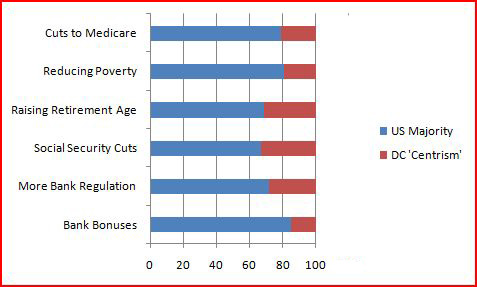
The blue portion of the bar represents the majority opinion on each issue. In every case, this view is supported by most Republicans and independents, as well as by most Democrats. There's a real bipartisan consensus in the nation -- to protect Social Security, tax the wealthy, preserve Medicare, improve banking regulations, and ban big bonuses at banks which were rescued by the taxpayers. The ersatz 'centrism' being peddled in Washington is on the wrong side of every single issue. It would turn the leadership of the country over to people on the red, rightmost side of the chart, restricting the debate to the best way of implementing these unpopular positions.
No wonder 70% of people surveyed are "somewhat" or "deeply dissatisfied" with the way Washington works. The political consensus doesn't represent them, and these "solutions" would merely institutionalize that lack of representiation.
Bipartisan, Nonpartisan, Antipartisan
Sure, people say they'd prefer a "bipartisan" solution when pollsters. They'd rather see politicians act in the country's interests, rather than their own. But "bipartisan" literally means "of two parties" - Democrats and Republicans. On issue after issue, neither party is promoting the public's preferred policies. What's striking about the polling data is how much agreement there is among registered Democrats, Republicans, and independents - and how different that agreement is from the conservative agenda being peddled in their names as "centrism."
Neither the public, nor the press, nor politicians seem to understand the difference between "bi-partisanship" -- something negotiated between Democrats and Republicans -- and "non-partisanship," which is the process of making decisions without partisan preference or loyalty.
A "nonpartisan" set of solutions crafted by experts might closely parallel the public's preferences. Or the experts might offer several alternatives for the public to choose from. Either way, a non-partisan approach would probably lead to far more democratic results than the bi-partisan approach being pushed in Washington today.
The Third Way Fallacy fundamentally misreads independent voters, too. While many of those voters will vote for candidates from both parties -- "I vote the man, not the party," as they said in the old sexist days -- many of them hold both parties in equal disdain. They'll vote for a candidate like John McCain for just as long as they can believe he's not a self-serving politician like all the others. These voters aren't bi-partisan, either. They're anti-partisan.
Why doesn't the "centrist"/Third Way/ "No Labels" pitch ever work with voters who don't like either party? I can only use a personal example: I don't like pickles in my sandwiches. I don't like cottage cheese, either. If someone offered me a pickles-and-cottage cheese sandwich, I would not want to eat it.
Do not remove tag under penalty of law
Another prominent member of the "No Labels" team is David Walker, the former U. S. Comptroller General who comes to the team after two years in the employ of Pete Peterson's foundation. Peterson's the billionaire who opposes most taxes for the wealthy, wants to radically downsize government, and has spared no effort or expense in his mission to cut Social Security benefits. Peterson's used the "no labels" playbook for many of his highly subsidized ventures, including the "AmericaSpeaks" forums, his "bipartisan" commissions of right-wingers from both parties, and of course his "Deficitball" games.
How would a truly "no labels" agenda look if it reflected the strongly-held policy preferences held by Americans across the political spectrum, and weighed the consensus view of truly non-partisan experts? It would protect Social Security benefits, promote public investment in jobs and growth, tax the wealthy and the big banks to restore deficit balance, and expand the financial regulations passed earlier this year.
What do all those positions have in common? They're the exact opposite of everything David Walker's been trying to accomplish for the last two years . As for "No Labels," it is keeping a veil of secrecy around its donor list. We're not allowed to know who's bankrolling this venture.
See why we need labels?
Behind the labels
Why aren't the views of the American majority represented in Washington? For one thing, they threaten the vested interests that bankroll political campaigns -- and gimmicky "centrist' organizations, too. For another, these views look an awful lot like liberalism, which Washington elites have spent decades demonizing. A lot of "Third Way" types are too locked in the left/right paradigms of the past to embrace positions that look this much like Mommy and Daddy's liberalism. But unfortunately for them, yesterday's liberalism is today's bipartisan consensus. So they keep trying to marginalize these ideas by pretending they represent the extreme wing of one party, rather than the views of an overwhelming majority.
There's nothing wrong with holding center-right opinions, of course. And there's nothing wrong with advocating a form of governance that would dispense with public debate and turn decision-making over to current or former leaders from both parties. But it's misleading to label those positions "mainstream" or "centrist." They're not. Back in the 1990s, a lot of people in both parties believed financial deregulation and reduced government services would lead to a brighter future. But deregulation led to disaster, and today the American people see the vital role government plays in their lives. The public has changed with the times. The "Beltway bipartisans" have not.
Third-Rate Results
We saw the electoral fruits of the Third Way fallacy in November's election. Democrats who embraced it were seen as representing nothing in particular, so they were judged by the status quo -- a status quo that was made worse by "centrist" policies. Now we're seeing an ever-widening gap between the public's wishes and a Republican/Democratic/media elite that refuses to accept or acknowledge them. That's a recipe for bad policy, and politically it's a one way ticket for the Democratic Party to receive the Mother of All Shellackin's in 2012.
It's still not too late. Many Democrats embrace the proposals most Americans want. A few Republicans will back them too, if forced into the open by partisan "bickering," as we learned during the financial reform debate. The President can still embrace them too, leading his party and the country toward a much brighter future than the one they seem to face today. But to do that he'll have to let go of the Third Way Fallacy and fight for the positions that the American people want and need.
_________________________________________________
Richard (RJ) Eskow, a consultant and writer (and former insurance/finance executive), is a Senior Fellow with the Campaign for America's Future. This post was produced as part of the Curbing Wall Street project and the Strengthen Social Security campaign. Richard also blogs at A Night Light.
He can be reached at "rjeskow@ourfuture.org."