
More

Featuring fresh takes and real-time analysis from HuffPost's signature lineup of contributors
Richard (RJ) Eskow

Richard (RJ) Eskow

Posted: April 1, 2010 02:28 AM

Resident Evil: Are Struggling Homeowners as Immoral as the Big Banks?

What's Your Reaction:

Do homeowners who are underwater on their mortgages deserve to lose their homes? That's what finance commentator Barry Ritholtz says, in a post called "More Foreclosures, Please." Ritholtz must have been channeling his inner Rick Santelli when he wrote that "the boom and bust saw irresponsible and reckless behavior by lenders and home buyers alike," adding that mortgage relief programs for homeowners reward those who were "reckless, speculative, and foolish" while punishing those who are not.

It's not reasonable to put Barry Ritholtz in the same category as Santelli, of course. Ritholtz is a highly informative, widely quoted writer on economic issues. Santelli's the frat-boy trader turned CNBC host whose rant about "rewarding the losers" got a cheer out of some morons on the Chicago Mercantile Exchange (and started the Tea Party movement). But Ritholtz puts financially beleaguered homeowners in the same "moral hazard" dumping ground as the banks who wrote their mortgages, suggesting that both of them "overused leverage, disregarded risk, (and) ignored history." Is that really fair?

After all, what kind of information was available to the average home buyer during the last decade? How would the average reasonable person have decided whether to buy a home or what kind of mortgage to use -- in, say, 2004?

They probably read articles like the one published in February of 2004 in USA Today ("America's newspaper") with the headline "Greenspan says ARMs might be better deal." "Overall, the household sector seems to be in good shape," said Greenspan, who added that adjustable-rate mortgages might be the right choice for many homeowners. Greenspan enthusiastically promoted the new-style mortgages that later played a big role in the meltdown: "American consumers might benefit if lenders provided greater mortgage product alternatives to the traditional fixed-rate mortgage," he said.

Greenspan wasn't just Chairman of the Federal Reserve at the time. He was the man the press kept touting as a genius, the one they called "Maestro." Were homeowners guilty of a "moral hazard" for listening to him? Should they face foreclosure because they weren't reading Nouriel Roubini or Paul Krugman or Joseph Stieglitz?

Ignorance of the law is no defense, but ignorance of contrarian economic thought circa 2005 should be. If Greenspan and Geithner and Paulson and all the talking heads on CNBC and the other networks couldn't see the bubble, how could the average home buyer?

The truth is, most people buy homes because they need a place to live -- and because for generations they've been told that buying a home is preferable to renting. Our tax code is structured to encourage home ownership, and the ownership message is reinforced in everything from news reporting to popular culture. (Think Miracle on 34th Street.)

And generalizations about irresponsible, speculative borrowing overlook the fact that the nation's housing problems vary widely by geography. Some areas aren't having a housing bust:
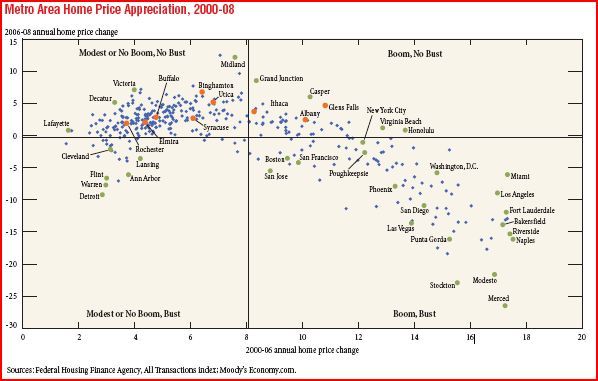
Is a homeowner in Glens Falls, NY any more "reckless, speculative, and foolish" than one a couple of hours down the road in Poughkeepsie? Poughkeepsie experienced a boom in prices followed by a bust, while high-performing Glens Falls experienced a boom with no bust. West of Glens Falls, my home town of Utica did pretty well too, as this chart illustrates:
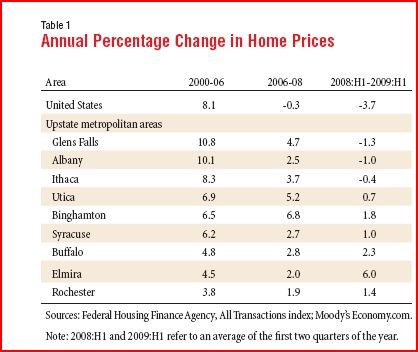
It probably helps that Utica experienced its financial collapse a long time ago, so housing prices were already unusually low.

Here's something interesting: The areas with stable housing prices had a much lower percentage of nonprime loans than the country as a whole. As the report's authors mention, the explanation for that probably "runs in both directions--an increase in nonprime lending led to more significant home price appreciation, and more rapid home price appreciation led to a rise in nonprime lending."

In other words, it was a cycle: Risky loans drove housing prices up, and climbing housing prices led to greater availability (and selling) of risky loans. That's not a borrower problem -- it's a pattern of lender behavior. It's a sign of banks driving a speculative frenzy as a "get rich quick" scheme, then leaving the borrowers with the wreckage.

Ritholtz makes some excellent points about the weakness of HAMP (the Home Affordable Modification Program), and its tendency to reward banks for their very real "moral hazard." The biggest problem with the revised HAMP program isn't that it's too generous to troubled homeowners. It's that it's a "pretty please" program that only requires lenders to consider lowering the principal on home loans (or, in the Orwellian language of the program's Fact Sheet, "servicers will be required to consider an alternative Modification approach" - "required to consider" being one of those self-contradicting phrases George Carlin used to rattle off, like "jumbo shrimp.")

But the idea of principal reduction -- whether it comes from HAMP or individual lenders like Bank of America -- is a reasonable one. Most reductions in principal will still leave homeowners owing more than their house is worth, which should give them their just portion of punishment for any "moral hazard."

"More foreclosures, please" is exactly what we don't want. Ritholtz is understandably concerned about the unfairness of "rewarding" homeowners who got in trouble in a way that keeps prices higher for those who behaved responsibly. But he paints an overly rosy scenario of bad actors being driven from their homes like poltergeists, so that new and vibrant families can move in -- families that can afford the mortgage and have money left over to spend in the local economy. The real solution is going to look less like a ghost story and more like Tim Burton's Beetlejuice, where the ghosts and the living learn to live together happily.

The millions of homeowners who got in over their heads have already suffered a lot. Let's get them some help. And let's keep the focus on the people who caused this problem: The bankers who got rich off these schemes, and the politicians and regulators who let them do it.
___________________

Richard (RJ) Eskow, a consultant and writer, is a Senior Fellow with the Campaign for America's Future. This post was produced as part of the Curbing Wall Street project. Richard blogs at:

No Middle Class Health Tax
A Night Light

Website: Eskow and Associates


Follow Richard (RJ) Eskow on Twitter: www.twitter.com/rjeskow


  • Comments
  • 326
  • Pending Comments
  • 0
  • View FAQ
Comments are closed for this entry
View All
Favorites
Bloggers
Recency  | 
Popularity
Page: 1 2 3 4 5  Next ›  Last »  (8 total)
photo
HUFFPOST SUPER USER
DebtNavigation
Attorney and Author
01:12 PM on 05/11/2010
The solution is cram down of principal residence mortgage balances in Chapter 13--it was there before '93 and it needs to be put back, or this crisis will grind on forever and a day. Wall Street will feed on it like they fed on the boom. Or, the American people could fight back on their own.

In Mexico in the mid-'90s Wall Street engineered a currency coup that tripled the debt owed by small businesses and family farms and also allowed for them to be massively ratejacked on top of it. Mexicans consequently formed the "el Barzon" movement and pushed back Wall Street and deposed their ruling party of 60+ years. In this country YouTube phenom Ann Minch has already declared the debtors' revolt and begun going after them http://www.revoltstartsnow.com

If you've been pushed under, you can read every other page of my book for free: http://www.scribd.com/doc/25443175/Debt-Hope-Down-and-Dirty-Survival-Strategies-Evaluation-Version-Complete
photo
HUFFPOST SUPER USER
OBroadhurst
My politics do not meet guidelines.
09:25 AM on 04/20/2010
Principle forgiveness on such loans is needed and necessary NOW

These loans would never have been possible but for deregulation urged on by the banks - so, let them reap the whirlwind for lobbying against America.
03:32 PM on 04/13/2010
It's the system that is rotten to the core and immoral.
11:10 PM on 04/04/2010
The officers who MADE the loans... and even the banks that issued them... sold them to someone else. Institutionally speaking, they "knew" they were going to pawn off these loans to someone else before they made them. All the bankers and officials...the people whose job it was to know how this stuff works... the ones who wrote up, reviewed and signed off on these junk loans... they all got paid... typically they got paid lots...some of them far more, bonuses, commissions, etc, because the loans, bad ones, good ones, were made...some of them received many millions of dollars. They keep that money, even if the companies they purportedly worked for subsequently went under, the mortgage holders lose their homes and their savings, etc.

This is NOT an equitable distribution of responsibility. The people MOST guilty of misconduct walk away with millions, while those with the least culpability lose everything.

I didn't get involved in this. The whole idea of entering into a contract where the other party could change the terms of purchase on me, after the fact, seemed like a bizarre leap of faith... I'd never have taken out a variable rate mortgage. But nobody can persuade me that it was fair or necessary to bail out the big banksters, and Wall Street, but leave the struggling home-buyers to drown. It WAS unwise to have trusted the banksters, but the breach of fiduciary duty was committed by the banksters, not the buyers.
This user has chosen to opt out of the Badges program
10:20 PM on 04/03/2010
It's a little bit funny that this new bailout for underwater homeowners comes just after the new big story of the new year; underwater homeowners sending their keys back to the bank and enjoying it big deal by spending the new saved money at Disneyland.
I think that this charitable bailout is de facto another bailout to the banks. We have been manipulated again and again for years. No reasons for it to stop.
05:47 AM on 04/03/2010
Is it fair for the responsible among us to have to pay for the irresponsible among us?

As it fair for people who have not wasted their money buying junk; that is- those who saved money, to get less than 1% in interest in a bank account?

Is it fair that the shareholders who lost money because they invested in banks that the FDIC closed should see the fat paychecks of the bankers who were bailed out?

Our neighbor, Canada, did not have the same problems in the housing market that we have. Why???
02:36 PM on 04/02/2010
I suppose it is no coincidence that the closing part of this article points to the bankers, the politicians and the regulators as being, for the most part, responsible for the horrific condition of millions of american home owners today.
But you know, dam it, regulators and regulations keep coming up at the center of the foreclosure subject right out of the de-regulation 90's...the era of the Bush Administration. It is not only banking, but de-regulation of the FCC, FAA and more, giving the high end money people the right-of-way to steal openly and with full abandonment.
It will take decades to recover some sanity in these areas...sure, some home buyers were ill-suited to attempt home loans, but there were supposed to be regulations and rules to ensure basic sound economic facts were in place for potential buyers, without which home loans should have been denied.
It took twenty-five years after the crash of '29 to get us going back in the right financial direction, (not to suggest that 1955 was the good-old-days).
I have Faith that things will correct with some sense of responsibility for returning our Middle Class to a state of wholeness, but I will admit my Faith is blind.
Peter Bright
03:28 PM on 04/02/2010
Don't try to do three things at once...I miss-stated myself above...I meant the early years of this Century and the era of the Bush Administration.....I think I need this holiday weekend to chill out...Happy weekend to you.
Peter Bright
02:08 PM on 04/02/2010
"Is that really fair?"

No.
Banks have huge organizations where the people who run them get together regularly and discuss the trend in policies, and even collude at times. They have people on the boards of federal reserve banks. What kind of access to complex info and market manipulation do homeowners as an ORGANIZED group have? None.

And let's not forget the people who DID FORESEE the trends, MANY YEARS AGO, like Brooksley Borne and several other people who actually made huge bucks betting the fall would happen? Bankers chose not to see that reality that was quite forseeable, and chose to risk the fall of the world out of pure greed. Banks are far more guilty because they accepted bad mortgages and sold them to investment banks, washing their hands of the risk in the process. Homeowners did no such thing, because they had less knowledge of the big picture.
This user has chosen to opt out of the Badges program
photo
01:21 PM on 04/02/2010
If we could bail the banks out, why can't honest people who could afford their home before the bubble be helped.
On the other hand, those who bought or owned a house, then used their home equity line of credit to buy new cars, take trips and go on a spending frenzy using their home as a piggy bank, should be let to sink. I had neighbors who did just that and now can't repay the equity loans and are losing their house. Hope they enjoyed all those trips to Las Vegas every month. They still have the three cars they bought with home equity money, too.
12:12 PM on 04/02/2010
If you don't own much of value, and don't earn much money (check the rules) use the credit card to pay student loans, move into an apartment, file chap 7 bankruptcy and get a job at wal-mart or mcdonalds (those are the service sector jobs Bush and Clinton promised us while offshoring manufacturing). It sucks, but with the government supporting offshoring of jobs through free trade, how can anyone expect to have or get a decent paying job. Ever see a 1950's housing area where the houses are 900 sq. ft.? We need to start living in something like that or in $1500 sheds like other countries with no jobs and stop paying life long interest on something we can't afford. Live beneath your means, save money, and hope for the best while preparing for the worst.
This user has chosen to opt out of the Badges program
photo
11:27 AM on 04/02/2010
I'm not teabagger or conservative, but we should foreclose on all bad loans and purge the system.
1- If you can't make the mortgage- regardless of fault- you need to lose the house. A bailout rewards people who took out loans they shouldn't have taken and rewards carnivorous banks.
2- Some of us were responsible, realized prices were too high, the loan terms ridiculous and decided to wait to buy when prices settled. We are the ones funding the bank bailout, paying the taxes funding unemployment and all the rest. Our chance at buying at a reasonable price is being wiped out by artificially propping up prices that are simply detached from reality.
3- Millions who have lost cars and homes in other times due to illness, unemployment or whatever were not bailed out and have had to rebuild their credit & lives the hard way. Try getting a job today, an apartment or whatever with a bad credit score- it's pretty impossible even in good times. Why should this bunch be special?
4- Fraud by either borrowers or lenders should be prosecuted to the fullest extent of the law- not just fines, but revocation of professional licenses for realtors, accountants, lawyers and the rest. Complicity is a crime when you know what is going on and play along for profit.
photo
MyFatCat
Slacktivist no longer
03:20 PM on 04/02/2010
Those positions are both conservative and not evenly well-informed.

1. Balderdash. The article comments, extensively, on the degree of asymmetry between what the banks know and what a prospective homeowner knows. The problem also shows in the consumer credit market, but in a different way: a lot of places insist on credit card guarantees because the banks ALWAYS have money. And it's insidious throughout life. Try getting a mortgage, a car, or a college education without debt.

2. I'm in this group with you. I don't want to see many people suffer due to the problems I noted in #1 just because a few undeserving idiots live in McMansions.

3. The fact that misery was extent in the past doesn't mean it should continue into the future if it's preventable. See point #1.

4. Agree with you on this one, but we can only get the justice we can afford. Congressional aides don't call the lobbyist waiting areas "Gucci Gulch" for nothing.
This user has chosen to opt out of the Badges program
10:10 PM on 04/03/2010
Prices are still too high in Los Angeles at least. By bailing out underwater borrowers you effectively keep out of the market would be entrants. Bailing out the banks was a huge mistake, let's not make another one.
Regarding the asymmetry, I don't agree. In 2004 I remember reading an article in the LA Times about a women who was buying an apartment she couldn't afford with a teaser rate loan. Asked what she's going do when IR will reset, she answered; they'll find a way. Bailout mentality was already in force.
HUFFPOST SUPER USER
mjc
Avoid printing any..
10:14 AM on 04/02/2010
For sure there were people seeking to take advantage of what looked to be a buyers' market two or three years ago but they all, or perhaps, most, had to go through a banker or mortgage lending institution. That's the bottom line. The price of most homes REQUIRES a bank with enough collateral to fund buyers. If the bank approved the loans, knowing what they should have been required to have known of the ability of the mortgage holders to re-pay the loan with interest, there should have been no problem; however, those loans were often sold to other companies, holding companies, who MIGHT have known the ability to re-pay as well as the bank that originally funded the loan. The greed of the banks...for more money than their mortgage loans...and the greed and responsibility of the holding companies who gathered more and more loans to their bosom, unafraid of foreclosure for the people who bought the homes...because they would reap their funds anyway.., such practices only led to failure, for the homeowners...not for the banks or holding companies. Bottom line: banks are in business of lending but with many focused restrictions, the goal, recouping their funds plus interest.
10:35 AM on 04/02/2010
Very good description of what happened.
08:47 AM on 04/02/2010
The boom and bust may have seen irresponsible and reckless behavior by lenders and homebuyers alike, but who was left holding the bag and who got away with the cash?

Just follow the money.

Sub-prime candidates were targeted and conned into mortgages. This was a top-down driven scam with Wall Street incentivizing and pushing for ever increasing numbers of mortgages with fewer restrictions and higher fees. Aggregators assured agents there was no need for scrutiny due to the lax standards and naked greed emanating from on high over at Wall Street, where hucksters securitized the dreams of America’s most vulnerable citizens and peddled them off to the Chinese with the U.S. Treasury picking up the tab for the under-funded, unregulated, credit default swap insurance policy.

Give me your tired, your hungry, your poor and we’ll convert it to cash.
10:37 AM on 04/02/2010
And they did convert it very well, at the same time demonizing those they victimized.
This user has chosen to opt out of the Badges program
11:06 AM on 04/02/2010
and then they fought for bankruptcy reform legislation while they were cradling borrowers with debt that was unsustainable.
This user has chosen to opt out of the Badges program
photo
08:45 AM on 04/02/2010
So why is the "moral" middle class in so much trouble? Because we pay our taxes (and don't have off shore havens?)? Because we contribute the single biggest percentage of charitable funds per income of any group? Because some of us had to take care of our parent(s) and GRANDparent(s) in the mid oughts and had to buy at house at that time, looked for over a year, put 20% down, rehabbed what we did get, and still are underwater now? Because we are the hardest working group IN THE WORLD (by production measures and hours worked)? Because we can read and write? Because we don't buy it that being lied to by corporate giant advertising, bank lenders, politicians, or religious leaders is OK?
photo
FirstGame72
The Sleep of Reason Produces Monsters
09:35 AM on 04/02/2010
Reticent, I'll answer your question quite simply. The reason the middle class (and lower middle) is now in so much trouble is that we have not stuck together, watched each other's backs, and most-of-all VOTED AS A BLOCK for only those politicians who would MOST watch out for our interests.
When do you think the last time a Democratic candidate for President (ie the candidate who would most look out for the interests of the middle class) received even 30% of the votes of all eligible voters (not just the people who voted but including all those who could have voted)?
Let's face it, when a tiny percentage of the public - the super rich - steal from the rest of us, who do we blame and who do we turn against in anger and hatred? Each other of course. There's no winning with that formula.
10:42 AM on 04/02/2010
I agree. It's time we stopped celebrating the criminals because they make more than the rest of us. It's time we looked at exactly how they make their wealth and insist they play by the same rules we have to.
This user has chosen to opt out of the Badges program
photo
06:02 PM on 04/02/2010
See what I posted below. It's called rhetorical question by the way.
This user has chosen to opt out of the Badges program
photo
11:33 AM on 04/02/2010
The 'middle class' is a myth. I love how someone in year one of a 30 year mortgage is called a homeowner when all but a couple of cents of their mortgage is pure interest. You are a homeowner when you have burned the retired mortgage and have no lien on it.

Tens of millions have kept up the illusion they are 'middle class' by living beyond their means,-not saving for retirement or their kids education, etc.- so they can lease a BMW, buy trendy clothes and have a Mc Mansion in the gated community. They used to call it being a poser.

It's time for reality to rule the day.
This user has chosen to opt out of the Badges program
photo
06:04 PM on 04/02/2010
Hey jerk- we have one car that is 6 years old we paid CASH for. Otherwise we ride bikes and walk. We also take care of two elderly people and two small people. Generalize about the keeping up with the jerks people to the small percentage it is, and leave the rest of us hard working, rational folks out of it.
photo
HUFFPOST SUPER USER
den1953
The best politicians are for free!
08:20 AM on 04/02/2010
The problem is when your in over your head and can't get the government to bail you out because your not wealthy then i guess the only thing left to do is bail,you would think anyone that got hooked up in this mortgage mess would have learned there lesson but it still goes on. I guess you can't teach a horse to drink after twenty times.
10:50 AM on 04/02/2010
Thing is the average man operates under different laws and mores than corporations. Those that haven't bailed our of their underwater mortgages haven't done so because they've been told that would be morally wrong and will injure their credit rating. What they fail to realize is credit ratings are just another game the rich and powerful use against our best interests. They don't realize the game is stacked against them. They'll never be allowed to play on an even playing field. That would infringe on the profits of the wealthy and powerful that have dibe and will continue to do everything in their power to exploit the average person with the complicity of the government tying the average person's hands.