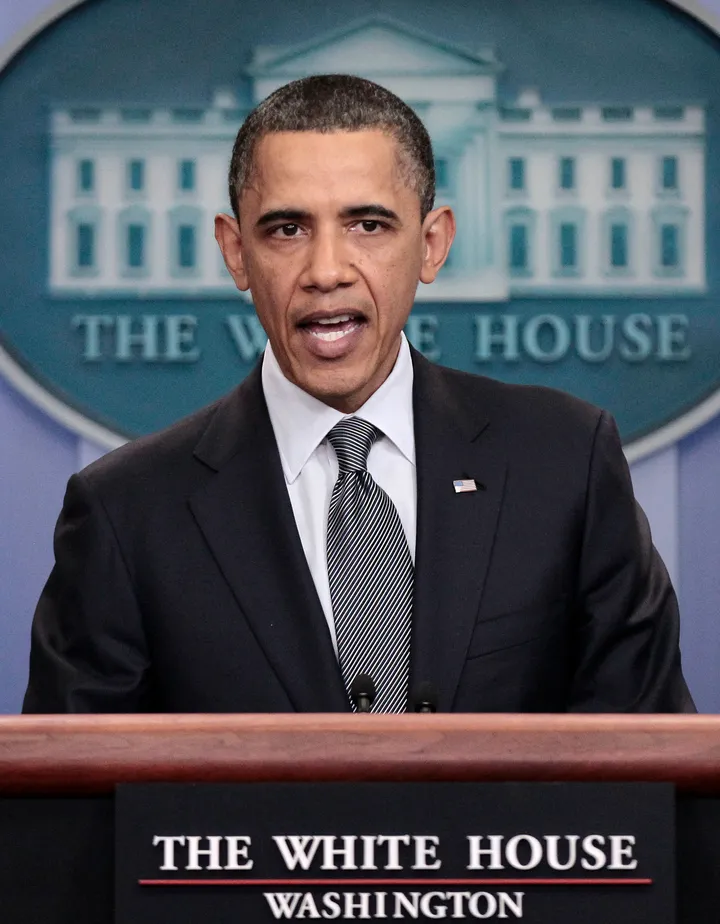
The President speech on the Federal deficit marked a brilliant return to what might be called his "holographic" style. Like a hologram, the President's speech was beautiful and evocative and shimmered with light. But like a hologram, what you see depends on where you stand.
Many progressives will hear a brilliant defense of government's role in the economy, and of the role that progressive taxation plays in a fair-minded economic system. Conservatives(those who aren't absolutely nuts) will hear a ringing endorsement of a plan that would downsize government and benefit the wealthy. And they'll love the President's "debt triggers," which could force the government to enact drastic cuts if targets aren't met.
This holographic quality, the ability to present himself as all things to all people, is the President's unique gift - unless, in the end, it turns out not to have been a gift at all.
What were the positives in the President's speech? It made a long-overdue case for government's vital role in society. It skewered the conservative notion that taxing the rich is unfair. And it took the right approach to Medicare by emphasizing the need to cut costs, not benefits.
Here's what the speech didn't do: It didn't emphasize the fact that we're in the middle of an ongoing jobs crisis, one that's left entire regions and social groups in a full-scale depression with no end in sight. It didn't explain why we urgently need short-term investment to reinvigorate the stagnant economy and avoid a double-dip recession. And the speech didn't tell us where the President stands on the most contentious budget issues..
Most of all, the President's speech failed to shift our national debate away from its obsessive focus on deficits - an obsession that's crowded out even more urgent problems like joblessness and the decline of the middle class. Polls show that the public considers the stagnant economy and unemployment to be much more pressing problems than the deficit. The President didn't move our national priorities toward these concerns, which are our greatest economic challenges. As long as deficits continue to dominate the debate, neither the President nor the public can win.
In the end, the President's actions will outweigh the impact of any speech he might give. The President's ambiguity means that his positions are still a work in progress. In one sense that's good news. It means they can still be molded by political pressure. The public still has time to call on the President to do what's needed: protect Social Security, preserve Medicare, assist the needy, and rescue the dying American middle class.
Here's an overview of the speech: the good, the bad, and the holographic.
The Good
President Obama gave as brilliant a defense of government's role as we've seen in a generation. After decades in which paying taxes, even for billionaires, has been characterized as "oppression," these Presidential words were refreshing and urgently needed:
As a country that values fairness, wealthier individuals have traditionally born a greater share of this burden than the middle class or those less fortunate. This is not because we begrudge those who've done well - we rightly celebrate their success. Rather, it is a basic reflection of our belief that those who have benefitted most from our way of life can afford to give a bit more back. Moreover, this belief has not hindered the success of those at the top of the income scale, who continue to do better and better with each passing year.President Obama also explained the real causes of today's deficits in clear, direct terms:
We increased spending dramatically for two wars and an expensive prescription drug program - but we didn't pay for any of this new spending. Instead, we made the problem worse with trillions of dollars in unpaid-for tax cuts - tax cuts that went to every millionaire and billionaire in the country; tax cuts that will force us to borrow an average of $500 billion every year over the next decade.The speech included a number of moments like these, and President Obama is to be commended for them. Most of all, he deserves credit for this important observation about Republican budget proposals: "Their vision is less about reducing the deficit than it is about changing the basic social compact in America. "
To give you an idea of how much damage this caused to our national checkbook, consider this: in the last decade, if we had simply found a way to pay for the tax cuts and the prescription drug benefit, our deficit would currently be at low historical levels in the coming years.
The President's praise for their leadership was a jarring and odd moment, even as a tactical move, especially since the Commission became hopelessly deadlocked under their leadership and failed to produce a report (although the President, like others, continues to cite that non-existent document when referring to a proposal issued by co-chairs - one which merely states their own opinions, rather than those of the Commission.)
The President suggested that he would "borrow" from Bowles' and Simpson's personal suggestions in crafting his own deficit reduction plan. But the President's rhetoric was inconsistent with the personal ideas of these two gentlemen,which came to be widely - and falsely - described as the "Deficit Commission proposal" by the careless reporters (and by the President today). That proposal1 would impose harsh benefit cuts on the elderly (elderly women would be hurt most of all). It would result in millions of lost jobs and would have a racially discriminatory impact. For Medicare, our gravest financial challenge, it would merely shift exploding healthcare onto older Americans, rather than actually controlling them.
The Simpson/Bowles proposal shrugs off the cleanest, most effective, and most publicly-supported solution to its long-term actuarial imbalance: lifting the payroll tax cap. Instead, the two individuals offer Draconian cuts that are neither humane nor necessarty. These cuts are sugar-coated - slightly - with a slight boost in benefits for the deeply impoverished (although Social Security is a self-funded form of insurance, not an antipoverty program) and a very slight benefit boost for the "very old" - a boost that would favor those wealthier (and whiter) recipients who live much longer on average.
In his gravest omission, the President failed to mention the 24 million Americans who are unemployed or under-employed. That mean he failed to shift the political center of gravity away from deficits and toward the millions of Americans who might be helped by short-term government spending.
The Holographic
By appearing to embrace the Simpson/Bowles proposals, the President stirred the hearts of those who want to see their conservative (marketed as "centrist") agenda imposed on the nation. But his rhetoric also gave encouragement to those who see that agenda for what it is: A rollback of the American dream and a vehicle for transferring even more national wealth to the already-wealthy. The President spoke stirringly about vital government programs, yet didn't indicate how deeply he would fight for them.. He offered "debt triggers" that would force additional spending cuts or tax increases, but the impact of those triggers remained cloaked in vagueness and the uncertainty of the future.
The White House seems to have floated quite a few trial balloons before the speech, which led to contradictory news stories that either suggested he would make a bold pro-government stance or embrace the draconian cuts in the Simpson/Bowles plan.
In the end he did both. If you're concerned about preserving our social compact, it's more important to make your feelings known now than it has ever been. The President has spoken. Now it's your turn.
______________________
1 See "10 Reasons the Deficit Commission Proposal is Still Unconscionable and Unacceptable" (it was still a draft Commission proposal, rather than the co-chairs' personal recommendations, hence the title).
For more on public opinion and the public's priorities, see:
The New Silent Majority
... the Wisdom of the American Public ...
The Six Percenters
Richard (RJ) Eskow, a consultant and writer (and former insurance/finance executive), is a Senior Fellow with the Campaign for America's Future. This post was produced as part of the Curbing Wall Street project and the Strengthen Social Security campaign. Richard also blogs at A Night Light.
He can be reached at "rjeskow@ourfuture.org."
Website: Eskow and Associates
Follow Richard (RJ) Eskow on Twitter: www.twitter.com/rjeskow
This is logic out of Orwell or Koestler's 'Darkness at Noon.' Obama is telling us he is a true Dem but that right now history and rationality are helpless to confront the terrible crisis that awaits America if it doesn't abandon the New Deal. The real crisis of unemployment, severe recession, and the demise of the middle class disappears behind the smoke and mirrors of the alleged "fiscal crisis," and this justifies preemptively selling out to the Repubs.
The "fiscal crisis" is a Repub fiction designed to increase the wealth of the plutocracy and destroy the New Deal, and Obama is willingly contributing to this fiction. We need a Dem primary challenger.
http://www.rasmussenreports.com/public_content/politics/obama_administration/obama_approval_index_history
Trump 2012. Watch for it.
And why over a 12 year-period and not a decade? Had to add a couple more years of "savings" to get to $4 trillion. I'm happy he has joined the conversation about our nation's finances, although a cynic would ask why he didn't lead with his recent budget propsal.
For those who feel that we shouldn't worry about the deficit, let's ignore Moody's and the IMF. Then we'll watch borrowing costs soar and see how much better things are then.
If there's to be a battle over the budget, spending, the deficit, then Obama has to be willing to fight to win, i.e. continue to go before the public consistently to remind them what Democrats stand for and what Republicans oppose at every turn - a budget that benefits the majority of Americans, not the wealthy few.
As far as progressives go...we've got to keep pressure on both sides. Remind the President and ALL Dems in Congress who and what they're supposed to be representing while reminding Republicans we have no intention of allowing them to further destroy America with their "take from the need and give to the greedy" philosophy.
A deficit we can never control, Gas at $4.00 gallon, unemployement at 9%, the housing market free falling, people losing their homes, values dropping by 40%
Why - well lets see could it be all the failed policies of the Dems/Commies/"Progressives" in the last 4 years?
You know the last 2 years of Bush's presidency controlled by Dems in congress and senators, installing programs like everyone gets a mortgage even if you can never pay it back.
America has had enough of "progressive" creating class warfare (all the while, they skim off the top for their own needs) You know the "share the wealth" mentality but the problem is ITS NEVER YOUR WEALTH THAT GET SHARED!
Exactly like the teachers- They voted for the party of "share the wealth" and when it came time for them to pay just a tiny bit into their pension, medical, what happened?
Strikes, marches, protests, storming the capital building-- how pathetic.
We didn't mean share OUR wealth - just your wealth!
That is the mentality of "progressives".
The class warfare destroying our country is the war against the working poor and the middle class, the haves and have mores want it all. Seems they have just about accomplished their goal....
List of causes: out of touch with reality.
Tax cuts on the wealthy that turned surplus into deficit: Passed by a Republican controlled Congress. Signed by a Republican President.
Failure to regulate mortgage markets and speculation thereon, directly leads to current economic situation: Republicans in charge of executive branch. (See also Republican regulators downloading porn when they were supposed to be overseeing mineral extraction.) Give Slick Willie some, but not all, of the credit for signing Gramm-Leach-Bliley (a Republican wet dream if there ever was one).
You're like an arsonist who complains about his house burning down.
My biggest problem is on the substance -- once again, the president has put together a proposal that might have been a good endpoint for a bipartisan compromise, midway between the progressives and the lunatic fringe. Unfortunately, it will be treated by the news media and the powers that be as a starting point, meaning the end result will give the Republicans pretty close to 100 percent of what they really wanted all along.
So he says he won't allow the tax cut ENTITLEMENTS for the rich to be extended? I'll believe it when I see it. Further investigation into his actual proposal reveals that he cuts social programs $3 for each $1 cut from defense. That is what I mean by his starting from a weak position and then compromising from there. We are so hosed.
Housing and charities may not be the "entitlements for the rich" that many progressives are protesting. People should take a closer look at what is being proposed before they come down on supporting or rejecting the plan. Same with the Repub plan.
1. This year, we will still spend more than we did last year.
2. Next year we will spend more than we did this year.
3. Over the next decade, there will be no reduction in debt.
4. Our federal reserve will help congress spend by inflating our currency.
5. We all will be worse off because of it.
There is no change coming, the president did nothing more than make a campaign speech yesterday. And, the Republican party is not serious about becoming fiscally solvent.
In truth, NO CUTS are really needed at all. All that's needed is to collect the corporate taxes already owed and unpaid, repeal the tax cuts for the top 2% of the wealthy, and eliminate oil subsidies. That's over a trillion dollars that should be in the treasury and isn't.
Other things that can be done - but harder to do - repeal Medicare Part D which costs billions but was never included in any of Bush's budgets after being passed; repeal No Child Left Behind....same reason; and overhaul of military spending procedures.
While people allow themselves to get brainwashed with the idea we're spending too much, the truth is we're really not. We're just not collecting the amount of money that's legally due us.
You contradict yourself within your response, you state that we do not have a spending problem, but then give me a list of things to cut from the spending or overhaul. The reality is, the DoD is unauditable as are other organizations within the federal government. The federal government is not responsible with the money they extract form the country and therefore it should be limited.
You can brainwash yourself into thinking that soaking the rich will bring on prosperity, but the reality is, that never lasts. The thirst for growth from the federal government will not be satisfied by those in the upper incomes. When the16th amendment to the constitution was enacted, it began with a modest percentage of income tax. The lowest rate was 1% on income under 20k and the highest was 7% on income over 500k. Through the welfare / warfare state those number increased dramatically due to the need for funds. The rich get soaked as do the poor. Perhaps examining the federal foot print and its services is a better course of action.
WE ARE SPENDING TOO MUCH
WHAT PART CAN''T YOU COMPREHEND?
This president hits the right progressive notes and syncs the words but his actions always reveal his true agenda. And that includes marginalizing and insulting the base (recently framed as good politics although his progressive posturing is what got him elected). Political pressure is referred to as "whining". Think of how the progressive caucus was threatened, while the minority Blue dogs were given starring roles. The Right bows to tea party pressure because the tea party ultimately promotes a corporate friendly agenda. The progressives oppose a corporate-friendly agenda so they are ignored by the corporate media and both corporate-friendly parties--even when progressives reflect the majority consensus. Obama can not be moved by political pressure from progressives--he doesn't even seek bi-partisan unity with them--his intent is to ignore them--until it comes to election time when he recites the right lines again--like a well-oiled performance.
I don't want a president who bows to or is molded by public pressure, which can be nothing but the heat of the uninformed moment.
The last section of your post is your opinion, not everyone agrees with this.
What is this? Liberal bashing? Interesting that you would take up the rightwing agenda without engaging in any critical thinking at all--you just automatically echo the words you hear repeated over and over again.
The fact that you refer to Obama's ongoing failure, deceptions, capitulations and betrayals as little more than his limitations means that you will unthinkingly accept everything and anything and attack those who seek to force Obama to represent the citizens over the corporations. It is not as if these issues are arbitrary--but so often true believers are enamoured with the trappings --the performance, the obviously modulated tones, the conversational intimacy, they are willing to be blinded and remain in denial--even if the price is their own eroded standard of living.
"I don't want a president who bows to or is molded by public pressure, which can be nothing but the heat of the uninformed moment."
This is pathetically sad. What is it you want? A pop star hero you can pin on your wall and drool over? A crush?
Progressive's don't oppose a "corporate-friendly agenda"; we opposed being financially raped by an overly-friendly, lay down and let ourselves be walked on corporate agenda.
It's obvious that the ripest area for cuts is our bloated defense budget, WHICH EXCEEDS THE REST OF THE PLANET COMBINED. Cutting overseas spending will not damage the domestic economy. Start by getting out of Iraq and Afghanistan! Other program cuts can have unintended consequences (intended if you're a Republican), reigniting the recession. Cutting social programs will have direct and indirect harmful consequences. (The uninsured are a cost to the system).
Obviously we need to address the revenue side. Creating jobs with targeted spending on infrastructure, unemployment, etc. will accelerate money through the economy. Raising taxes on top earners will accelerate their payback of money borrowed from payroll taxes over the last 30 years to finance unwise income tax cuts. It's more than fair. Within a few years we could pare down the deficit to a manageable 400 billion or so. Once the economy gets rolling we can start paying down the debt and amortizing future costs of Medicare.
If this be Class Warfare, Bring em on!
People with cash want more, and they will invest, trade, build companies, hire workers and many other things to get more. If all of these things are excessively taxed, it lowers the incentive to do them.
That family owned print shop – raise their taxes! It will result in them cutting back on expenses, and business tends to have high labor expenses.
The super rich, like the Kennedy family, will never pay taxes. It is already overseas. Soros will never pay a dime in US taxes in spite of his US investments. The rich that will be “soaked” will be small and mid sized business.
Every time taxes are lowered, MORE money comes into the federal coffers. That is why Obama lowered taxes on the rich. It brings in more money. Lets both get behind bringing in more money. lets move to a better place on the laffer curve.
Since the early 80's it has reduced take-home pay by about 12.4% at the low-middle end of the income scale. As to the EITC, it doesn't adequately offset the payroll taxes on low wage earners. Do away with it. Enact simplified progressive taxation, with a zero tax base of low income workers and about four brackets. In the short run I would surcharge millionaires (as Trump suggested a decade ago). Once the economy gets rolling: proposed tax revenues = budgeted spending + 30-40 year amortization of debt and Medicare.
Wall Street Journal editorial this morning: "blistering partisanship," "multiple distortions," "fundamentally political document," "three significant tax increases—via higher top brackets, the tax hikes in ObamaCare and fewer tax deductions."
"The speech he chose to deliver was dishonest even by modern political standards."
That is how the debt gets "lowered".
The most ominous line in the speech was when Obama said he is attracted to the idea that you shouldn't cut deficits during a recession but that the urgency of the moment demands action now. This is pure intellectual whipped cream. He gave no defense for this major claim, which denies not only Keynes but the common sense of the majority of economists who associate in any way with the Dem Party. Translation: "Folks, I now believe in supply-side, trickle-down Republican voodoo economics. Hail St. Ronnie." In the name of a fake deficit crisis, everything now seems negotiable. We are in free fall.