The word for today is "choice," not "crisis."
It's time to stop saying the country "can't afford" Medicare, Social Security, or other programs that benefit the middle class. If I told my mother that I "can't mow the lawn" or "I can't do all that homework" when I was a kid, she'd say: "Don't say you can't. Say you don't want to." (The outcome of these exchanges was inevitable. Hello, lawnmower ...)
Now we're told there's a "crisis" and we can no longer afford the middle-class American dream. The truth is the opposite: Our long-term problems aren't caused by the middle class, but by politicians who choose to sacrifice the middle class for wealthy interests.
All this talk about a "debt crisis" is a way for politicians to avoid telling the truth: They'd rather say they "have to" sacrifice the middle class than admit they're making a choice.
"It Needs to Happen"
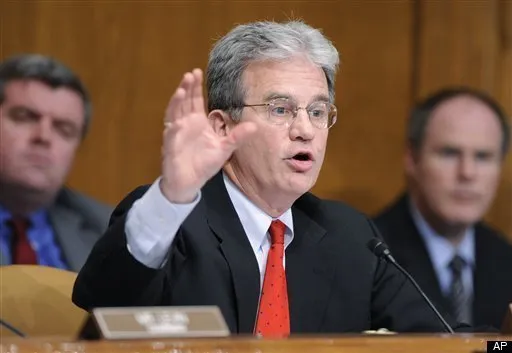
A comment today from Sen. Tom Coburn reflects the 'crisis mentality' masking today's choices. Sen. Coburn reportedly withdrew from the "Gang of Six" Senators trying to craft a budget-cutting deal. According to a report in the National Journal, Coburn said the Senators "can't bridge the gap between what actually needs to happen and what people will allow to happen."
The Journal described the "gang" as "the group most likely to produce a bipartisan deal that combined deficit reduction and tax changes that would allow a rise in the nation's debt ceiling." So that, we're told, is what "needs to happen." But is it?
First, note the choice of words: "tax changes" rather than "tax increases." Tax increases for the wealthy are off the table, but they don't want to admit that. And "deficit reduction" is being used here as a euphemism for "spending cuts." We're in an artificially-generated crisis brought on by tax cuts and two wars. Their tax "changes" would hurt the already-damaged middle class even more by taking away tax deductions for health insurance, mortgages, children, and other breaks they desperately need right now.
Last week's reports from the trustees for Medicare and Social Security were a perfect illustration of how the game's being played: First, create a problem by serving the privileged few. Then use that problem to explain why we can't afford financial security for the middle class. Then do it again. Unless this cycle is broken, it will become a death spiral for the American dream.
It didn't have to be this way. It still doesn't. These changes don't "need to happen" at all.
Social Security Spin
Make no mistake: Despite what you may have read, cuts to Social Security and Medicare are still very much on the table. They're just likely to be disguised as artificial "ceilings," "triggers," or other gimmicks designed to protect politicians from accountability.
Social Security's projected long-term shortfall isn't caused by baby boomers entering retirement. Social Security has a $2.6 trillion trust fund because planners have known about the baby boom for many years (not an impressive achievement, since the last one was born in 1964).
The main reasons for the long-term shortfall are stagnating wages for most Americans, and the fact that the wealthiest Americans capture far more of our national income than at any time in modern history.[1] That's because politicians made choices - about deregulation, banking, government investment, trade, and other key issues.
A bipartisan commission led by Alan Greenspan restructured Social Security during Reagan's Presidency. It solved its financial problems, which were very real then - or it should have. But even the crusty old libertarian Greenspan didn't realize that the rich were about to hijack so much more of the nation's income, or that wage growth for everyone else would flatten so badly. Social Security is funded by a payroll tax that cuts off at a specified level (currently just above $106,000). But these changes - the result of political choices - mean it's too low to keep the program going indefinitely.
Social Security's long-term projections are slightly less favorable under the latest report. One reason is that they're now expecting people to live about six months longer. As Dean Baker points out, longer lives are a good thing. As Baker also points out, the change is trivial as far as government deficits are concerned.
But it's also important to remember that life expectancy isn't fair or democratic: People with more money have much longer lives, and white people live longer than African Americans. Those who want to cut Social Security benefits because "people are living longer" are just creating another way for middle- and lower-income Americans to lose and wealthier people to win.
Social Security's long-term finances are out of balance because politicians made choices. Now we have another choice: ask the wealthy to pay their fair share, or cut benefits for people who didn't cause the problem and can't afford to pay for the solution.
Medicare: Tougher Choices
As for Medicare - well, Medicare's The Big One. In the long run, all other government spending pales in comparison. Exploding health care costs are tomorrow's biggest problem.
They're today's problem, too: Middle-class families are struggling under the weight of exploding health care costs. Even those lucky enough to have employer health benefits are paying more of these costs out of their own pockets.
These costs are devastating for working Americans. Out-of-pocket health expenses for a family of four with insurance have more than doubled in ten years, from over $9,000 in 2002 to more than $19,000 in 2011. They went up more than $1,000 last year alone.
And remember: Those "tax changes" we hear about could cause these out-of-pocket costs to jump by twenty or thirty percent overnight.
The same health costs that are crushing American family budgets today will swamp the Federal budget in a few short decades. But Republicans aren't proposing to control these costs for Medicare. The budget passed by the House simply shifts them onto the backs of the elderly. Nobody's willing to have the discussion we we urgently need, about ways to eliminate inefficiencies, bad incentives, and excessive healthcare profits.
We'll face a tough set of choices. But the longer we wait and let ourselves be distracted by false arguments about vouchers or benefit caps, the tougher it will get.
Jobs + Growth = Healthier Entitlements
Both Social Security and Medicare took a financial hit because of unemployment, too. Right-wingers are using the increased and ongoing deficits in these programs as damning evidence that we can no longer afford financial security for middle-class Americans in their retirement years.
But unemployment didn't happen in a vacuum, either. Politicians made a choice to block more government investment in jobs and economic growth so that those tax cuts for the wealthy could be preserved.
The middle class has already endured years of record-high unemployment, wage stagnation, and sluggish growth because politicians chose to protect tax cuts for the rich, rather than investing in a thriving middle-class America. Now it's being asked to sacrifice its senior years for the same reason.
An honest debate
Dave Johnson points out that today's deficit scare talk looks a lot like other manufactured debt crises, such as Canada's in 1993. Rather than letting politicians scare us, we should demand they give us an honest debate. If some of them would rather keep taxes low for the wealthy, and would sacrifice the middle class to do it, let them say so.
If other politicians - in the Democratic Party or elsewhere - recognize what's happening and disagree with it, they should say that too. They should stop being coy and start leveling with the public, even if it temporarily makes unpopular and necessary "bipartisanship" a little more difficult. The public will thank them for it.
Wealthy Americans and corporations have enormous political influence. That means it's easier for politicians to say "We can't afford today's Social Security and Medicare" than it is to raise taxes on the wealthy and move away from our dependence on for-profit healthcare. But every time they say that somebody should hit 'em with Mom's words:
"Don't say we can't. Say you don't want to."
_______________________________________________________________
[1] See, for example, Bivens, L. Josh.
Richard (RJ) Eskow, a consultant and writer (and former insurance/finance executive), is a Senior Fellow with the Campaign for America's Future. This post was produced as part of the Strengthen Social Security campaign. Richard also blogs at A Night Light.
He can be reached at "rjeskow@ourfuture.org."
Website: Eskow and Associates
Follow Richard (RJ) Eskow on Twitter: www.twitter.com/rjeskow
Sen. Carl Levin: Time to Fight Conflicts of Interest on Wall Street
Chris Weigant: The Full 2012 Republican Field
Daniel Marans: Ryan Budget Fast-Tracks Social Security Cuts
Sen. Dick Durbin: Social Security Cuts Should Not Be Ruled Out ...
It would be worth you time to google her. She has been on TV shows and comes down against Simpson's plan. She was on his deficit commission and voted against the health care plan. She has created a good plan.
There are others but I can't think of their names right now. I will post them when I think of them.
You state, ‘Exploding health care costs are tomorrow's biggest problem.’
You are right. The PPACA did not address the problem of medical care in the United States, but rather who pays for it & that was the wrong battle to fight. The costs are going to continue unabated until we work to make the markets more open, more competitive, & less litigious. Competition is the real manner in which to bring prices down, not price & provider controls.
You state, ‘The same health costs that are crushing American family budgets today will swamp the Federal budget in a few short decades.’
Which really means American families who pay tax. All you did was make big medical costs mandatory for everyone…every year.
You state, ‘Politicians made a choice to block more government investment in jobs & economic growth so that those tax cuts for the wealthy could be preserved.’
Rightly so. Since stimulus creates no lasting jobs & sustainable jobs need to germinate at the private economy level, not through government make-work programs, or worse, transfer payments.
You state, ‘Dave Johnson points out that today's deficit scare talk looks a lot like other manufactured debt crises, such as Canada's in 1993.’
Thanks for pointing out! They were in bad shape in the early 90’s now they have one of the best economies in the world, all predicated on government spending & tax cuts. Next year they want to reduce corporate tax to 15%.
Kai
I can see where you might get that idea. Tax cuts in themselves do not produce immediate jobs but they do produce long-term sustainable jobs.
You state, ‘The fact, a fact most people acknowledg¬e, is that the wealthy have created jobs only in Asia, & a few in Latin America.’
America has been the number one destination for FDI in the world for decades, I think we still beat China but I may need to check, regardless we will be a close second. Preferential tax rates help attract capital. But the composition of the rich has changed over the last several decades & the people that we rich in the 1970’s are not the same people that are rich today, several new industries have started, small industries like Microsoft, Apple, Google, Ebay, Facebook. All of those companies started with seed capital from rich people…thus creating jobs…in America & globally.
But the best thing is that the tax cuts have not cost us much & that we collect as much in tax revenue today a percentage f GDP that we always have.
Bad government policy, combined with falling education & skill levels & changing demographics is what has changed the make up of the workforce & the middle class. Technology that has disintermediated the jobs that used to allow unskilled labor to still maintain a middle class income are quickly disappearing. Not the fault of the rich, more the fault of the unskilled who did not pay attention in school.
Thanks for another amusing article.
You state, ‘We're in an artificially-generated crisis brought on by tax cuts and two wars. Their tax "changes’
I totally agree with you about the wars but we collect as much tax revenue recently (correcting for the recession of course) as a percentage of GDP that we did in the late 1950’s, about 17%-18% despite going through several tax cuts in the last 5 decades. Why? Lower tax rates make it up in increased economic activity and volume. So tax cuts are not the problem. So it must be spending.
You state, ‘even the crusty old libertarian Greenspan didn't realize that the rich were about to hijack so much more of the nation's income, or that wage growth for everyone else would flatten so badly.’
True. Changes in technology and the value of intellectual and financial capital have increased the economic mobility of the those with specialized skills and education, but the increase in wealth at that top did not hinder the poor and middle class from also recognizing gains, which they have.
You state, ‘Now we have another choice: ask the wealthy to pay their fair share, or cut benefits for people who didn't cause the problem and can't afford to pay for the solution.’
Or yet another more practical choice, reform entitlement programs to be more sustainable.
Kai
Higher (punitive) taxation on the top earners offers the opportunity to introduce "carrots" in the form of exclusions for investment in our economy. That investment creates jobs that create other jobs and business opportunity and a multi-layered taxation system that takes a percentage of the flow of capital at every change of hands. The middle class spends almost all it's income and generates demand for goods and services which all equate into taxing opportunities. This was the methodology applied in the 40's, 50's and 60's that created America's middle class and made it the envy of the world.
Our tax and funding structure is based upon taxing the middle class. The wealthy didn't actually pay any more tax under the 90%+ rates than they do now. The difference is that they were "herded" into beneficial use of their wealth by taxation and exemption. Now, we have the exemptions without the higher rates, which often results in negative taxation for business, as in the case of the oil subsidies and GE.
You claim, ‘As the generation of the GDP is concentrat¬ed at the top of the income scale, as it has been for the previous three decades of "trickle down" vodoo economics, taxing it becomes a single tier factor in the equation of our complex economy.’
We have been decreases taxes since Kennedy (the single biggest tax decrease before Bush) and in that time tax revenue has stayed constant as a percentage of GDP, about 17-18%. So no budget impact there. More importantly, true that taxes went down for the rich, but they went down more for the poor. In fact, Bush created a new low income group to ensure that they got more tax relief than the rest of the nation. That is technically, trickle up! Regardless, in that last 30 years, wages for everyone has gone up in real terms, the rich maybe more than the poor, but that is to be expected as the value of intellectual and financial capital increases in value relative to unskilled labor, which is getting disintermediated by machines. Not the fault of the rich that the unskilled are unskilled.
You state, ‘If we taxed the entire incomes of those above $250k we still would not properly finance government and maintain the nation's infrastruc¬ture.’
True, because we do not have a revenue problem, we have a spending problem
Kai
You claim, ‘Higher (punitive) taxation on the top earners offers the opportunit¬y to introduce "carrots" in the form of exclusions for investment in our economy.’
No it doesn’t, it incentivizes them to relocate their wealth out of the US. More importantly, it disincentivizes those with intellectual or financial capital to bring their capital to the US. Why would they if you are going to penalize them for doing so, with punitive taxation. We have already seen fallout from these types of class warfare policies in Europe when they were tried. It is one of the reasons that the best and brightest that Europe has, work in the States, which is our gain.
You state, ‘This was the methodolog¬y applied in the 40's, 50's and 60's that created America's middle class and made it the envy of the world.’
Yeah back when the world economy was more autarkic, and Europe and Asia were stilll trying to recover from WWII. Those days are gone my friend and industry and the wealthy have other options. Canada will be reducing its corporate tax to 15% next quarter. In the early 90’s they realized that big governemnt and high tax was killing their economy.
Kai
The article writer thinks the same as I do.
What do you think the budget battle was about?
WHO gets the money....all for the upper classes or do the lower classes get or keep some.
------------------------------------------------------------------
What do you think the debt ceiling is about?
Despite what the tea baggers think, it is really not (just) the deficit.
It is again a fight over WHERE the government spends money....on the upper classes only or some for the lower classes.
------------------------------------------------------------------
Think about it....The Repugs will NOT raise taxes, but have no problems cutting medicare and (eventually) social security.
And I don't quite trust the Dems....they just are NOT fighting hard enough for the lower classes.
This is really good, old fashioned class warfare.
After the Great Depression, the wealthy were chastised and even a bit scared.
They accepted regulations on Wall Street and for banks.
They realized that a strong (and happy) middle class was in their and the country's best interests.
Time marches on.
The lessons of the past are forgotten.
We have a new bunch of oligarchs and politicians.
Either the politicians can cater to the Rich and their wants and demands only....or they can give some of the nation's bounty to a flourishing middle class.
However, the Wealthy want it all....and they buy and pay for the politicians who are more than willing to do their bidding.
If you want to see class warfare....just look around you.
America 2011.
Sadly, the Wealthy and Politicians are going to decimate the middle class AND destabilize the country.
Is that not worth a "hmmmmmmmmm" because it's pretty obvious there are a few pockets being lined here, wouldn't you think? And I'm sure an educated guess would be that this little scheme is widespread and rampant. No doubt the home upcharges to the resident so they make a little, the sales rep makes more and the manufacturer makes more......... all on the government's (i.e. taxpayer's) tab.
A clampdown and investigation into practices seems like a logical place to begin a so-called Medicare reform.
2. Suppose his need increased. Wouldn't it be a good idea to have the extra Depends already there, rather than go through a lot of time consuming red tape to acquire more?
Hope was not all that long ago eternal.
Where has our America gone?
Who exactly are (by name) are these faceless people who have our legislators in their pockets and are pushing this nation off the cliff ??
I see reference to this analogy almost every where but, the only names that seem to pop up in context with it are the Koch Brothers.
As bad as those two appear to be, there must be a few more of them out there.
Please join in all the people who have woken up to the horror of the Obama regime, and it misguided intentions and failed policies for America, and let us sweep them from all levels of Govt in 2012!
Where the have you been for the last 12 years, living in a cave? Its the reublican that have murdered this nation. The Dems need a DNA fix as well, but their a long way from being the roots of a deeper problem.
The second sentence may or may not be true, but it does not necessarily follow from the first.
Try to get your head around the fact that any mathematical formula has (at least) two components. In the case of the budget deficit the formula is "INCOME" - expenditures. To claim that the income side is off the table, in spite of our (actual) taxation rate being at the lowest level in a century, is quite simply ignorant. To do so while fighting two wars is insane. Welcome to the insanity that is American style conservatism.
On the Medicare side, the story is different. The susbsidies of the Medical Establishment provided by Public and Private insurance are exactly the reason why it has imposed an awful drain on the economy and made simple office visits nearly unaffordable for the uninsured. To bring health care costs down, both public (Medicare and Medicaid) and private insurance must be limited to catastrophic events, only. The only way to bring the price down is to force indidividuals to price shop for the quality of care that they seek. If the Congress wants to help, they can insist that the prices for the majority of services offered by a doctor or hospital be posted in the office (like thay are by car mechanics) and agreed upon with the patient before treatment begins.
> DEMOCRATIC PARTY SOLD OUT TO THE REPUBLICAN PARTY AND NOW AMERICA STANDS FOR ONE PARTY NATION UNDER GOD - THE REPUBICAN PARTY
>
THE REPUBLICAN AND DEMOCRATIC MERGER NOW STAND FOR:
>R- RUTHLESS - E - EVIL - P- POLITICIANS - U -UNITE - B- BRINGING- L -LOBBYIST - I- INTEREST - C- CUTS - A - ACROSS - N- NATION
>
> WHILE KEEPING THEIR OWN RETIREMENT AND HEALTH BENEFITS IN TACT. NO NEED TO VOTE ANYMORE DUE TO AMERICA BEING SOLD OUT TO ONE PARTY!
They just united under the same master... Self serving arrogance driven by unmitigated greed.
The political doctrine in America has officially become: " It is all about me so, screw the working class."
The calls for privatization are merely a smokescreen to install future campaign contributors between our Tax money and the services we not just expect but demand. The "fix" for Social Security Trust fund is to simply raise the cap on it. Medicare /medicaid are admitedly a tougher nut but both could be solved with single payer medicare for all eliminating the overhead costs of private companies and providing a not for profit solution that would benefit all americans not just that top 2% and politicians. Will Either of those things happen? it is yet to be seen but history tells us that they are not likely, mores the pity. In the meantime we need something like a War surtax to be put in effect to rid us of the debt/deficit naysayers. To say this great nation is "Broke" is a joke, we are not broke or broken,just badly bent into following Conservative naratives and not watching their actions.
It is entirely indefensible... but he's trying!