

There are lots of things to be thankful for in this world, and I've got a pretty good list: A loving family, the glittering splendor of the cascading galaxies, Eddie Hinton's guitar solo on the Staples Singers' "I'll Take You There" [1]... you know, the usual stuff.
But here's something you may not think warrants much gratitude this November: The wisdom and common sense of the American people. Just hear me out, okay? If you do then, in the spirit of the holiday, there will be pie afterwards.
Pie charts, that is.
Before everybody starts shouting about the foolish choices the public keeps making -- Tea Parties and Republican victories, or that lame fashion trend of wearing tights without any pants, or the fact that Dollhouse got cancelled[2] but Dancing With the Stars is still popular -- listen to this:
The American public would rather raise taxes on the wealthy than cut Social Security. They want to protect Medicare from future cuts and ensure that the college loan program remains intact. They think Congress should focus on creating jobs and fixing the economy, and deal with deficit spending later. They'd rather see politicians support a "made in America" program than vote for more free trade. They want to see significant investment in infrastructure and want to end tax break for the wealthiest 2 percent of Americans.
And that's not all. By enormous majorities, the public want to do more to reign in Wall Street, spend more to end poverty, and ensure that everyone has access to health care. When it comes to the issues, this country is overwhelmingly progressive, overwhelmingly pro-government, and overwhelmingly in favor of doing the things we need to do to build a better society.
But wait, as the late night TV ads say. That's not all. The public's preferred prescription for the nation -- higher taxes for the wealthy, more infrastructure spending, preserved or expanded social programs, reigning in the bankers who wrecked the economy -- is exactly what most economists think is needed to improve our financial picture. Once in a while that "wisdom of crowds" thing works. Now that's something to be grateful for.
Sure, most people don't call themselves "progressive" or "liberal" in polls. Why should they? They've lived through decades of a saturation-media campaign that's told them those words mean something weak or mushy. But who cares what they call themselves? These labels are getting a little moldy, anyway. Consider this: Banks should be required to do more lending to small businesses, rather than make a profit off their discounted Federal Reserve money with reckless bets and cynical deals. More money for the entrepreneurs that are the lifeblood of the economy: Is that a "liberal" position? Maybe, but it also fits the kind of thinking that used to be called "conservative," too (back when "conservative" wasn't a euphemism for "a hired hack generating talking points for sell-out politicians at a corporate-funded 'think tank' (and we use the term lightly)").
What about the last election? Didn't the "people" elect a new Congress that's going to work night and day to undermine these goals? Yes, they did. But what real alternative were they given? Which party was out there night and day telling voters they'll protect Social Security and Medicare, tax the wealthy, and fight poverty? Sure, we saw some individual politicians saying that. But which party sent a clear message on behalf of the people's agenda? Neither. In its absence, voters voted against the party in power because they don't like what they see.
Many of these observations were confirmed in a post-election poll co-funded by the Campaign for America's Future. 58 percent of voters said they were trying to send a message that said they were unhappy with the way things are done in Washington. Why should they be anything but unhappy, when nobody's speaking for them?
Maybe that's why more voters than not would change the Constitution to overthrow the Supreme Court's Citizens United (46 percent to 36 percent) decision so that corporate campaign contributions can be limited. They're right about that, too.
The fact that nobody's speaking up for the public's aspirations may help explain why voter turnout this year was an anemic 40.3 percent, up only slightly from 2006. And here's a statistic that should interest a certain president and party who rode into office on the crest of a youth wave charged with enthusiasm and energy: The number of young voters plunged by more than half. 51 percent of voters aged 18-29 showed up in 2008, and that number plummeted to a truly pathetic 20.4% this year. That's even fewer than voted in 2006.
If politicians want to know how to win power and build enthusiasm, they should spend less time on the people that voted against them and more time on the people who didn't vote at all. Good policies happen to be good politics, too. (What's that expression -- "doing well by doing good?")
Even when the media and the special interests try to manipulate public opinion, this stubborn preference for the good keeps rearing its head. The New York Times deficit calculator, for example, was a somewhat slanted exercise that (intentionally or not) overemphasized deficit cutting at the expense of more urgent priorities. Nevertheless, as David Leonhardt wrote, their preferences were: "Reduce the size of the military rather than reduce pay for noncombat members of the military. Impose a millionaire's tax rather than cut deductions for high-income households. Cap the growth of Medicare spending rather than raise the eligibility age."
The same thing happened with last summer's AmericaSpeaks "town hall" venture. Despite slanted materials and distorted questions, participants came up with a decidedly progressive set of recommendations anyway. It was, as we said at the time, "a mind-control experiment gone horribly right." (And the planners' attempted self-justification after the fact didn't pass intellectual muster.)
A political scientist once said that the media can't influence what you think, but it can influence what you think about. A lot of money and effort has spent lately to influence both. As Robert Borosage [3] observed, efforts funded by billionaire Pete Peterson have succeeded in making sure that government deficits become the primary focus of debate -- despite the rampant unemployment and stagnant economy that should rightfully be a higher priority. But the effort to change what you think has been a bust. The public's smarter than a lot of people think.
And for that, I am truly thankful.
_______________________
Here's the dessert -- pie, and lots of it.
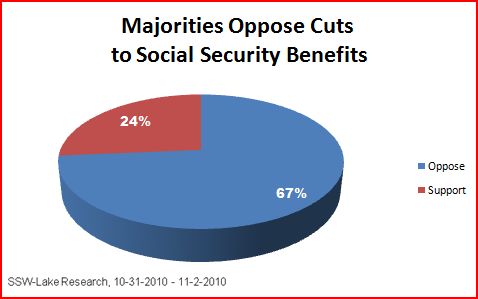
Voters would rather raise taxes on the wealthy than cut Social Security benefits (a perfectly viable option that never seems to even warrant a mention in these Peterson-funded projects):
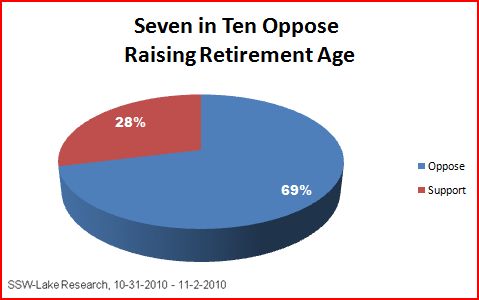
And despite the money spent to persuade us that raising the retirement age isn't a benefit cut [3], a virtually identical number of people oppose that idea, too:
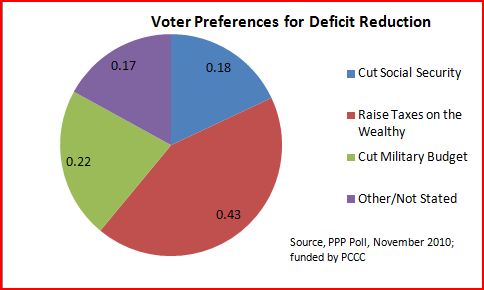
And they're right. It's not necessary to make these cuts. They would impose unnecessary hardship, and there are other ways to get the necessary revenue. What would the public rather do about the deficit?
What's more, the public believes in government and its mission. Americans don't want to cut Medicare, as the Bowles/Simpson and Rivlin/Domenici proposals would do. They'd rather protect it than cut it in the name of deficit reduction:
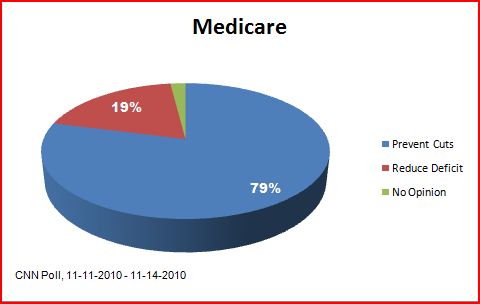
They want to protect college loan programs, too:
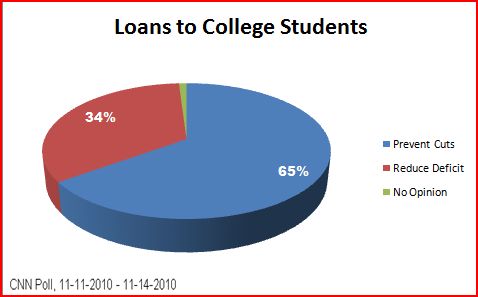
And they want to extend benefits for the unemployed (Congress, are you listening?)
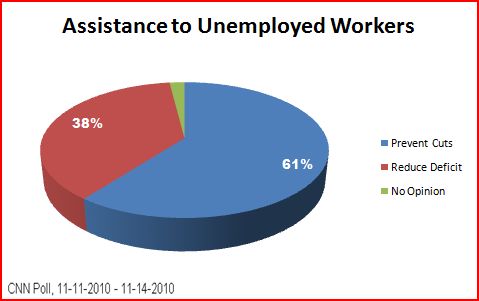
I'm genuinely moved to see that, even after a half-century-long effort to demonize the poor, Americans still care about poverty and want to do more to end it:
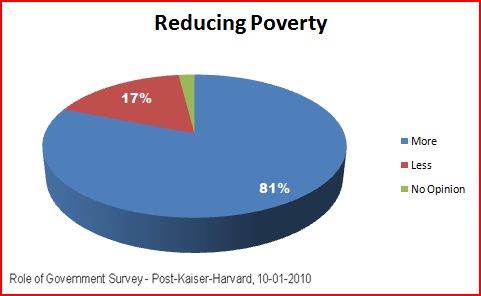
And when it comes to deficits, they know who really got us into this mess, which is why they want to do more to restrain Wall Street recklessness:
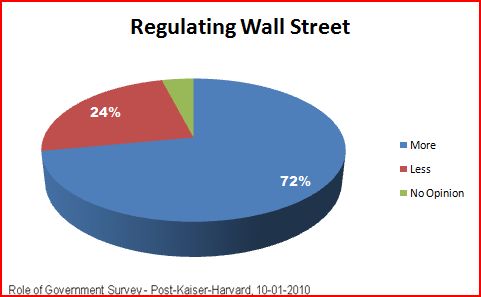
Pretty smart, if you ask me. Happy Thanksgiving!
_______________________
[1] I love Pops Staples, but it was the late, great Eddie Hinton -- guitarist, songwriter, and singer par excellence -- who played that beautiful solo.
[2] Dollhouse was science fiction, and most people don't like science fiction. They like Dancing With the Stars better. I think that's wrong (and it probably also explains why I didn't get more dates in high school.)
[3] Conflict of interest alert: I work for the guy -- he's one of my bosses at the Campaign for America's Future -- but he's right.
Richard (RJ) Eskow, a consultant and writer (and former insurance/finance executive), is a Senior Fellow with the Campaign for America's Future. This post was produced as part of the Curbing Wall Street project and the Strengthen Social Security campaign. Richard also blogs at A Night Light.
He can be reached at "rjeskow@ourfuture.org."
Website: Eskow and Associates