More

Featuring fresh takes and real-time analysis from HuffPost's signature lineup of contributors
Rob Richie

Rob Richie

Posted: October 29, 2010 05:00 PM

Former president Bill Clinton has been campaigning feverishly in his bid to help Democrats hold onto Congress and win state races across the country. But it wasn't fatigue or the heat that led him to campaign for Kendrick Meek, the Democrats' U.S. Senate nominee in Florida, and then urge him to drop out of the race. It was a dysfunctional electoral system that some American states and cities are starting to change.

Here's the backstory. As reported in a front-page story in The New York Times, Bill Clinton campaigned for Congressman Meek, but then almost succeeded in persuading him to drop out of the race to help boost independent Charlie Crist over Republican nominee Marco Rubio. The reason is simple: with Meek in the race, Crist will probably lose. With him out of the race, Crist would have a real shot at winning, with polls showing that Meek backers support Crist over Rubio by a 10-to-one margin, and Crist has indicated he would caucus with the Democrats in the U.S. Senate. [Note, added October 31: Clinton says he did not ask Meek to drop out, contradicting his spokesman.]

On the one hand, Clinton is right: Meek is now as much of a "spoiler" as Ralph Nader was in the 2000 presidential election in Florida. In a plurality voting system, everyone has one vote, and the candidate in first wins no matter how low their percentage of the vote. In some elections, it's crystal clear how most backers of the candidate in third would vote if choosing between the top two. A Suffolk University poll showed that Meek backers supported Crist as a second choice by more than ten to one.

But on the other hand, Clinton's outreach to Meek is an insight into the appalling, anti-participatory, undemocratic nature of the plurality voting system that we too often take for granted in the United States. Meek seeks to make history with his campaign, not be a "spoiler." He is running to be Florida's first-ever African American Senator - and indeed, if elected, would be the only African American member of the U.S. Senate next year. He's a major party nominee, a Member of Congress and the winner of a hotly contested primary over a self-financed zillionaire. His party's nominee for governor, Alex Sink, is fighting for every vote she can win in a toss-up race for governor -- a race with potentially huge implications for congressional redistricting in 2011 and the presidential election in 2012.

Even as the Meek-Clinton story was breaking, Dr. Howard Dean was proposing a sensible cure for the plurality voting "spoiler" disease: the instant runoff voting form of Ranked Choice Voting. Dean knows politics well -- he was several gubernatorial elections in Vermont, was a frontrunner in the race for Democratic presidential nomination in 2004 and was chair of the Democratic National Committee from 2004 to 2008. In his commentary for the McClatchy-Tribune News Service, he wrote:

Ranked choice voting handles voter choice with a sensible change. After indicating your first choice, you have the option to rank alternate choices. If no candidate wins a 50 percent plus one majority, then those rankings are used to simulate an instant runoff: the weak candidates are eliminated, and their backers' votes are added to the totals of the frontrunners. The candidate who wins a majority in the final instant runoff is the winner....


Having more competition forces candidates to clean up negative campaigning and stick to the issues. Knowing they may need support from supporters of other candidates to win, candidates have to tone down personal attacks. Reaching out to more voters also helps them govern better when they win.

The fundamental issue is majority rule. Without a majority standard, you can't hold power accountable. It's a blight on democracy when an incumbent can be returned to office even though 60 percent of voters reject that candidate as their last choice....With ranked choice voting, we can uphold majority rule, make campaigns less negative and foster less partisan elections. Let's make democracy work for all of us.

Gov. Dean is right, of course. We in fact should fight for any majority system over plurality voting. Brazil is in the midst of a presidential runoff election because in the first round the leader won "only" 47% -- that's a higher percentage of the vote than likely to be earned by winners of some ten races for U.S. Senate and governor next week, but it's not a majority. Candidates still could have been "spoilers." So Brazil requires the top two to face off and uphold majority rule.

Ranked choice voting is called instant runoff voting because it accomplishes this goal in one efficient round of voting by allowing voter to rank indicate alternative "runoff" choices by ranking candidates first, second and third and then using those rankings to simulate a runoff. Traditional runoff elections are better than plurality voting, but they come with a price-tag: literally, as big cities and states with runoffs spend millions to administer them. In this era of grotesque big money politics, they also give a boost to money in the second election, especially in the zero-sum world of "if you lose, I win" negative attack ads. Turnout often plunges, especially when the runoff is for an office other than governor or mayor.

Ranked choice voting has been used in Australia for more than a century. It was used this month to elect the mayor of New Zealand's capital Wellington and in 1990 was key to Mary Robinson becoming Ireland's first woman president, vaulting her from second place. It's getting some fascinating use this November -- a first-ever general statewide election in North Carolina. Oakland is using ranked choice voting for the first time in an open seat race for mayor, as our other Bay Area cities like San Francisco, Berkeley and San Leandro. In fact, every November since 2004, it's been passed by the voters in at least one American city -- cities like Ferndale (MI) in 2004, Takoma Park (MD) in 2005, Minneapolis (MN) and Oakland (CA) in 2006, Sarasota (FL) in 2007, Memphis (TN) in 2008 and St. Paul (MN) in 2009. Portland (ME) has it on the ballot next week.

Gov. Dean is not only in backing ranked choice voting. In 2002, a young state senator in Illinois introduced legislation to use RCV for primary elections: Barack Obama. That same year, Sen. John McCain taped a phone message for Alaska reformers seeking to win RCV for statewide elections. This year, Minnesota is seeing a slew of calls for ranked choice voting from several of that state's most respected leaders from across the spectrum.

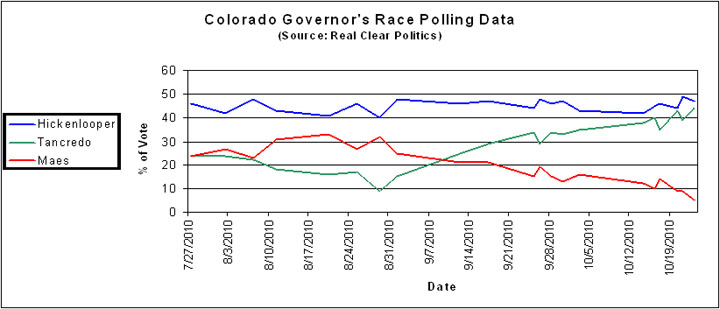
I'll end by pasting in a fascinating set of poll numbers from my colleague Chris Marchsteiner's non-majority rule blog that help show how RCV works. In Colorado, Republican Dan Maes has seen is gubernatorial campaign implode. As his numbers have fallen, this fellow conservative Tom Tancredo of the Constitution Party has seen his numbers rise to the point that Democrat John Hickenlooper now is in a real contest- -- most Maes' backers supported Tancredo as a second choice, just as most Meek supporters back Crist as a second choice.

We can never make a perfect electoral system. No system is entirely "spoiler-free" or sure of electing a majority candidate. But never was the case for ranked choice voting clearer than in the last 24 hours in Florida.
2010-10-30-Colorado_Gov_data.jpg


Follow Rob Richie on Twitter: www.twitter.com/FairVote


  • Comments
  • 17
  • Pending Comments
  • 0
  • View FAQ
Comments are closed for this entry
View All
Favorites
Recency  | 
Popularity
photo
HUFFPOST SUPER USER
Hazumu
05:42 PM on 10/31/2010
Can we afford NOT to have Ranked Choice Voting?

The costs are not just in the process of administering an election, but in the term of office the elected officials serve after the election.

It seems that our seemingly cheaper-to-do first-past-the-post, winner-take-all system encourages aggressive, adversarial, race-to-the-bottom campaigns with winners who carry that us-against-them mentality into office - governance in the image of high school society, complete with cliques, in-groups, out-groups, and the 'royalty' clique.

I think it's past time to shove Ranked Choice Voting down everybody's throat.
Genders
Love, Tolerance, Enlightenment
02:25 PM on 10/31/2010
First let's outlaw all political contributions: stop the bribery.
Actually first, stop the GOP/tea from getting back in power to finish their goal of destroying the democracy so the multinationals can rule unfettered. VOTE!
Then there is problem of conservative ownership of the vote stealing machines. No voter vied paper, not vote. Then finally, yeah, it would be great if we had the instant runoff capability.
HUFFPOST SUPER USER
2lib4oh
09:53 PM on 10/30/2010
This is how Canada's system works-by instant run-off voting.
photo
HUFFPOST BLOGGER
Rob Richie
10:14 AM on 10/31/2010
Canada in fact uses plurality voting as well -- it's led to many non-majority winners.
03:18 PM on 10/30/2010
This is a very interesting proposal. If one looks over American Presidential history, we find that many minority (but elected) Presidents have reigned over great American catastrophes.
photo
WASanford
I think, therefore I am mad as hell!
07:06 PM on 10/30/2010
If we're going to go about changing anything then let's change everything and move to a parliamentary form of government. You say you want compromise? A parliamentary government guarantees it. You want third and fourth political parties? You can have as many as you want. Our form of government guarantees a two party system because of its winner take all elections.

But let's be realistic! These kinds of changes will be difficult to the point of impossible to accomplish. I'll settle for public financing of our political campaigns and getting the special interest money out of the halls of our congress. If we can do just that little bit, we'll all be better off.
HUFFPOST PUNDIT
verycold
12:32 PM on 10/30/2010
This article is missing the point about this very scummy development.

In the senate race there is one white male, one black male, and one Hispanic male. The white male has teamed up with another white male(Clinton), and a black president to ask a black male to step aside for the good of the party to defeat a Hispanic. Now if a republican had concocted such a trashy scenario the world would come to an end. BTW, for the president to refuse endorsing the democrat in RI and instead stand by his friend Chafee, another independent, is equally egregious.

Crist is supported by moderate REPUBLICANS much like Lisa in Alaska. Crist has been putting out the rumor that Meek will step aside and thus some blacks have moved to Crist thinking he will keep his word and caucus with the dems.

This article forgets that while some supporting Crist might he on the fence about Rubio, will NOT tolerate Crist caucusing with the dems. If they wanted a dem they would have voted for Meek who seems to be a good guy caught up in a soap opera story orchestrated by Crist that is a pathetic loser. Crist is downright strange these days. I too thought he was a good guy, but boy has he unraveled.

This "independent" category is becoming the avenue for the big whiners to try to get elected after they have been beaten in the primaries.
photo
HUFFPOST COMMUNITY MODERATOR
Salvador Doggy
hi.
01:24 PM on 10/30/2010
Straight to the heart!
HUFFPOST SUPER USER
atcrossroads
09:50 AM on 10/30/2010
Consider that most of the information about this comes from Crist. As far as I can gather, Clinton never endorsed Crist, he simply discussed possible scenarios with Meek, and it would be naive to think that the possibility of Meek withdrawing would not be discussed. But the person who is making this a big issue is the one who has most to gain out of the confusion.

And I am also not convinced that Crist would win if Meek withdrew. Even if he picked up all Meek's voters, it would be tight. But I doubt whether all Meek's supporters would turn up and vote for Crist.
HUFFPOST SUPER USER
atcrossroads
09:42 AM on 10/30/2010
In South Africa we have proportional representation. The result is the even the smallest parties have a shot at being represented in parliament. Parties compile candidate lists at both a national and a provincial level. Half the members of parliament are determined of the national party lists, and half are divided up between provinces, each provincial delegation determined by the number of voters in that province. And the percentage share of the vote determines how many candidates you send to parliament. This means that parties only need .5 of a percent at a national level to have 1 member of parliament. Before '94, we had a first past the goal post system, and smaller parties, even if they had significant support at a national level, were never represented. I really prefer the current system.
photo
HUFFPOST SUPER USER
Strateshooter
02:39 AM on 10/30/2010
Rubio is dangerous....I'm a Democrat and a Liberal...Please forgive me folks, but Kendrick, you've got to drop out my brother!!
10:04 PM on 10/29/2010
These are both men -- Howard Dean and Bill Clinton -- for whom I have enormous admiration. I agree with Governor Dean that our system should be reformed. But, it has not been, and it is not likely to be in anything like the near future. President Clinton, whatever he did, was trying to maintain a Democratic majority in the Senate to benefit the party and the President (and I am sure the President knew what was going on -- this kind of thing does not happen in a vacuum) and do it in a way that would leave Mr. Meek's dignity and future prospects intact. The deal is not to be, which will fill election night with even more anxiety. If we Democrats lose the Senate, this will be the deal that could have changed our history. If we keep the Senate, this will be forgotten by Christmas.
photo
HUFFPOST SUPER USER
frank day
Republican = FAIL
08:53 PM on 10/29/2010
Its really late and I'm having a stupid fit.

I can't understand this article. Ranked voting?
09:40 PM on 10/29/2010
Basically. It would require whoever wins the election, to actually win the election (50%+)
01:24 AM on 10/30/2010
Glad you asked. Try:

http://www.fairvote.org/instant-runoff-voting

It's how Nader could have made an even bigger impact in 2000 while Gore would have wound up winning Florida.
06:57 PM on 10/29/2010
Why is it OK to betray a gentleman who won the primary by his own party? Bill Clinton endorses Independent candidate Crist, who is a turncoat Republican. That's just wrong. I didn't point out the racial aspect of this, because enough race-baiting is going on and needs to stop. But Mr. Meek was wronged in this situation. Shame on the DNC, and well, Clinton is shameless.
02:14 AM on 10/30/2010
The shameful part is how this move, by Clinton and others, encourages future such divisiveness. (And saps the party unity that Alex Sink needs for becoming Governor.)

Crist misjudged the love he received for vetoing a stealth "education" bill that would have been ruinous for Florida's children. He did the right thing, but an IRV system is the only way he could have translated the special interest support from teachers into victory against both Meek and Rubio.

While Crist could not win a Republican Primary against Rubio, he might have been able to win a general election victory if there was no one to split the vote with.

For that, Crist, or billionaire Jeff Green, would have had to have won the Democratic Senate Primary. Jeff Green had money but no base and would have played into the hands of Crist's "rotten politics" message. But Meek is an established Democrat with a strong base, and once early voting began, it was too late for the candidates to make a deal. With IRV, no such dealmaking is necessary since the electorate makes such decisions on its own.