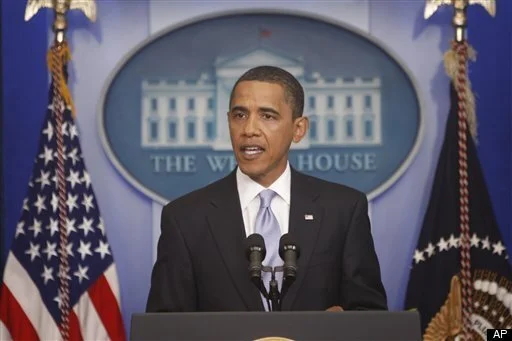
"[I]t is a clear abuse of power to use such [Presidential signing] statements as a license to evade laws that the president does not like or as an end-run around provisions designed to foster accountability.I will not use signing statements to nullify or undermine congressional instructions as enacted into law."
- Senator Barack Obama, December 20, 2007 (Boston Globe)
"However, provisions of [HR 2436] ... would interfere with my constitutional authority to conduct foreign relations by directing the Executive to take certain positions in negotiations or discussions with international organizations and foreign governments, or by requiring consultation with the Congress prior to such negotiations or discussions. I will not treat these provisions as limiting my ability to engage in foreign diplomacy or negotiations."
- President Barack Obama, June 24, 2009 (Signing Statement accompanying signature of HR 2436)
The message sent, tellingly on a news-cycle-shy Saturday, is that those who sought legal idealism from the Obama administration won't be getting it, and those who saw a bloated, creeping Executive branch under Bush/Cheney have not, after all, voted in a choirboy. The creep has been slowed, not stopped.
While the Obama administration's pace of signing statements is currently about 1/12th of what the Bush administration's was (5 statements in 5 months against 1,100 by Bush across 8 years), that number is rightfully of little comfort to fans of the balance of powers. It is long past time to walk away from to the rhetorical binaries of the campaign trail, because on the subject of Executive power, the President absolutely has.
Not for the first time, the Obama White House has thumbed its nose at the concept that massive financial institutions such as the IMF deserve to be held accountable for what they do. Congress made it law that the President's negotiations with the International Monetary Fund on the matter of worker's rights, greenhouse gas costs, and its overlap with the World Bank will be done above board, with reports to Congress. Obama has chosen to evade that law.
In a precise example of an "end-run around provisions designed to foster accountability", the President's signing statement is, in his own words of 2007, a "clear abuse of power" that reinforces the idea that business interests can turn off the lights whenever they choose -- or get their centrist President to do it for them.
UPDATE: Further research is showing that the counting of signing statements I gave is inexact. Some published counts are of the number of statements signed, some counts are of the number of provisions of law affected by the statement.
According to a well-annotated FAQ on signing statements, the Bush total of 1,100 pertains to the number of provisions of law affected by his use of the mechanism (which he used 161 times.) President Obama has affected about 18 provisions of law in 6 or 7 signing statements in five months in office.
This changes the comparison math, and not in Obama's favor: Obama's use on average of statements to affect provisions of law is 3.6/mo on average (18/5) where Bush's average is 11.4/mo average (1100/96).
This puts Obama's use of the statements at around 32% of Bush's - about 4 times worse than I said it was in the first place.
UPDATE 2: A commenter is correct that I failed to link to the June 24th statement in question. I have altered the post to include the link.
Follow Rob Warmowski on Twitter: www.twitter.com/warmowski
Want to reply to a comment? Hint: Click "Reply" at the bottom of the comment; after being approved your comment will appear directly underneath the comment you replied to
This factual trend in continuation of resorting to presidential signing statements is very troubling indeed ! What truly matters in the final outcome that affects people's lives and the nation's destiny in history is what the President does, not his eloquent words and inspirational speeches. These actions further solidify a growing trend of precedents in circumventing constitutional power and responsibility of Congress and the legislative branch with a benign intelligent president. What would happen when a truly malignant, unintelligent and sociopathic / psychopathic president gets elected or usurps power in illegitimate means in times of great national trauma and crisis? I shudder to speculate.
For the record, in 2008, Mr. Warmowski did not ask for ZERO signing statements from President Obama. Mr. Warmowski asked for FEWER signing statements.
Rob Warmowski, April 2008:
"It is the legal milieu of the Oval Office that I would expect to change for the better if he were elected. Attempts to reverse the damage done to the mechanics of the constitution and balance of powers at the hands of Bush/Cheney is exactly what I would expect of any constitutional scholar brought to the Oval Office in the wake of such a frat party. I would expect Obama to set a less retarded tone, make the proper appointments, and roll back portions of the previous eight years of executive branch abuse. Fewer signing statements. Supreme court appointments drawn not from a pool of Texas hacks. Rescinding of hair-raising executive orders. Etc.
Not more than that, but not less, either."
'Fewer signing statements'.
It was only bad when Bush did it. Now that Obama is doing it, its okay. We can trust Obama, bush was a liar!
LeeScho you wrote: "I took President Obabma's campaign assault on signing statements as criticism of their multiplicity and cavalier issue by President Bush. At no time did President Obama state that he would not use them." .youtube.c om/watch?v =seAR1S1Mj kc e-Hypocris y
Actually, candidate Obama DID say that he would NOT use signing statements. Perhaps you should check it out here: http://www
If you folks will put down the kool-aid for just a minute you might see that Mr. Warmowski was simply pointing out that it hasn't taken the President long to break campaign promises.
Hope-Chang
Mr. Warmowski, if you wish to attack the president on his constitutional use of signing statements, you should at least get the number right. It's HR 2346, not HR 2436. Also,k an ellipsis should not be used to exclude important information. "However, provisions of [HR 2436] ..." makes it seem Obama rejected the entire bill. The full quote is: "However, provisions of this bill within sections 1110 to 1112 of title XI, and sections 1403 and 1404 of title XIV," clearly showing it only applied to a small portion of a very large bill. I'm sure the omission was unintentional rather than to create a controversy where none was warranted. Wasn't it?
"I will not use signing statements to nullify or undermine congressional instructions as enacted into law."
S.ORG
RYVOTERS.O RG
Remind me again why we thought Obama would be a
"Change"
from Bush's hated policies?
SIGN THE PETITION
To Prosecute Those Bush staffers who Tortured In Our Name
at ANGRYVOTER
http://ANG
Try this little thought-experiment with me:
Q. Can congress pass laws which seriously overstep it's constitutional role?
A. Yes, of course. They can pass anything.
Q. Can congress incorporate clauses containing such laws into other, badly needed legislation?
A. Yes again.
Q. Doesn't this hold the badly needly law hostage to congress's improper attempt to usurp authority?
A1. That depends. If (as this piece claims) the president's only option when faced with such a law is to sign or veto it, the answer is yes. Congress is playing chicken with the president. "Sign this bill or the kitten* gets it!"
A2. Conversely, if the president is not limited to the two options above, the answer is no. He can sign the bill while noting that one of the provisions it contains is unconstitutional, because it concerns a matter beyond the jurisdiction of congress.
Q. If A1 is the correct answer, wouldn't congress be able to strip the executive branch of any and all power by adding such clauses to every bill it passes?
Only if the SCOTUS decided the law was constitutional. One of the benefits of three branches.
Who needs a veto when you can simply write (or un-write) entire bodies of legislation with a signing statement?
Personally, I forsaw all this hypocrisy from Senator Obama's vote on the FISA bill. You aren't going to fight corruption when you've already helped cover it up.
yep.
This isn't hypocrisy, it's constitutional common sense. The line between the Executive and Legislative is blurred with regard to foreign policy, leading to some understandable disagreements between the two branches. Not all signing statements are objectionable and all presidents have used them (Clinton holds the record). The ellipsis in the article made it look like Obama was objecting to the entire bill. I suggest you read the entire signing statement of HR 2346 (NOT 2436) at: http://www .whitehous e.gov/the_ press_offi ce/Stateme nt-from-th e-Presiden t-upon-sig ning-HR-23 46/
It's the number of challenges within the signing statements that is the issue...W holds the record by a huge margin.
http://www .usdoj.gov /olc/signi ng.htm
I couldn't get the cite/site on one of my posts and I didn't want people to think I was trying to claim it as my own.
J
In each of the last three Administrations, the Department of Justice has advised the President that the Constitution provides him with the authority to decline to enforce a clearly unconstitutional law.(7) This advice is, we believe, consistent with the views of the Framers.(8 ) Moreover, four sitting Justices of the Supreme Court have joined in the opinion that the President may resist laws that encroach upon his powers by "disregard[ing] them when they are unconstitu tional." Freytag v. C.I.R., 111 S. Ct. 2631, 2653 (1991) And indeed, in a recent decision by the United States Court of Appeals for the District of Columbia Circuit, Federal Election Comm'n v. NRA Political Victory Fund, supra, the court cited to and relied upon a Presidential signing statement that had declared that a Congressio nally-enac ted limitation on the President's constitutional authority to appoint officers of the United States was without legal force or effect.
If the President may properly decline to enforce a law, at least when it unconstitutionally encroaches on his powers, then it arguably follows that he may properly announce to Congress and to the public that he will not enforce a provision of an enactment he is signing. If so, then a signing statement that challenges what the President determines to be an unconstitutional encroachment on his power, or that announces the President's unwillingness to enforce (or willingness to litigate) such a provision, can be a valid and reasonable exercise of Presidential authority.
This comment and your comment below both deal with the Appointment Clause. not with the Presentment Clause. Further, I'm sure I'm not the only one who holds that the DOJ (in recent history) will go to any length to provide the president with the advice he desires.
" To begin with, it appears to be an uncontroversial use of signing statements to explain to the public, and more particularly to interested constituencies, what the President understands to be the likely effects of the bill, and how it coheres or fails to cohere with the Administration's views or programs.( 3)
.(4) Cf. Bowsher v. Synar, 478 U.S. 714, 733 (1986) ("[i]nterpreting a law enacted by Congress to implement the legislative mandate is the very essence of 'execution' of the law."). Signing statements have frequently expressed the President's intention to construe or administer a statute in a particular manner (often to save the statute from unconstitu tionality) , and such statements have the effect of binding the statutory interpretation of other Executive Branch officials. (5) "
.usdoj.gov /olc/signi ng.htm
A second, and also generally uncontroversial, function of Presidential signing statements is to guide and direct Executive officials in interpreting or administering a statute. The President has the constitutional authority to supervise and control the activity of subordinate officials within the Executive Branch. See Franklin v. Massachusetts, 112 S. Ct. 2767, 2775 (1992). In the exercise of that authority he may direct such officials how to interpret and apply the statutes they administer
http://www
Thank you.
The Legislative Branch is the people's branch of government, the people's equal branch, according to the very design of our system and the inarguable intent of our Founders.. .
d is ever shrinking. ..
..
n Federalist 78...one that the Federalist Society loves to quote but the reality is quite the opposite.. of their insidious intent due to their warped agenda..
So any end run around the Legislative branch is an end run around we the people... or what little voice and representation we have been allocated by our Founders by design..an
That which diminishes the Legislative branch diminishes our democracy.
Hamilton warned us that when the Judicial Branch allies with either of the other two Equal Branches then we will lose our democracy itself...i
The failure by Obama and Holder to reform and purge the Justice Dept. of all these Bush sycophants and Federalist Society stooges and Pat Robertson Theocratic lawyers is even more disappointing to me than this first signing statement by Obama but it is a sign that there are more to come and that Obama has bought into the Unitary Executive Doctrine and Heresy..!
I would agree ,except for the fact that our congress sucks, and cannot be relied upon to work for the people instead of corporations.
The Congress can pass whatever the hell the want - if within that bill it will hinder the foreign policy duties of the President, that will be in the nations best interest, then the President has a duty to do what President Obama has done . I applaud the President for having good sense, and being practical, and responsible!
Beyond the gotcha moment above, I failed to see an coherent discussion of whether the president was right. His signing statement about the IMF is correct. Congress can decide it wants to run the FP part of the executive branch but they don't. And frankly, they shouldn't. Our FP is run out of the executive for a reason.
J
How do you figure foreign policy is run out of the executive? I don't doubt the executive's agility in handling emergent situations, but
1. Signing statements are extra-legal to begin with, and,
2. Foreign policy is dependent upon Congress' ability to declare war and control the purse.
How did you come to your decision?
1) -- responses to foreign events
ns/funding denials
.state.gov /fpc/6172. htmm
2) -- proposals for legislation
3) -- negotiation of international agreements
4) -- policy statements
5) -- policy implementation
6) -- independent action.
These are the ways the president and the executive run the FP of the country. The congressional roles are all passive
1) -- resolutions and policy statements
2) -- legislative directives
3) -- legislative pressure
4) -- legislative restrictio
5) -- informal advice
6) -- congressional oversight.
The lists are a quote by the way I didn't come up with them.
There is a constitutional division of powers, and while the founders didn't create a dictatorship, they vested powers differently. If the congress wants to strong arm the pres and cut off funding for things. Ok, Gingrich tried it unsuccessfully in the 90s, but it is possible. but there is money that is already budgeted by the congress for the running of the government. They can alter funding for the next budget but not for this one, it passed in feb. So what I am basically saying is that countries don't negotiate with out congress they negotiate with our president. Our FP is run out of the executive branch, with due respect paid to the congress but ultimately it is courtesy not law. Congress can try and pass laws about FP but you'll need the supreme court to rule on the constitutionality of it.
http://fpc
You must be logged in to comment. Log in or connect with