
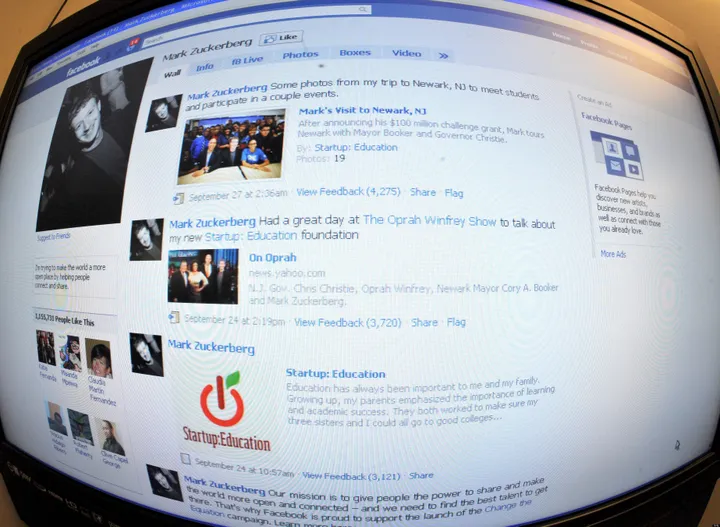
At the end of the recent film The Social Network, Mark Zuckerberg's character, by now a wealthy and successful entrepreneur in Silicon Valley, types in the name of the young woman from Boston University who had dumped him at the beginning of the film. He sits all alone before the computer and stares at the screen, suggesting to filmgoers that the billionaire with millions of "friends" still yearns for a truly human connection.
But would it be fair to say that Zuckerberg, played in the film by Jesse Eisenberg, is depressed?
A study in the April issue of Pediatrics, published by the American Academy of Pediatrics, posits that there is a "new phenomenon" known as "Facebook Depression," in which kids can become depressed when they compare such metrics as their number of "friends" and "status updates" to those of their peers.
This study follows last year's vote by the American Psychiatric Association to include Internet addiction in the Appendix but not in the actual body of the Diagnostic & Statistical Manual of Mental Disorders-V.
Just as the APA hedged its bets about whether Internet addiction will someday merit inclusion in the DSM, the pediatricians group did not state that "Facebook Depression" is an actual diagnosis. It is not clear that the "phenomenon" of "Facebook Depression" is unique to users of the social networking site or whether it represents an extension of latent depression in a child. Such a qualifier by the researchers shows some understanding that there is a difference between technology-driven disappointment and true depression, a term that is used far too promiscuously.
As I have written before, depression of a clinical nature does not come and go based on technological success or popularity. Clinical depression often remains with a person for his or her entire life.
Still, I recognize that we are all facing pressures now that we never faced in our hunter-gatherer past. We are not used to leading a 24/7 existence and being besieged by technology.
According to a Kaiser Family Foundation study from last year, children and teens from the ages of 8 to 18 engage in more than seven hours of electronic activity daily.
Adults have been known to spend time on their computers and even to write for online publications such as The Huffington Post, as this writer does. Fortunately, most adults know that the most valuable friendships are those of a face-to-face variety, not those separated by the scrim of a computer screen.
Kids, on the other hand, need to be taught the value of real, palpable friendship, the kind that you can only forge through offline contact with another individual.
Facebook itself seems to be learning this principle as Zuckerberg woos former White House press secretary Robert Gibbs, an actual human being, to communicate primarily in non-electronic, as well as electronic, means with the press.
I share the concerns of Norman Mailer, who late in his life contended that "technology was invented by Satan." Mailer was not referring to mechanical products, such as typewriters, which have a heft and a feel to them. Rather, he was referring to electronic gadgets such as computers, which have no true connection between them and human beings. That seems to be the lesson and the irony of The Social Network and the lesson and irony for children of all ages.