
iPhone app iPad app Android phone app Android tablet app More

Featuring fresh takes and real-time analysis from HuffPost's signature lineup of contributors
Robert E. Scott

Robert E. Scott

Posted: September 23, 2010 06:44 PM

Hearings held last week by the House Ways and Means and Senate Banking Committees marked a turning point in Congressional debate on China's currency manipulation policies. There was widespread support for getting tough with China from members of both houses, and only token opposition from a few business witnesses. Fred Bergsten, head of the Peterson Institute for International Economics, came out in favor of a limited form of the Ryan-Murphy currency bill (HR 2378), which would allow the Commerce Department to treat currency manipulation as a subsidy in some countervailing duty investigations. He also called on the Treasury to name China a currency manipulator, and for the United States to mobilize allies in the G-20 to file a complaint against China at the WTO, requesting authority to impose restrictions on Chinese imports unless its currency rises significantly.

Yesterday, Ways and Means Committee Chair Sandy Levin announced that the committee will meet on Friday, September 23 to mark up a version of the Ryan-Murphy currency legislation. Levin noted that he had received a letter signed by 101 House members, including 30 Republicans, urging the Committee to consider and pass the Ryan-Murphy bill.

Meanwhile, opponents of getting tough with China have been reduced to recycling widely discredited claims. In a recent posting on his blog, former Labor Secretary Robert Reich (who also helped found EPI and is currently a board member), claimed China might retaliate by selling off some of their $843 billion in Treasury bill holdings. We should be so lucky: the dollar would fall, making U.S. exports more competitive. And it would have no impact on U.S. interest rates (contrary to Reich's assertions). As Paul Krugman has pointed out, "this fear is completely misplaced: in a world awash in excess savings, we don't need China's money -- especially because the Federal Reserve could and should buy up any bonds the Chinese sell."

Some U.S. businesses could suffer in the unlikely event that the U.S. and China do enter into a trade war. Companies like Boeing that sell lots of aircraft to China and foreign investors in that country could be penalized. However, China's exports from the United States exceed U.S. exports to China by more than four-to-one. Exports make up approximately one third of China's GDP, while U.S. exports to China are less than 0.7% of U.S. GDP. Countries like China with large trade surpluses always have more to lose in a trade conflict. This also illustrates why it's important to persuade other major governments such as the European Union (E.U.), Brazil and India to join us in threatening China with sanctions for its illegal currency manipulation. If the U.S. and E.U. both impose tariffs on Chinese imports, China would be unable to play Boeing off against Airbus.

Reich also claims (as do many others) that revaluation would not create jobs in the U.S. because other lower wage countries would just take their place, and because other countries would rush in to compete in China and other markets. But this claim ignores many studies showing that if the dollar falls, relative to the yuan and other currencies, the U.S. trade balance will ultimately improve. The most recent study, by Bill Cline of the Peterson Institute, showed that for every 1 percentage point rise in China's real effective exchange rate, its global current account surplus (the broadest measure of its trade balance) will fall by $17 to $25 billion. The corresponding improvement in the U.S. current account would be $2.2 to $6.3 billion. Thus, a 25% appreciation in the yuan would reduce China's current account surplus by $425 to $580 billion, and reduce the U.S. trade deficit by $55 to $157.5 billion. Cline's conservative estimates imply that only one-eighth to one-quarter of any reduction in China's current account would be reflected as an improvement in the U.S. trade balance. Nonetheless his study shows the U.S. trade balance would improve significantly if Chinese currency manipulation were reduced or eliminated.

Reich's claim about substitutes from other low wage countries primarily relates to the effect of currency manipulation on U.S. imports. But currency manipulation also acts like a tax on U.S. exports. This reduces U.S. export to China and every country around the world where we compete with Chinese exports. According to data from the Federal Reserve China is our most important competitor in world export markets, more important even than the EU or Japan. Eliminating currency manipulation will stimulate U.S. exports to China and the rest of the world, creating new jobs in the United States, especially in manufacturing, which produces most traded goods.

It is also important to remember that China is not the only country that manipulates its currency--other countries also need to revalue. Cline and Williamson (2010) have also identified Singapore, Taiwan, Malaysia and Indonesia as currency manipulators, and other countries such as Japan, Sweden and Switzerland need to revalue as well. A global currency realignment along these lines would result in further improvements in the U.S. trade balance.

Reich also argues that China's export policy doubles as a social policy that is needed to absorb the millions of workers flooding into the cities from the countryside, and that China risks riots and other upheaval if they don't continue to manipulate their currency. This claim ignores the fact that revaluation would be good for China's workers in several ways. It would raise real wages, allowing them to purchase more imports and enjoy the fruits of their labors. It would put downward pressure on Chinese inflation. It would also force China to invest more in infrastructure and the social safety net. This would create the domestically-oriented growth needed to sustain China's development while providing its citizens with the public and social services (e.g., housing, transportation, safe water and waste disposal) that they need and deserve. It will also reduce pollution and China's growing demand for energy and other materials needed to fuel its export engines.

Finally, Reich argues that the U.S. needs twenty million jobs and ending currency manipulation by China and other countries alone will not solve that problem. Most analysts agree that eliminating Chinese currency manipulation alone will generate between 300,000 and 1 million U.S. jobs. However, there's no reason to leave those jobs on the table while we search for bigger answers to the unemployment problem.

In fact, eliminating the overall U.S. trade deficit could provide the foundation for rebuilding manufacturing and the U.S. economy and to generating massive employment growth. Eliminating the overall U.S. trade deficit, including most or all of our oil imports, could support three to six million new jobs, or more. But it won't be cheap, and it will not happen overnight. We need massive new investments in clean energy technologies, infrastructure and R&D, to develop new clean energy industries and to rebuild U.S. infrastructure and manufacturing industries. We also need new tools for fighting unfair trade policies such as China's illegal subsidies to its steel, glass, paper and clean energy industries. Taken as a whole, these strategies could eliminate U.S. trade deficits and generate most of the jobs needed to get unemployment down to five percent. But it won't be cheap, or easy.

Attacks from the right

Proposals to punish China for currency manipulation have also been attacked from the right, most recently by Mark J. Perry of the American Enterprise Institute. Perry recently summarized a blog posting by Scott Grannis, former chief economist for a private investment management firm in California, and an acolyte of Arthur Laffer and other supply siders.

Grannis begins by claiming that the yuan is not too weak because it has appreciated 23 percent since 1994, and because inflation has been low in China for some time. Neither of these statements says anything about the appropriate level of the yuan or renminbi (RMB--the official name of China's currency). China maintains closed capital markets and does not allow its citizens to invest abroad. It maintains complete control of the domestic money supply, which is the primary determinate of domestic inflation.

Regardless of what has happened to the value of the nominal value of the RMB since 1994, the fact is that China is egregiously violating every accepted standard of currency manipulation (Scott and Bivens, 2006). It has maintained a large, bilateral trade surplus with the United States for more than a decade, both in dollar terms and as a share of its GDP. China has maintained large global current account surpluses (the broadest measure of all trade in goods, service and income flows). And it has massively intervened in currency markets.

China has purchased $1 billion or more per day in foreign exchange reserves for many years. This is prima facie evidence of currency manipulation. They have acquired $2.5 trillion dollars in reserves, equal to 22 months of import purchases, and far in excess of ratios held by other countries named by the United States as currency manipulators in the past (Taiwan, South Korea, and China itself on two occasions in the early 1990s).

Next, Grannis asks "if the yuan were chronically 'too weak,' what's the problem anyway? ...some manufacturers might go out of business but all consumers would benefit." Perry goes on to claim that if China is forced to appreciate the yuan only a small group of American producers will benefit, but it will harm "all consumers and many businesses." This is sadly confused logic. Unfair trade with China (and other countries) affects the United States in at least three ways--all must be considered to determine whether currency policy will help or hurt most or all Americans.

First, it is critical to remember that consumers are workers, too, for the most part. If imports are cheaper but workers have less to spend because imports and offshoring have depressed their wages, then the ultimate impact of imports on consumers can be negative. And trade with low wage countries like China does affect wages. This is a well known result in trade theory, but one that rarely makes its way into introductory economics textbooks.

Josh Bivens has shown that the rise of import competition from low-wage countries has depressed the wages of manufacturing production workers, and all other workers with similar skills by approximately $1,400 per year for the typical median wage earner. Most manufacturing production workers do not have college degrees, and the group of comparable workers in the economy is composed of all non-college educated production and non-supervisory workers. There are about 100 million such workers and they make up about 70% of the labor force.

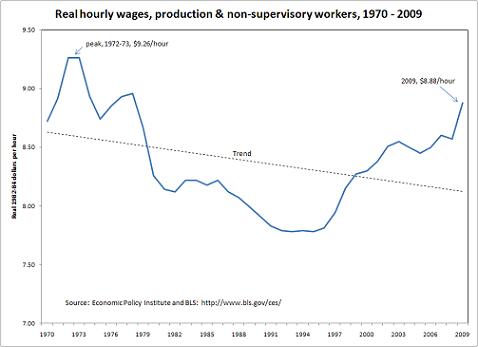
As shown in the Figure below, the real wages of production workers fell significantly between 1973 and 2009. The trend line in the figure shows the tendency of real wages to decline in this period.
2010-09-23-realwagesIIi.JPG

(Note: The uptick in production worker wages in 2009 was an anomaly due to the sharp fall in energy prices during the recession. Real Wages are falling in 2010 on a monthly basis, and will likely fall more in the future as long as unemployment remains well in excess of five percent. )

If import prices were falling fast enough to provide a net benefit to production workers, then their real wages would have increased in the past three decades. In fact, they have fallen, as shown in the figure. The bottom line is that globalization and especially unfair trade with China have eliminated millions of U.S. jobs, especially in the past decade, and have contributed to the prolonged decline in the real wages of working Americans. Ending currency manipulation will reduce the downward pressure of globalization on U.S. wages.

The real beneficiaries of cheap goods from China are workers with college degrees, and especially professionals, managers, executives and stockholders. Those in the top 1 percent of all wage earners, who derive most of their incomes from profits, have benefited most of all from globalization. Between 1979 and 2007, before the start of the recession, this group captured 38.7 % of all the income growth in this period (Mishel 2010). Nearly two-thirds (63.7%) of all income gains went to the top 10%, and an additional 11.5% went to the next 10% of all households. Thus, the bottom 80% of the labor force captured only 26.3% of all the gains in income over this three-decade period. The most important effect of globalization, and especially unfair competition with China, has been to redistribute income from working families to those at the very top of the income distribution. It was a battle between Main Street and Wall Street, and multinational corporations captured the lion's share of the spoils in this fight.

The most direct effect of unfair trade is that it causes trade deficits to rise. A new EPI report shows that rising trade deficits with China will cost one-half million U.S. jobs in 2010 alone. Since China entered the World Trade Organization (WTO) in 2001, the United States has lost 5.5 million manufacturing jobs and more than 26,000 (net) manufacturing plants. China is responsible for at least 2.4 million of those lost jobs. These are concentrated loses, but the costs of unfair trade do not end there.

The Ryan-Murphy currency legislation being considered by Congress is a first step in the fight against currency manipulation. If passed, it would send an important message to China and the administration that Congress will no longer tolerate illegal currency manipulation. However, the legislation would apply to only a small share of total U.S.-China trade--only products subject to countervailing duties might be penalized (fewer than 60 products from China are now subject to antidumping or countervailing duties). It would not necessarily impose duties in particular specific cases--it would merely authorize the Commerce Department to treat currency manipulation as an illegal export subsidy in countervailing duty Investigations. There is growing support for much more aggressive action against Chinese currency manipulation, such as a 25% across the board tariff. If the Ryan-Murphy bill is passed and China does not get the message, then it will soon be time to consider much broader restrictions on Chinese imports.

Disclosure: EPI is a non-profit think tank that receives the majority of its funding from foundation grants but also receives support from U.S. labor unions and industrial associations.


  • Comments
  • 58
  • Pending Comments
  • 0
  • View FAQ
Comments are closed for this entry
View All
Favorites
Recency  | 
Popularity
Page: 1 2  Next ›  Last »  (2 total)
12:49 AM on 09/30/2010
A rise in the value of the Yuan will create millions of jobs, not less than a million. One factor that wasn't considered is that other nations - India for example - manage their currencies against a basket of other currencies. A rise in the Yuan will result in a rise of the Rupee. That spells tech jobs coming back.

There may be some losers - Boeing perhaps. But this is a net win for the United States. I would argue that Boeing will also be a winner because more jobs means more people traveling, which means an increased demand for civilian aircraft in our own country.
11:51 AM on 09/27/2010
This is just a bunch of sound and fury, signifying nothing. To maintain their mercantilism (which rewards our Billionaires with factories in foreign countries), Japan and Brazil have intervened in the currency markets to unilaterally lower the value of their respective currencies. China has held their currency artificially low for a long time relative to the productive output of their worketrs. This can all be fixed overnight by our Philosopher Kings (apparently answerable to know one, even after creating a 2nd Great Depression) at the U. S. Federal Reserve. Through Quantitative Easing (printing money), they can simultaneously rejuvenate the economy, lower unemployment (the part of their mandate that they've woefully neglected), and put irresistible upward pressure on the yuan and other world currencies. They could probaly create $4 Trillion in new currency with little chance of inflation in the near term. Our friends in the European Union could do the exact same thing to restore their moribund economies well. If we both did this as a matter of policy, we could end the imbalance in North American and European vs. Asian currencies.
04:28 AM on 09/29/2010
Hmm... a chicken in every pot? $4 Trillion divided by 300,000,000, so each person gets about $13,000? I like that. And no inflation too? That'd buy quite a few chickens. Costco sells them roast chickens for only $4.99 each. Yum!!
10:18 PM on 09/26/2010
It is indeed curious. I have posted several times the example of the tire tariffs in the past year, as factual PROOF that protectionism RAISES PRICES and KILLS JOBS. Yet despite all the name calling, no one was able to refute that with better or more recent actual factual examples.
05:47 AM on 09/27/2010
Any objective report not from those who import tires from China or the US-China business council? Tires from China are down but have shot up suddenly from other Asian countries? How many of these tires are shipped from China to 3rd countries then imported into the US? Any studies done on this yet? It was shown that after the US hit Chinese honey imports they immediately exported and re-branded their product from a third country to avoid tariffs. Imports starting coming in from countries with no previous history of honey export and small honey industries. How did the rate of US based job losses in the industry compare with previous years? One thing is a fact, I could find you over a 1000 examples of entire factors shut down in the US with production moved to China that have resulted in direct job losses not fluffy hypothetical losses like the China commerce propagandists always try to use to counter-act real data. How does that create jobs? Where are these jobs unskilled retail, real estate, financial institutions? Well those industries have sure put the economy on a positive path, NOT. Give it a rest.
05:34 PM on 09/26/2010
BTW every one should read this article I'm posting at the end of this post.

Zhuubaajie clearly fits the bill of what the Chinese call their “comrades of good ideological and political character" in order for them to "assert supremacy over online public opinion" which is nothing more than hiring thousands of "freelance" internet propagandist.

Seriously, go read his comments, they're nothing but Chinese apologist that protect Chinese interest day in and day out. His comments are worthless.

READ: http://itmanagement.earthweb.com/columns/executive_tech/article.php/3795091/How-Chinas-50-Cent-Army-Could-Wreck-Web-20.htm
10:04 PM on 09/26/2010
So, having neither the facts nor the debate skills, the red-baiters swamp with demagogy.

ZBJ is honored.
photo
HUFFPOST SUPER USER
frank day
Obama cares about all of U.S.
02:47 PM on 09/27/2010
You might want to study american idioms and brush up on your language skills if you plan to continue tro11ing here.
Linda from Deerfield
Paying attention
12:57 PM on 09/26/2010
It is amazing how many years it has taken this dialogue to even begin. Under Republican control, the U.S. Treasury Secretary would have regular talks with China pretending to be upset and then nothing would happen -- to such a boring, repetitive extent that it seemed most certainly to be mutually orchestrated. For raising it to another level, I give some credit to the Democrats. If they can get something to change, I'll credit them even more. If it works, they are doomed to be blamed for less desirable side effects, though, such as goods inflation.
03:43 AM on 09/26/2010
I read an interesting set of arguments being made between someone who noted that labor costs shouldn't effect the price of something as mundane as a toothbrush, and someone else noting that if US labor costs were applied, it would be somehow not be affordable.

Well, these days a lot of people have difficulty affording that toothbrush at either price, because they don't have a job. That job was sent overseas, so that an investor or management executive could keep make more money selling things back to the people who now no longer have jobs.

The ridiculous trade arrangements that made this affair possible didn't really have that many other possible outcomes.
photo
cyclone70
When one facepalm isn't enough
07:53 PM on 09/26/2010
funny that people had no problem affording toothbrushes when they were made in the US

these stories of prices doubling and tripling from the globaist apologists are simply scare tactics with no basis in reality
10:23 PM on 09/26/2010
WHY do they have no basis in reality? You care to state you case? The math is rather simple, and I trust that even you should have no problem with it. If the labor cost is 5 cents on the dollar on the widget, the rest being materials and other costs, then holding the other costs constant, you just apply overseas vs. U.S. labor costs. If the overseas labor cost is $1/hr. and the U.S. cost is $18/hr., then the new labor "component" is 18 times higher, or $0.90 (instead of $0.05). Add that to the constant $0.95, that gives you $1.85. Not quite double. But close.

WHY is that a scare tactic. WHO in America can afford that sort of price increases today? Please do explain.
10:44 PM on 09/26/2010
"funny that people had no problem affording toothbrushes when they were made in the US" cyclone70

Nope, they didn't. At least not as much as they do now.
photo
HUFFPOST SUPER USER
Louis Bloom
09:48 PM on 09/25/2010
Surely this sentence was unintentional: "China's imports from the United States exceed U.S. exports to China by more than four-to-one." One of these cannot exceed the other, as the two are the same thing.
03:10 PM on 09/26/2010
Good eye. That kind of stumbled me too, with a huh? - but I moved on without really noticing.
06:26 AM on 09/27/2010
The only thing I can think is that it's Chinese companies importing and US companies exporting.
01:49 AM on 09/25/2010
“the real wages of production workers fell significantly between 1973 and 2009.”

---No. Read the chart again. What it shows is a solid decade of increases from 1997, a brief pause and then a surge in the most recent year.
This user has chosen to opt out of the Badges program
photo
MSROADKILL612
love auto biographys. any appS to write mine?
07:34 AM on 09/25/2010
Maybe so, but what it doesnt show is that there are so few production workers now.
JNarragansett
Check your premises
12:51 PM on 09/27/2010
And yet we are producing more than we ever have in the past. If you want to look to where those jobs went, look to increases in technology more than outsourcing. Would you suggest that we get rid of efficient technologies to help increase employment?
11:14 PM on 09/29/2010
Correct!
That would be an article on a different subject!

To print an article, with a graph, and then argue that the graph says something it clearly doesn't say is to assume that your average reader can't read a chart.

Not smart around here.
09:21 PM on 09/24/2010
Are consumers really better off because of "cheap" Chinese goods? I recently saw an article stating that Americans are on par with the purchasing power they had in 1972. But in 1972 most goods were actually made in America. I'd even go as far as saying Americans had more purcahsing power in 1972 as the things they bought back then were of far higher quality. Back then things were made in America yet somehow people were able to buy American-made TVs, American-made vacuums, American-made kitchen appliances, and a whole range of other goods that are now universally imported from China. Today with the recent advances in automation I see no reason why we would be unable to afford American-made appliances since they would be relatively cheaper than they were in 1972 due to increased productivity.

What I find particularly disturbing is the recent trend of imports from China on goods where labour makes up less than 5% of the total cost of production and no obvious comparative advantage exists. When manual toothbrushs, lighting, plastic clothes hangers, birthday cards, metal pins, plastic/metal tubing, containers, steel beams, screws and a whole wack of other highly automated goods are being shipped from the other side of the planet and still undercutting local producers you know there are serious market manipulations at play.
03:29 AM on 09/25/2010
WHY do you find it disturbing? If labor makes up 5% of the cost of production, and the labor cost differential is $18/hr in the U.S. vs. $1/hr. overseas, that 5 cents out of a dollar gets turned into $1.20, taking the total cost of production up to $2.15 ($1.20 + $0.95).

The price more than DOUBLES if the labor cost is 5%. Is that enough of a comparative advantage?
05:09 AM on 09/25/2010
First, read my post. I said less than 5%, but even those at 5% should not be competitive in an open market when shipping is concerned. These type of goods (particularly larger product) have shipping costs (includes shipping, storage, port fees, middle-men etc) that should easily outweigh labour. The most obvious explanation is massive Chinese subsidies for key state-run supply chain companies like those in metals and petrochemicals that creates overcapacity and allows dumping of goods. If labour were the only issue here we'd have been flooded with Mexican products not Chinese products.
08:36 AM on 09/25/2010
You are doing a good job for the Chinese-American Chamber of Commerce.

YES to protectionism !
06:15 PM on 09/25/2010
You made a whole slew of great points. I am trying to make the transition ton supporting American goods myself. .
09:01 PM on 09/24/2010
"However, China's imports from the United States exceed U.S. exports to China by more than four-to-one."

A misbegotten sentence? Those two things are the same thing! It should be ""However, China's exports to the United States exceed U.S. exports to China by more than four-to-one."
09:35 PM on 09/24/2010
Keep in mind that the balance of profits is much in favor of Americans in this trade. American companies make over $80 Billion in reported profits from China each year, while the profits on the $300 B in Chinese exports to China is MUCH LOWER (1-5% gross margin).
12:49 AM on 09/25/2010
Chinese exports to China ???
07:10 PM on 09/24/2010
Thank you for an excellent article Mr. Scott. I have never had good explanation of currency devaluation and it's possible benefits. One possible drawback is if wages don't rise, then it will reduce instead of raise standard of living. I will read up more on the subject from the links you provided. The rest of your points are well made.
10:37 AM on 09/24/2010
_______________________________

Our economy is slowly dying, your job, lifestyle are dominated by anxiety.

The economy is kept alive artificially.

No one is proposing a solution because no one has the slightest idea of why it is happening and many have vested interest in the present system.

However an objective observation of the phenomenon can help us understand it and provide us with an innovative solution.

Of course we can't solve the problem with the tools that brought us there in the first place and we need a new ideology.

_______________________________

In order to alleviate those economic woes wee need to create, as fast as possible, a new credit free currency that will solve the credit crunch and

bring incremental jobs, consumption and investments to the present system.

An Innovative Credit Free, Free Market, Post Crash Economy

A Tract on Monetary Reform

http://post-crash.com/credit-free.html

It is urgent if we want to limit social, political and military chaos.

_______________________________
02:33 PM on 09/24/2010
WHY would you say that the American economy is dying??!! Compared to America, there are many other economies that are in worse shape - e.g., many European economies are comatose in comparison.

America is blessed with so much - land, water, natural resources, etc. It may be under really bad management, but the basic essentials are still there, pretty much tappable under the right guidance.

Forget all these hifulutin' economist, banish the protectionists, tell the environMENTALS to let up and let live - and America would be back on its feet in 10 years max.

WORST CASE - look at how well the Aussies are living, just digging dirt and exporting them. America has at least 50 times more to offer and has only 6 time more mouths to feed (compared to Australia). WHAT ME WORRY?
06:30 AM on 09/27/2010
When you say it's not, what are you looking at? The GDP? Or what?
03:39 AM on 09/24/2010
Protectionists take the position that "it will soon be time to consider much broader restrictions on Chinese imports."

WHY? Because the Chinese had been too nice to America? For over 20 years, they sent affordable goods of high quality to America, thereby holding down inflation. Moreover, pursuant to agreement with Washington (Beijing was told that ALL nations who have a trade surplus with American is expected to do so), Beijing recycled trade dollars into investments in Treasuries and GSEs, thereby providing dirt cheap money to fuel the American economy. For the whole generation (over 20 years) America enjoyed prosperity - asset prices rose steadily, unemployment was never a serious problem, and almost everyone had extra money to spend. It was the golden age, largely thanks to the largess of the Chinese people. Then the 8-million American jobs were lost overnight due to the derivative fraud of the American banksters, and the Beltway pols reacted by forking over another $12.8 Trillion (according to Bloomberg) to save the butts of those in the financial industry. But even in the face of such folly of historic proportions, Beijing stood by the American people, and refused to join Putin to sabotage the U.S. financial system. Instead, China continued to prop up the American financial system with more purchases of Treasuries and GSEs.

Yet look at what the protectionist ingrates are doing now!! If they could have, they would be blaming those 8 million job losses on China too.
07:02 PM on 09/24/2010
China is practicing protectionism themselves. You have no argument. At least an honest argument.
09:29 PM on 09/24/2010
WHAT SORT OF PROTECTIONISM is China practising?? HOW MANY cars have American auto makers sold in China? in Japan? in Korea? in Germany?

China today is the MOST PROFITABLE market for MANY American companies. By June, 2009, the total number of U.S. investment projects in China had exceeded 57,000 and the value of accumulated U.S. investment in China reached 61 billion dollars. These U.S. companies operating in China REPORT annual profits of at least 80 billion U.S. dollars. The actual profits are of course much higher, as they are hidden with transfer pricing moves. According to the American Chamber of Commerce in China's 2009 White Paper, about 74 percent of American businesses in China made profits and 91 percent chose to stay in China to expand their business. Many of these businesses are enjoying not only whatever industrial policies promulgated by Beijing, but they are also enjoying preferred status, advantaged over the locals.

On the other hand, cumulated Chinese direct investments in the U.S., due to the hostility shown by the American Congress, has been only US$3.1 Billion by June 2009. The $80 Billion in American profits from China is MANY TIMES that of the profits on China's exports to America ($300 Billion, with profits averaging 1-5%).

Protectionism will just jeopardize Americans' ability to make profits from China. It will also kill the fastest growing export market (China) for American exporters.

Say NO to protectionism.
09:46 PM on 09/24/2010
Do you honnestly believe that dribble about China acting in America's interests. China is acting in China's interests alone. China is spending a billion dollars a day to manipulate their currency. To do so they have to use billions of yuan to purchase billions of US dollars. Since they end up with a wad of US dollars that is difficult to invest they throw it into US Treasuries. China keeping its currency artificially low and China buying Treasuries are part of the same symptom.

Is China doing this to help the US out? No, this is a beggar-thy-neighbour practice that has clearly intensified under the Hu-Wen leadership with the trade deficit rising exponentially in just 8 years. China has lots of people to employ, the US has/had industries and importantly a consumer-base that drives demand, so China has used national power to prod relatively weak individual businesses into shifting their production offshore. No other country in the world has used nationalistic pressure to manipulate markets to the extent China does. In the end American consumers get a brief period of undervalued goods but over the long run they lose their jobs, technical know-how, and thereby innovation, future potential and competitiveness to a China that would like to quickly engineer its rise rather than let nature development forces take place. However, when the global rebalancing does eventually occur everyone may lose, particularly the "engineered economies" that rely on artifical growth.
03:44 AM on 09/25/2010
Er, HOW is this purchase of U.S. Treasuries DIFFERENT from what the Japanese and the Saudis do? Are they also engaging in a beggar thy neighbor practice?

Are you sure : "No other country in the world has used nationalistic pressure to manipulate markets to the extent China does. . ."? What do you call the $12.8 Trillion (according to Bloomberg) subsidies that Washington thrown at the financial industry after 2008? Sorta larger than what the Chinese ever did CUMULATIVELY since perhaps 1948, no?
02:42 AM on 09/24/2010
These protectionists simply ignore REALITY. What happened in the last year after they imposed a 35% tariff on Made in China tires? Prices of the tariffed tired IMMEDIATELY went up 25%, and prices for ALL tires went up 10-20%. Moreover, as predicted by everyone else (other than the protectionists), the demand merely shifted to other low labor cost countries - tire imports actually WENT UP by 21% in that one year period, AND according to Dept. of Labor statistics, American labor for tire manufacturing DROPPED 10% in the first half of 2010. Nobody looked at the actual effect of the higher prices on decreased demands, and thus the further reduction in retail jobs - but the overall unemployment numbers certainly supported that theory.

American working class folks lose all the way around, when the protectionists act - higher consumer prices, fewer jobs. Why can't the protectionists get their heads out of the sand and dedicate their energy to promoting American EXPORTS instead?
07:05 PM on 09/24/2010
I'm sure you would like Americans to keep selling Chinese goods. That has worked out very well for China. Tire demand dropped because of the labor market. It wasn't exactly a banner year for car sales.
09:31 PM on 09/24/2010
Forget what it does for or to the Chinese - the focus ought to be, would the proposed move BENEFIT AMERICANS. Protectionism HURTS Americans in many ways - it jacks up prices, reduces consumer demand, AND kills jobs. Americans LOSE all the way around.

The better route would be to INCREASE American exports, especially to China. And you can't do that by pissing off the Chinese.
02:18 AM on 09/24/2010
The DO NOT RIGHT clowns on the Hill have totally screwed it up for Americans in the last few years. It was one horrid decision after another, each having decades long harmful consequences. As least they are consistent, as the now proposed protectionist moves will DEFINITELY make life EVEN HARDER for most Americans. Higher consumer prices, fewer retail jobs due to lowered demands, destroying all hope of participating in the fast growing export market that is China. What is left? Drag America into WW III?

If Robert Scott is right, Americans will have lots of character, as hardship breeds character.
03:25 AM on 09/25/2010
I´m sure you would enjoy selling spring rolls for the minimum wage.
The U.S. should look at Germany as a reference. Why compare the U.S. with China? that is going back 150 years in time. I am offended when people compare the U.S. with China