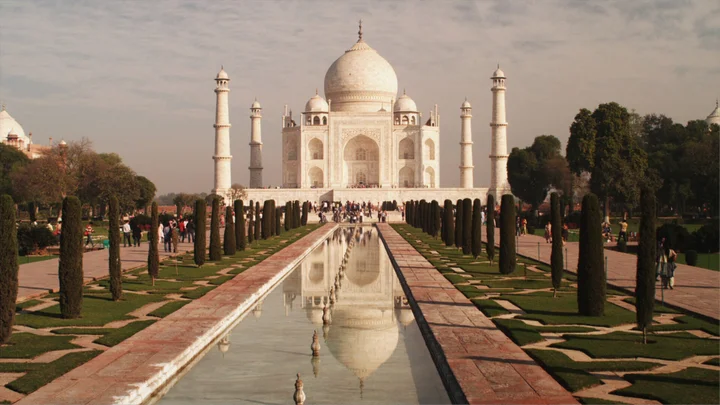
During the production of "Islamic Art: Mirror of the Invisible World," which airs this Friday as part of the PBS Arts Summer Festival, we filmed some of the most stunning examples of Islamic architecture in the world.
Two buildings that represent a great contrast and diversity in Islamic architecture are the Taj Mahal in India, probably the best known Islamic monument and one of the most memorable buildings in human history, and the Great Mosque of Djenne in Mali, the largest mud construction in the world, an astonishing example of indigenous African adobe architecture.
The distinctive profile of the Taj Mahal -- like the Pyramids, the Eiffel Tower or the tower of Pisa -- has become an icon for its native country of India. The Taj's immense scale can only be understood when we compare the tiny figures of visitors gathered at its base to its monumental dome and minarets.
It was built as a tomb for Mumtaz Mahal, the favorite wife of Shajahan (1628-1658), the most prolific patron of the arts of all the Mughal emperors of India. Built after her unexpected death in 1631, it took 16 years to complete. The tomb and the platform upon which it sits are made of translucent marble decorated with understated patterns of inlaid stone (pietra dura) in slender arabesques combined with extensive Arabic texts from the Quran.
Security regulations placed on the camera crew at the Taj Mahal limited our use of digital cinema cameras to telephoto lenses. For closer shots, we used high-resolution still cameras adapted for use with motion picture lenses. These cameras are capable of shooting high definition video, allowing the crew to appear as tourists. After computer stabilization was added during post-production, we very closely mimicked the camera moves of the much more elaborate Steadicam rig.
In stark contrast to the polished marble and stone inlay of the Taj Mahal, the Great Mosque of Djenne is built entirely of cylindrical mud bricks, with a surface of mud stucco -- an African architectural technology that has been in use for more than a thousand years. The only decoration on the smooth exterior comes from the diagonal shadows of the logs regularly protruding from its surface. These logs are used as scaffolding for the annual resurfacing of the building that serves to preserve it after the heavy rainy season.
Inside are 99 massive mud pillars supporting the roof, rising almost 50 feet -- each pillar for one of the 99 names of God. The only source of illumination comes from regular spacing of light-wells in the roof, each one covered with a hand-turned pottery covering. The light filtering down into the interior is mystical and subdued, like sunlight in a dense forest.
One of the greatest challenges we set for ourselves in filming these buildings was to keep the camera moving. To do this, we used two tools -- a 25-foot collapsible robotic camera crane, that can be disassembled for shipping and for entry into the buildings themselves, and a Steadicam, an elaborate mount worn by the cameraman, that mechanically isolates the camera from his movement as the he walks through the space, allowing for a smooth shot even when moving quickly over uneven surfaces.
The use of these tools enables the viewer to experience the unfolding of the architect's original vision in three dimensions. The camera soars through arches, observing minute architectural detail high above and can view the structure looking down from the height of a great dome.
Robert Gardner is the Director and Producer of "Islamic Art: Mirror of the Invisible World," a 90-minute documentary to be broadcast nationally on PBS July 6th at 9pm (check local listings) as part of the PBS Arts Summer Festival. The Festival is a seven-part series that featuring artists and performances from nine different communities around the country, and underscores PBS's ongoing commitment to provide viewers a front-row seat and a back-stage pass to the art-making process. See below for a clip about calligraphy, from the film.
Kelly James Clark: Burning Mosques and Building Mosques
Any Islamic presence in India was that of raiders , rapists , killers and looters. Shahjehan had over 3000 sex slaves and had no time for remembering a wife , except for burying one in a Rajput palace to humiliate them.
The story of Taj Mahal, like Sophia Cathedral in Turkey and thousands of similar stories in Europe is one of encroachment and modifications after a 100% bloodbath. It is hard to think of anyone native being survivors then.
In a world of innocent villagers here were a mob of 100,000 plus muslim militia - poisoning waters and beheading families , and then rewriting history to claim credit for what ever survived that holocaust.
Jahangiar boasted 'I made it my plea for throwing down the temple which was the scene of this imposture and on the spot with the same materials I erected the great mosque"
Additional infor on Taj: P S Bhat and A L Athawale agree it was originally Hindu, the qiblah is not aligned to Mecca and the measures are the Hindu angulam or vitasti which was in use continuously in India by Hindu builders until replaced by British measures. They say this use of traditional Hindu building measures proves many mosques and tombs called Inslamic were built by Hindu
Taj Mahal: Taj = Crown Mahal= Palace that is why it is Taj Mahal.
We Muslims take of our shoes when we go to the Mosque or someones grave, even when we enter ( all of South Asia does this I thing majority of people in the east do it, because shoes are dirty.) Which may be hard for you to understand because one can even wear shorts to Churches, and stand on the grave and talk to the head stone. Or take flowers to someone's grave, how do flowers help the dead person, do they have vases inside the grave. Aren't there any prayers to ask The Creator to forgive the soul and give him/her peace?
According to those who hate Islam, every mosque was a temple or church. Since Islam is the fastest growing religion in the US, we are already eyeing the White House, we have plans to turn it into a Mosque and Muslim grave yard in a generation or two. Keep an eye on you local church, you will soon be hearing the Muslim call to prayer coming from there.
As for the Taj:
Who cares about the truth as long as one can make up things about Muslims.
But that thing about your church that is true, we are coming SOON. And wake the entire town up specially you up before sunrise with at 3 am for Morning prayers. We have plans to put loud speakers for the Adan and watch out for the month of Ramadan.
By the Mumtaz an Arabic name means: "the distinguished", "the best" or "excellent
This should be shouted from the pulpits. Echoed through the cathedrals, mosques, synagogs. And made actual by every pious hand who can say 'Amen.'
We do not need more or bigger or better buildings in which to worship.
We need to become the change for which we pray.
The architecture is interesting somewhat but how is it any different than building a prison in that it takes the money from people and just increases the suffering of those around it instead of helping them.
Also it is an example of the divisiveness of religion in general. I wouldnt feel comfortable going in most churches because it is understood that you are not welcome if you are not a member. Most of those buildings are just a huge waste of space that close their doors to the people who need them the most. And they are monumental examples of exclusion and obscene materialism.
How about a real church built by any so-called "religious" group to help everyone? That would be the most admirable thing they could do..
They mentioned rugs in the slideshow, but failed to actually show any. The patterns in many Persian rugs have a central "point" with radiating patterns. They reflect the central "creative force" that manifested our universe into being. Think "primordial atom" of the big bang theory. That's the scientific correlation.
===================================
These all have had religion and the mystical as their content. We lack content today and it therefore means that our "Art" is rather limited.
Every single one of those claims is just an opinion and highly dubious at that.
Math is also mysterious.
"The most valuable evidence of all that Tejo Mahalaya is not an Islamic building is in the Badshahnama which contains the history of the first twenty years of Shah Jahan's reign. The writer Abdul Hamid has stated that Taj Mahal is a temple-palace taken from Jaipur's Maharaja Jaisigh and the building was known as Raja Mansingh's palace. This by itself is enough proof to state that Tejo Mahalaya is a Hindu structure captured, plundered and converted to a mausoleum by Shah Jahan and his henchmen...
In "Aurangzeb's letter to Shah Jahan in Persian he has unintentionally revealed the true identity of the Taj Mahal as a Hindu Temple-Palace... In that letter Aurangzeb records in 1652 A.D itself that the several buildings in the fancied burial place of Mumtaz were seven storeyed and were so old that they were all leaking, while the dome had developed a crack on the northern side. Aurangzeb, therefore, ordered immediate repairs ... proof that during Shahjahan's reign itself that the Taj complex was so old as to need immediate repairs.
...De Laet, a Dutch official has listed Mansingh's palace about a mile from Agra fort, as an outstanding building of pre shahjahan's time. Shahjahan's court chronicle, the Badshahnama records, Mumtaz's burial in the same Mansingh's palace...
Many more aspects detailed at
http://www.flex.com/~jai/satyamevajayate/tejo.html
on youtube
I send it to everyone, he explains everything step by step .