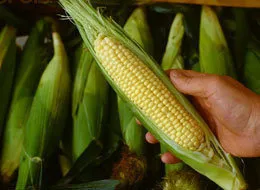
In America we grow a lot of corn, more than any other country. Last week, the USDA announced that 87 million corn acres -- the second highest amount ever -- were planted in 2009. It's a push for corn as fuel, not as food, that's spurring Midwest farmers to grow more corn. And there's a link between corn-ethanol production and the recent news that the Gulf of Mexico dead zone was more severe than in past years, which continues to jeopardize Gulf fisheries valued at $2.8 billion.
On the surface, growing more corn makes good sense. We can use it to produce
ethanol, reducing our demand for foreign oil. But my fellow scientists and I
have identified a troubling consequence of this headlong rush towards energy
independence: the fertilizer used on the corn fields is the principle
culprit responsible for the dead zone, a huge swath of ocean devoid of fish
and shellfish.
No crop can absorb all the fertilizer applied to it, but corn is especially
bad. Its shallow roots mix the nitrogen below the top few inches of soil, and
unlike most plants, corn takes up nitrogen for only two months of the year.
A quarter or more of the nitrogen fertilizer is wasted, running off the fields and into rivers and streams, which eventually drain into the Gulf.
The Obama administration claims to strongly support efforts to reduce
nitrogen and phosphorous levels in the Mississippi River Basin by 45
percent. But at the same time, the administration wants to raise the maximum
amount of corn ethanol permitted in gasoline from 10 percent to 15 percent.
These cross-purpose directives underscore the corn-ethanol conundrum. On the
one hand, what's wrong with subsidizing a home-grown fuel? On the other, who
can stand by while chemical fertilizer use in the Midwest destroys marine
life and releases nitrous oxide -- a greenhouse gas 300 times more potent
than carbon dioxide in its ability to warm the planet?
As a nitrogen scientist and author of a recent international science report
on biofuels' impact on the environment, I understand the dark side of
corn-ethanol policies.
The artificial drainage systems common in upper Mississippi River Basin corn
states exacerbate the problem, sending excess nitrogen to the Gulf of
Mexico. There, it spawns algae blooms that consume available oxygen,
suffocating aquatic life. Fish, shrimp and other shellfish that are the
mainstay of commercial fishing along the Gulf cannot survive in the Gulf's
8,000 square mile dead zone.
Dead zones caused by excess nitrogen kill marine life across the U.S., from
the Chesapeake Bay to California's Monterey Bay. On the shores of Cape Cod,
which I have studied since the 1970s, murky green waters now fill the bays
once dominated by healthy seagrass meadows. Scallop populations are
declining, and the habitat quality of these nursery grounds for other fish
and shellfish gets worse every year.
There are viable alternatives to corn-ethanol that allow us to produce
biofuels domestically without all of the environmental side effects. For
example, biofuels developed with switchgrass would provide a less-polluting
source of energy. Switchgrass is a fast-growing, tall prairie grass native
to North America that requires less water and chemical fertilizer than corn,
and it's being produced now in states like Tennessee, where the state
government is developing a biorefinery to produce ethanol from non-food
crops. Plantations of small trees like willow and poplar provide another
source of fuel more benign than growing corn.
The drive to produce biofuels from corn will only worsen the nation's
growing nitrogen pollution problem. As we consider a biofuels policy, we
need to remember that more corn-based ethanol production equates to
devastated marine fisheries in the Gulf of Mexico and elsewhere. Perhaps
it's time to give Gulf fisheries a much-needed break.