iPhone app iPad app Android phone app Android tablet app More

Featuring fresh takes and real-time analysis from HuffPost's signature lineup of contributors
Robert Kuttner

Robert Kuttner

Posted: September 27, 2009 10:25 PM

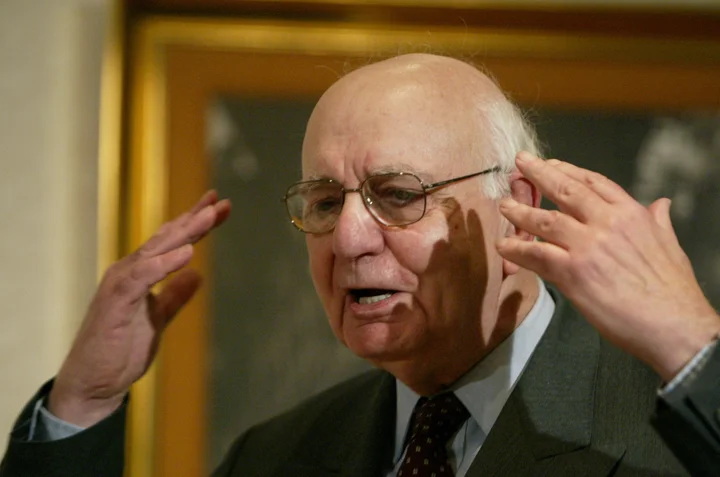
Listening to Paul Volcker

What's Your Reaction:

You know how far politics has swung to the right when the most left wing guy in the room is the former chairman of the Federal Reserve. But that's what financial reform has come to.

Paul Volcker was an early backer of Barack Obama. He counseled Obama on one of the best speeches of his campaign, his March 27, 2008 address on financial reform at Cooper Union, and sat in the front row as Obama delivered it. This was the speech where Obama declared that no corner of the financial system should be unregulated. And when Obama clinched the Democratic nomination, Volcker was introduced as a senior advisor.

But when it came time to allocate the jobs, the people with the real power managed to freeze out the grand old man of finance. Volcker, who had been touted as a possible treasury secretary, ended up chairing an advisory panel with little influence, the President's Economic Recovery Advisory Board, and for the most part his phone doesn't ring. The board, appointed last year, did not even have its first meeting until May 20.

Yet Volcker has continued to speak out, and he is worth listening to, even if the White House is ignoring him. In his recent testimony before the House Financial Services Committee, Volcker made it clear that he had serious reservations about the recent administration and Federal Reserve policy of propping up financial institutions deemed "too big to fail." Volcker said that the actions amounted to an unintended and unanticipated extension of the official "safety net," an arrangement designed decades ago to protect the stability of the commercial banking system. The obvious danger is that with the passage of time, risk-taking will be encouraged and efforts at prudential restraint will be resisted. Ultimately, the possibility of further crises -- even greater crises -- will increase.

Volcker explicitly challenged the very centerpiece of the administration's proposed reform program, the idea of focusing on "systemically significant institutions," which presumably would come in for additional supervision, but would be rescued if they got into trouble. Volcker said:


The approach proposed by the Treasury is to designate in advance financial institutions "whose size, leverage, and interconnection could pose a threat to financial stability if it failed." Those institutions, bank or non-bank, connected to a commercial firm or not, would be subject to particularly strict and conservative prudential supervision and regulation. The Federal Reserve would be designated as consolidated supervisor. The precise criteria for designation as "systemically important" have not, so far as I know, been set out. However, the clear implication of such designation, whether officially acknowledged or not, will be that such institutions, in whole or in part, will be sheltered by access to a Federal safety net in time of crisis; they will be broadly understood to be "too big to fail."


Think of the practical difficulties of such designation. Can we really anticipate which institutions will be systemically significant amid the uncertainties in future crises and the complex inter-relationships of markets? Was Long Term Capital Management, a hedge fund, systemically significant in 1998? Was Bear Stearns, but not Lehman? How about General Electric's huge financial affiliate, or the large affiliates of other substantial commercial firms? What about foreign institutions operating in the United States?

And, without using the words, Volcker in effect called for a restoration of the core principles of the Glass-Steagall Act, separating commercial banking from investment banking and proprietary trading. He said:

As a general matter, I would exclude from commercial banking institutions, which are potential beneficiaries of official (i.e., taxpayer) financial support, certain risky activities entirely suitable for our capital markets. Ownership or sponsorship of hedge funds and private equity funds should be among those prohibited activities. So should in my view a heavy volume of proprietary trading with its inherent risks.

Volcker made similar remarks in a speech in Los Angeles earlier this month. The point is that there is an entirely orthodox view of how to reform the financial system well to the left of the administration's. Similar criticisms have been made by progressives like Paul Krugman and Nobel Laureate Joseph Stiglitz, as well as relative conservatives such as former World Bank chief economist Simon Johnson. But it doesn't get much more orthodox than Paul Volcker.

As Congress deliberates the details of financial reform, several of the key elements of the Obama program fall short -- the idea that "systemic risk regulation" should just be bucked to the Federal Reserve; that immense financial conglomerates are perfectly fine as long as the Fed is keeping an eye on them -- the same Fed that totally missed the sub-prime disaster and that is owned by its member banks; the acceptance of the premise that customized derivative securities need not be traded on exchanges; the continuing toleration of the business models of behemoth financial conglomerates such as Goldman Sachs, which mix investment banking, hedge-fund speculation, proprietary trading for their own accounts, and commercial banking -- making them walking conflicts of interest.

Last week, there was a revealing skirmish on the House Financial Services Committee. The administration blueprint for reform, issued last June and currently being debated in several Congressional venues, includes a Consumer Financial Protection Agency (CFPA). In the draft sent to Congress, the proposed Agency had the authority to require that in addition to marketing other, more complex and risky retail products, banks and other institutions would be required to offer "plain vanilla" products. For example, a bank that marketed more lucrative and risky adjustable rate mortgages would also have to offer a traditional 30-year fixed rate mortgage. A similar "plain vanilla" requirement has been part of New York State banking law for three decades.

But when the White House endorsed the idea, the banking lobby went berserk. It targeted members of the Financial Services Committee, offering campaign contributions to friendly legislators and threatening to support the opponents of pro-consumer members. On September 22, Chairman Barney Frank sent his colleagues a letter declaring that he would oppose any "plain vanilla" language, adding that in his draft of the bill: "Financial institutions will not be required to offer plain vanilla products and services and CFPA will not have the authority to approve or change business plans."

Testifying the next day, Treasury Secretary Timothy Geithner, never an enthusiast of the proposed consumer agency, said Frank's changes were fine with him. But of course, the whole point of consumer regulation is to require banks to "change business plans" when those plans are built around insane products such as sub-prime loans or usurious credit cards. The bill is not even out of committee and the bankers' lobby is having its way.

If the American financial system needs anything, it needs a lot more plain vanilla -- fewer products of Byzantine complexity that serve no economic need other than the profit of their sponsors, less excessive risk, and more service by financial institutions to the real Main Street economy. We should be paying a lot more attention to plain vanilla type guys like Paul Volcker.

Robert Kuttner is co-editor of
The American Prospect and a senior fellow at Demos. His best-selling book is Obama's Challenge.


You know how far politics has swung to the right when the most left wing guy in the room is the former chairman of the Federal Reserve. But that's what financial reform has come to. Paul Volcker was ...
 
 
  • Comments
  • 153
  • Pending Comments
  • 0
  • View FAQ
Comments are closed for this entry
View All
Favorites
Recency  | 
Popularity
Page: 1 2 3 4 5  Next ›  Last »  (5 total)
08:56 AM on 10/01/2009
When Paul Volcker speaks NO ONE with authority listens! That is unfortunate since he knows from where he speaks.

Nothing will change on Wall Street until WE the PEOPLE take command of the situation. When we show our disgust and protest only then will Wall Street, CONgress, and Obama will sit up and take notice.

See how: http://www.youtube.com/watch?v=QmFzeaqMu8U

http://eye-on-washington.blogspot.com
05:29 PM on 09/30/2009
Anyone who thinks that bettter regulation would fix the system is part of the problem, not the solution.

Because the call for better regulation (which in fact is much needed) detracts attention from an essentilal unfaced truth: even with perfect regulation and honest behavior on the part of all lenders and borrowers, the present money and banking system is STILL doomed to collapse. It is inhenetly unstable, unsustainable in the long run.

Why? Because it is based on fractional reserve banking, which REQUIRES that debt keep increasing forever without limit. But that's impossible; when debt gets to the point where no more creditable borrowers can be found, and banks begin to fail for making bad loans, the system is bound to freeze up in a credit crunch. This is very likely what is happening now, and regulation, however needed it might be, cannot fix that inevitable collapse.

What's needed is a sustainable banking system with 100% reserves, and creation of the the money supply by the government, not the banks.

See www.thewebofdebt.com and www.monetary.org for more on this.
01:57 PM on 09/30/2009
My neck grows six inches when THAT name appears before me.

Might I remind you that that guy raised the credit rates to OVER TWENTY PERCENT to make struggling new democracies in Africa and south America slaves to the ones who had paid there torturers before they raos up to fight them?

Volcker was part of the people who made the victims of torture pay for the equipemnt they were tortured with!!!

And we are surprised when the people we made dictators torture and murder hate us.

And we forget what we did and put someone like Wolcker in a position of importance instead of Jail where he belongs.

Stunning.
photo
ibsteve2u
Someone who cares - to his unending regret
04:07 PM on 09/29/2009
"How about General Electric's huge financial affiliate..."

People should be made to understand the GE/high finance/CNBC link when the latter's talking heads rail against regulation in the finance industry.

They're all the same people.
guilatty
Something has got to make sense eventually
01:41 PM on 09/29/2009
Why do all these posters insist on attributing the present financial crisis to Fannie Mae and Freddie Mac? There are billions of dollars worth of foreclosures in this area on poorly planned shopping malls, office space, industrial parks, McMansions, empty subdivisions, flippers gone awry, cockamamie business ideas, etc. Nothing to do with low-income housing. You also had a quick run-up in fuel prices, two very expensive wars, an aging population that is becoming increasingly unproductive, a technological boom that had matured and wasn't creating much new value, ridiculous imbalance of trade, and a laissez-faire government that let corruption flourish. Enron was the canary in this coal mine. The corruption attracted most of the young talent into the ridiculously overpaid financial services industry instead of engineering, production, R & D, politics. And blaming the government is like blaming the gun in a homicide. Corporate America pulls government's trigger. This fourth branch of government has no check or balance on its power, you can't vote for its leadership, and it offers no due process or equal protection. Now that it controls government we are hastening toward the plutocracy this country was supposed to be insulated against.

The astonishing thing to me is how deeply the populace has swallowed the hook. We have people hating their government when it is the only thing standing between us and the power of the corporation. Flawed though it is, it is all you have. Make it better.
03:02 PM on 09/29/2009
Very well said.
photo
HUFFPOST SUPER USER
Mike Hihn
Political Writer
06:44 PM on 09/29/2009
>>>>Why do all these posters insist on attributing the present financial crisis to Fannie Mae and Freddie Mac

Because that's where it all began -- they both packaged and sold subprime loans (at a profit) -- while Democrats actively resisted any regulation at all -- apparently to protect a major cash cow.

>>>The astonishing thing to me is how deeply the populace has swallowed the hook.

Somebody has :-)

>>>We have people hating their government when it is the only thing standing between us and the power of the corporation

Don't we wish.

It's not government that a majority of voters hate -- it's the corruption in BOTH parties selling us out for cash. In this case, Democrats sold us out for $200 million from TOTALLY UNREGULATED PRIVATE CORPORATIONS who wanted to remain that way.

Barney Frank is now running around , snarling about financial regulation -- but back then, see for yourself.

Republicans, fearing a financial collapse, wanted stiff regulations over Freddie Mac and Fannie Mae. In the C-Span videos linked below -- watch Democrats shamelessly defending their corporate owners by refusing to regulate, and accusing the Republicans of making hysterical accusations!

Under the guise of affordable housing, Democrats pushed a massive increase in bad mortgage loans, throwing massive profits to their cash cows, causing the mortgage meltdown, nearly destroying our entire financial system, and causing a worldwide financial crisis.

http://politicallyhomeless.net/?p=283

Tell us again, please: WHO provides our only protection from corporations?
02:00 AM on 09/30/2009
I realize that you, like all right wingers, really think you know what you're talking about. But if you hadn't swallowed the corporate created, Fox News spewed hook, you would recognize that Fannie and Freddie were bit players in the catastrophe that occurred, and that the vast majority of sub-prime mortgages were written by private insurers, and that the real cause of the collapse was the irresponsible "securitizing" of these mortgages by banks and the exponential increase in risk when companies like AIG issued insurance on these bundles of mortgages.

The banks and insurers turned the mortgage market into a Vegas Casino. And when housing prices turned south, the Casino called in their chips and financial chaos ensued. Do some reading beyond your "government is the root of all evil" sources and educate yourself.
12:35 PM on 09/29/2009
I think Volcker is absolutely correct. I watched him this A.M. He is a very brilliant and honest man and perhaps Pres. Obama is not listening to him enough, but, instead, is being guided by Geithner who is doing the same old thing he did when he was a Wall Street man - sounds like Volcker is warning us that we are headed for the bail-out of banks all over again and Pres. Obama is listening to Geithner and should be listening to Volcker more.
12:17 PM on 09/29/2009
Too big to Fail?

If so they are too big to be allowed to exist in the first place. Banks serve a purpose in the economy, but they need to be reminded that they exist for the economy, it does not exist for them.

Actually, someone need to remind the politicians that THEY are supposed to serve the taxpayer, no the other way around. I am not speaking of O'bama; he seems to mean well but be greatly hampered by both dog-in-the-manger Republicans and Dems who act like Republicans. But too many pols act like the taxpayers are their personal ATM machines. Bush and Cheney are perfect examples. Start a couple wars on falsified evidence and pocket billions on the 1000% jump in the value of your Halliburton stock? Hey, why not? If God didnt want us to fleece them, why did He make them such sheep?

Of course, to the republicans greed is a virtue. But there are plenty of Dems who act like Repubs.
11:01 AM on 09/29/2009
I'm sorry to all you Paul Volker Fans, but how old were you when he ran the economy in the ground in the early 80's under Ronnie Ray gun ????

Yes, interest rates were high under Carter, but immediately after Ray Gunn took office they went through the roof got up to 16% to buy a house. This created the term STAG FLATION. Ray Gun did the same exact thing Dubya did run up the National Credit Card.

Obama is totally blindsided by Paul Volker. Volker is probably going broke and will say just about anything for money...............
photo
HUFFPOST SUPER USER
Mike Hihn
Political Writer
12:43 PM on 09/29/2009
>>>>I'm sorry to all you Paul Volker Fans, but how old were you when he ran the economy in the ground in the early 80's under Ronnie Ray gun ????

Old enough to know that the Volcker Recesssion began in early 1980, under Carter.

Old enough to have lost a succesful business, for market interventions even Volcker now admits were wrong.

Old enough to know that Volcker's failure meant Banks and S&Ls had to pay 12% or more just to hold their deposits. S&Ls were invested almost entirely in morgages at FIXED RATES as low as 6.5% (my own mortgage at the time).

In effect, Volcker polcy had forced banks to borrow money as 12% and lend it out at 6-1/2% to 8-1/2%. Do the math.

>>>>>Yes, interest rates were high under Carter, but immediately after Ray Gunn took office they went through the roof got up to 16% to buy a house

Bzzt. Interest rates had already peaked. The Prime Rate was 21% when Reagan too office.

>>>>This created the term STAG FLATION.

(LOL) Staglation was a 1970s problem that Volcker was appointed to fix. Obviouly he failed.

www.PoliticallyHomeless.net "The New Majority: Americans fed up with BOTH parties.
12:52 PM on 09/29/2009
You are WRONG...........

Stagflation is an 80's term. Ray Gun looted Social Security to pay for his huge deficits in defense spending. I am not saying things were great under Carter, but for the middle class
Ray gun made them much worse, stagnant wages and high prices.

All results of the 1973 Oil Embargo under Nixon
HUFFPOST SUPER USER
Eggsackley
Organic gardener & growers marketer.
02:15 AM on 09/29/2009
Volcker is a voice of reason. And, amazingly, Alan Greenspan is becoming one. I agree that the core of the Glass-Steagall Act should be restored, and that we need a consumer protection agency. The banks reaction to that proposal is the best proof that it is needed. I also agree that attempting to designate institutions as too big to fail is dangerous. Any such designation will distort the free market. If an institution has too big a share of a market, it should be an anti-trust issue. AIG should never have been allowed to get that big.
10:32 PM on 09/28/2009
--"But of course, the whole point of consumer regulation is to require banks to "change business plans" when those plans are built around insane products such as sub-prime loans or usurious credit cards. The bill is not even out of committee and the bankers' lobby is having its way." --

Barney Frank let us down on CFPA (Geithner never was trusted). CFPA was a worthy proposal and not even all that is needed -- promoted by Obama admin as ounce of prevention that is a cure for the effect of the financial sector. As with healthcare, Congress and the Corporatists seem to believe that the avg American has no choice but to be a sucker. They are behind the times, for the system has let us all down and it will take more than they are doing to restore trust/participation. Distrust is a disincentive to put your welfare in the hands of companies above the law.
09:39 PM on 09/28/2009
Mr. Volcker's time has come, and he should be listened to. Let the banks fail. Some things fail in business, life, and opportunity. Some things cannot be bailed out; and there should be no attempt to do so when so many questions go unanswered, or they have otherwise so far deviated from the norm.

Let them fail. New, better prepared and thought-out business (banks) will take their place. How many insurance agencies are covering the gamblers at Las Vegas so the gambler doesn't get hurt or suffer loss, and can gamble again the next time, and the next time...with the same bailout guarantee in place?
09:30 PM on 09/28/2009
Fan of Kuttner, but I am surprised by the intellectual laziness of the opening:"You know how far politics has swung to the right when the most left wing guy in the room is the former chairman of the Federal Reserve. But that's what financial reform has come to."

*Sometimes integrity is not a right or left issue.*

How far corrupt everyone is, Dems and Repubs, when a respected economist, who has been excluded by the Dem WH, is advocating more accountability and responsibility than the group elected on its supposed progressive values. Volcker's being a Republican, did not stop him from standing up to Reagan.
photo
HUFFPOST SUPER USER
Mike Hihn
Political Writer
10:57 PM on 09/28/2009
>>>Volcker's being a Republican, did not stop him from standing up to Reagan.

(LOL)_You might try thinking for yourself, instead of parroting the loonier parts of the left.

He "stood up" to Reagan untill October of 1982, when he realized his policies had been a disaster -- the worst recession and highest employment in 50 years. Volcker FINALLY adandoned his failed policy in late 1982.


Unlike Barney Frank, who caused the mortgage meltdown, Volcker publicly admitted his error.

That hasn't stopped the loonier left -- Reagan Deniers are like Holocaust Deniers -- from claiming it was Volcker, not Reagan who ended the Volcker Recession!! --- supported by a psychotic set of lies and distortions for their non-thinking supporters. Birthers of the left

Heres a link to Volcker being man enough to desribe it all. http://www.econbrowser.com/archives/2007/02/how_paul_volcke.html

There is a word limit here, so I've included just the key phrases from that link::

"... I thought it was a reasonably strong move and we'd get a favorable reaction in the market, but we didn't. ... So the market reacted very badly, which surprised me. I guess I was a little naive."

"Then in October [1982], or whenever it was, the money supply (by some measures) was increasing again rather rapidly. ...We came to the conclusion that it was not very reliable to put so much weight on the money supply any more, so we backed off that approach"
photo
HUFFPOST SUPER USER
Josh Seipp
09:16 PM on 09/28/2009
Great piece, I hope it gets some attention.
08:40 PM on 09/28/2009
While most of the bloggers appear to miss the point of your article, or are oblivious to it's content, I applaud you for it. Exactly spot on. "Plain vanilla" common sense tends to be the economic elixir to the systemic illnesses we now face. A successful economy requires real investment in real products and services that provide long-term positive returns. Our economy is doomed to failure re-creating the wheel in different forms all the way "creating (and ultimately destroying) share-holder value." The real wealth of this country continues to be auctioned off to the world leaving us with seemingly nothing to pay our debts and maintain anything close to our present standard of living.
07:02 PM on 09/28/2009
Listening to Paul Volcker is like hearing the rattler of a Diamondback.

At his Fed confirmation hearing in 1979, he infamously stated: "The American standard of living must and will come down."
photo
JayDDrew
Facts are neither conservative or liberal.
08:07 PM on 09/28/2009
And George W. Bush was either in a drunken haze, using cocaine, or both. But 20 years later, he ran for President. And we elected him. Twice! (At least, that's what they told us.)
Financial and economic predictions are as reliable as forecasting the weather. If you make any reasonable prediction, you'll be right, sooner or later.
11:59 PM on 09/28/2009
George W. Bush is insignificant. He was a front just like Obama. No one has been in control of the White House since JFK and for a while, Nixon. To some degree, old man Bush was in control because of vast experience and and even more vast connections.

No individual who cannot be bought will ever be elected President of the United States again.

What made Volcker's 1979 statement so important and what makes it scary that he is where he is now is that his prediction immediately came true. The whole shebang was manipulated then as it is now.

The decade of the eighties saw the Treasury looted, the Savings and Loans go belly up--costing ordinary Americans their life savings, and Wall Street addicted to cocaine--not to mention Iran-Contra.

By the time Lee Atwater helped GHW Bush win a "third term" in office, we were in a drastic downward spiral.

We needed a "real" war and we got one. #41 conned Hussein into a war he had no chance of winning, we spent tons of money and now we maintain a huge military base in the very land where many of the 9/11 terrorists called home.

A chessboard folks; that is all the world is to the Elite power brokers.
photo
HUFFPOST SUPER USER
Josh Seipp
09:16 PM on 09/28/2009
I agree with him.