
The other week was National Arts Advocacy week in Washington, D.C. Officially, Tuesday April 5 was Arts Advocacy Day, but it was so action-packed it took the whole week. The time period was a complex one in the nation's capital; a government shutdown was looming, and endless bickering threatened reasonable discourse and honest outcomes. But that didn't stop the arts.
Six hundred leaders from every part of America gathered on Capitol Hill to say that the arts are essential to the soul, the community, the economy and to the nation. And even though the government was still operating on Arts Advocacy Day, one early shutdown casualty was our congressional hearing about the arts. It was cancelled. We now know that the shutdown will not happen although it is just becoming clear how much support the arts will be receiving this year as the details are negotiated and finalized. But that too was not enough to stop the arts. Those of us slated to testify at the hearing took our testimony directly to the people: the 600 gathered there in the House of Representatives' Cannon Caucus Room, the hundreds of thousands online, the millions reached through social media, and the rest of the nation through TV and video.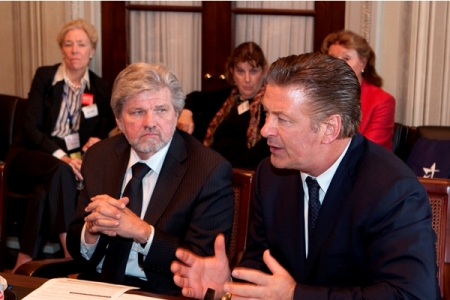
In our testimony, we illustrated how the many obstacles out there were not enough to stop the arts.
Actor Kevin Spacey asked the question "Do the Arts Matter?" as he had done the evening before in his riveting Nancy Hanks Lecture on Arts and Public Policy. He used his own life experiences as a shy, young boy whose life changed because of acting and the influence and help of a mentor artist, the great Jack Lemmon. Business leader Edgar Smith of Cincinnati illustrated how truly great communities depend on cultural stimulus. Mayor Elizabeth Kautz of Burnsville, MN, and president of the U.S. Conference of Mayors testified that the arts are at the top of the list of what mayors need and asked for from the administration to guarantee safer, stronger, more successful cities. Alec provided statistics about the slippage of Private Sector Support to the Arts that were a direct result of the last major federal arts cuts. And Robert thanked Ranking Minority Member Congressman Jim Moran (D-VA) and Congressman Mike Simpson (R-ID), who chairs the committee overseeing funding to National Endowment for the Arts, for their critical bipartisan support and leadership for the arts.
The most crucial parts of the day, however, were the one-on-one meetings with members of Congress. Arts advocates visited nearly all of the 435 members of the House of Representatives and most members of the Senate, and they had quite a battle in front of them.
Half (217) of these House members had just voted to cut the NEA by $20.6 million during consideration of HR1, a long-term Continuing Resolution (CR) in February, 2011. In the base CR legislation, 209 House members voted against the cut. (If just eight members of Congress had felt differently, the amendment to reduce would not have passed.) In earlier House negotiations the NEA budget had already been reduced to $145 million.
Still, arts advocates were there from every corner of our nation to make their case for the arts. And they did. They were also able to hear useful information about the issues the members care about most. Some care about jobs above all else, some about children, and others think their particular district doesn't get enough attention. All however, care about their own local communities, the opinions of their own local constituents and the stories of their voters and families of those constituents.
But guess what? These are the stories that all of us in the arts have: stories of the arts changing a child's life; stories of the arts humanizing a hospital environment; stories about the arts revitalizing a rural or urban downtown; and even stories about how the arts today are working with the military to find ways to save lives, help heal wounded warriors and contribute to our national security. We have stories about how the arts are not part of the problem but part of the solution to America's problems in every community, and yes, in every congressional district... at the very least eight more.
You see, tough questions and specific non-arts needs are not enough to stop the arts. The arts have worked hand in hand with every other industry and every other part of society for hundreds of years to build America. We just need to keep educating each new crop of leaders as they arrive in Washington, or in state capitals, or in city halls, or in corporate America or at foundations, one by one, again and again. The arts do make a difference and so do the efforts of advocates and congressional leaders from both sides of the aisle. In the FY 2011 Budget that Congress finished up last week $25 million of the funds for arts education that had been eliminated were restored and the cut to federal funding for the NEA and the NEH which had been voted by the House to be 26% ended up at a more reasonable 7%. It's a start.
So the next time we come knocking on the doors of Congress, if they want to hear stories of children whose lives have been changed by the arts, we will bring those children. And if they want the stories of workers who are back in business because of the arts, we know those workers. And if they want to meet a group of citizens and voters who are passionate patriots about a better America through cultural opportunity, we have a few hundred million arts consumers from 50 states and all 435 congressional districts eager to come to their offices to say hello... and show our elected officials in person why support for the arts is a priority for America and must be a priority for Congress.