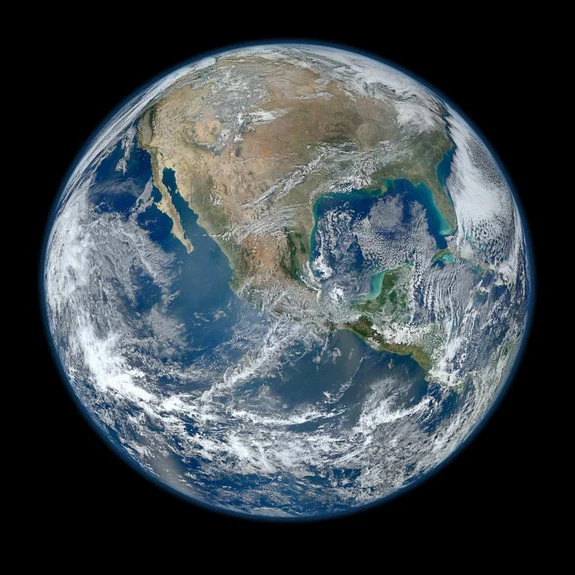
The story of Earth is a drama of constant, sometimes violent, change. Volcanoes, earthquakes, colliding tectonic plates and giant asteroid impacts have all imposed their transformations on Earth's outer layers. Yet, in what is becoming one of the biggest surprises in modern geology, it now appears that the most significant agent of change of Earth's near-surface environment is life. The evidence is everywhere, locked in almost every rock and mineral, but was hidden in plain sight.
My background is mineralogy, a field that has long been taught in a manner strangely divorced from the grand story of Earth. It's an inexplicable bias, for minerals form the solid Earth. Everything we know of Earth's distant past comes ultimately from evidence locked in the minerals. Yet the majority of mineralogists rarely talk about the ages or evolution of their samples. Rather, for more than two centuries mineralogical research has focused on their static physical and chemical properties. This mindset reflects mineralogy's origins in mining and chemistry, colored perhaps by a subliminal belief that the fields of physics and chemistry are more rigorous and thus a bit more "scientific" than the creative storytelling of the geologists. Consequently, few mineralogists had thought about the astonishing changes in Earth's near surface mineralogy through time.
That traditional perspective is changing with the growing conviction that rocks and minerals played central roles in life's origins. Some of the first experiments in origins-of-life chemistry mimicked ancient Earth by confining water and simple volcanic gases in a glass container while zapping the mixture with electric sparks -- a simulation of lightning in an atmosphere above an ocean. Those experiments produced such basic molecules of life as amino acids, the building blocks of proteins, but the complex chemistry leading to the first living cell required a lot more than oceans, the atmosphere, and some lightning. Our experiments show that crystalline surfaces of minerals could have facilitated life's origins by selecting and concentrating biomolecules, protecting those molecules from degradation, and promoting a host of biochemical reactions. It's easy to conclude that minerals are essential for life's origins.
In a startling turnabout, it now appears that life is essential for the origins of most minerals. In 2008, our research team wrote an unusual paper entitled "Mineral Evolution" -- an attempt to reframe mineralogy as an historical science. This venture into the mineralogical history of Earth posits that our planet's mineralogy has evolved through a sequence of stages, each of which saw changes in the diversity and distribution of minerals. Earth progressed from mineralogical simplicity to complexity, from only about a dozen minerals in the dust and gas that made our Solar System, to more than 4500 known mineral species today.
Looking at a familiar field from a new perspective can lead to unexpected results. We asked, for example, "What was the first mineral in the universe?" The answer -- diamond, which formed in the cooling carbon-rich envelopes of the first exploding stars more than 13 billion years ago -- was almost as surprising as the fact that no one seemed to have asked that question before.
Our biggest surprise was that 3,000 different minerals -- about two of every three known species -- are the indirect consequence of photosynthetic production of oxygen. We estimate that non-living, Earth-sized worlds like Venus are limited to about 1,500 different minerals. And Mars, too small to have enough inner heat to rework its crust, may have no more than about 500 different minerals. When you visit a mineral museum and see row after row of colorful minerals of copper, uranium and nickel, you're seeing the consequence of a living planet. The international media quickly picked up on the finding that life and minerals coevolved. One hyperbolic reviewer called our paper "the first paradigm shift in mineralogy in two centuries."
To put quantitative flesh on the bones of the mineral evolution hypothesis we needed to examine individual groups of minerals. That's why we contacted Ed Grew, Research Professor in Earth Sciences at the University of Maine and the world's expert on the minerals of the rare elements beryllium and boron -- elements that occasionally concentrate in big, beautiful crystals. Ed knows all 108 officially approved beryllium minerals like old friends. Each has a character; each plays a geological role. So we asked him when they first appeared, what processes led to their diversification, and have any beryllium minerals become "extinct?" No one had ever tried to answer such questions. To tease out when each species first appeared or disappeared is a monumental task. After a year of toil, Ed Grew produced a landmark graph showing the cumulative number of beryllium minerals through time.
As expected, it took a very long time for the first beryl to appear -- almost 1.5 billion years. The element beryllium is present at only about 2 parts per million in Earth's crust, so it takes time for hot fluids to select and concentrate that trace beryllium into a fluid that can precipitate beryl crystals. For another billion years only about 20 different beryllium minerals appeared. The biggest pulse of new minerals had to wait for the atmosphere to become laced with oxygen -- the consequence of photosynthetic life. Ed Grew followed up with an even more impressive survey of the 263 known boron minerals, and once
again he observed a doubling of the number of species after the rise of oxygen.
The implications are clear. The seemingly lifeless science of rocks and minerals is inextricably linked to biology. Life is among the most powerful agents of geological change. We cannot understand our planet's history, nor can we predict its future, without a keen sense of the coevolution of the geosphere and the biosphere.
Robert Hazen is Senior Scientist at the Carnegie Institution of Washington's Geophysical Laboratory and Robinson Professor of Earth Sciences at George Mason University. This essay is adapted from his latest book, The Story of Earth (Viking, 2012).