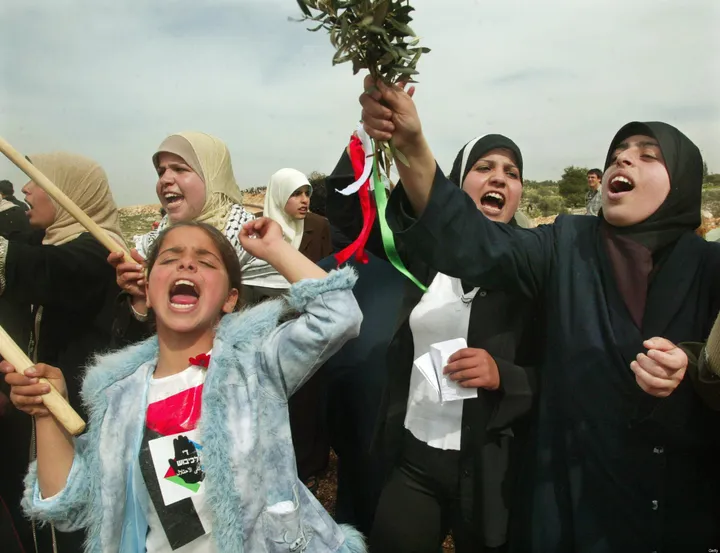
Many have long maintained that a mass-based and sustained campaign of nonviolent Palestinian resistance -- a "White Intifada" -- if vigorously supported by a united Palestinian leadership and by Israeli, Arab, and international peace and solidarity movements, could end the Israeli occupation of the West Bank, Gaza, and East Jerusalem.
The assertion is inherently speculative. The claim can never really be proved false, because if such a campaign were organized and did not succeed, it might still be true that it might have been successful had it only been more sustained, more widespread, more supported from the outside.
And there's only one way that the claim can ultimately be proved true: for such a campaign to be organized, and for such a campaign to win.
But one way to provide strong evidence for the claim would be to organize such a campaign in one place in the West Bank, for the campaign to be sustained long enough to attract significant Israeli and international support, and -- crucially -- for the campaign to win.
That is what the Palestinian residents of the West Bank village of Budrus did. They effectively conducted an experiment, by organizing a campaign of nonviolent resistance against the Israeli government's plans to route its "Separation Barrier" through their village lands, confiscating their land and destroying their olive trees in the process, thereby destroying their livelihood and culture; by sustaining the campaign for 10 months; and by inviting Israeli and international peace activists to participate. The experiment was successful, in that the Israeli government was eventually compelled to move the route of the Separation Barrier back towards the Green Line -- the internationally recognized boundary between Israel and the West Bank -- and 95% of the village land and olive trees were spared. It was also successful as a beacon to others, in that other Palestinian villages have sought to replicate its success in resisting the Wall.
The documentary Budrus by Julia Bacha of Just Vision is a well-crafted and compelling account of this successful experiment. And as of yesterday, any American with a DVD player and a bit of extra cash can watch this compelling account, because as of yesterday, the movie is available on DVD from Typecast Films and Netflix.
The widespread availability of this movie in the United States could not come at a more propitious time, because recent political developments have created an excellent environment in which to "scale up" the Budrus "experiment" to all of the Occupied Palestinian Territories; and a crucial component of such a "scaling up" is a "scaling up" of U.S. interest, knowledge, and support. Nonviolent resistance is like a Pete Seeger concert: it works best with vigorous audience participation.
One of those recent developments is the historic reconciliation and cooperation agreement between all the Palestinian political factions -- not just Fatah and Hamas. The agreement showed the power of Palestinian public opinion to move the Palestinian leadership. Palestinian national unity is key to a successful nonviolent resistance strategy, a point illustrated repeatedly in the movie Budrus. In the film you see, for example, a local demonstration of Palestinians against the factional split and in favor of national unity, a scene repeated many times in the West Bank and Gaza in the run-up to the reconciliation and cooperation agreement. Ahmed Awwad, a local leader of Hamas in Budrus who cooperated with local Fatah leader Ayed Morrar in organizing the village's nonviolent resistance strategy, says:
"We suffer greatly from what is happening inside Palestine due to the political divisions. We must be like brothers because we know that unity is the only way to achieve victory."
A second recent development that favors a mass nonviolent resistance strategy in Palestine is the wave of democratic uprisings that have swept much of the region, which with the exception of Libya, have been overwhelmingly nonviolent. In particular, the success of the nonviolent democratic revolution in nearby and influential Egypt, and the instrumental involvement of Egypt's Muslim Brotherhood in that nonviolent movement, creates a new political context for nonviolent resistance, in particular because Egypt's Muslim Brotherhood has close relations with Hamas, but also because a "White Intifada" is now likely to draw more vigorous support from Egypt and the region than it might have in the past.
At the high political and abstract level, Hamas has a strong ideological commitment to the right of the Palestinians to engage in "armed struggle." But as a practical matter, Hamas is quite capable of vigorously supporting a strategy of nonviolent resistance on the ground.
This is illustrated in the movie Budrus, when local Hamas leader Awwad explains why he supported the strategy of nonviolence in struggling against the Separation Barrier:
If we use violence to oppose the Wall, the resistance movement would not last long. The Israeli army would see this as justification to say, 'They are terrorists,' and to use all their weapons as if they were fighting an army. But truly, the resistance against the Wall, done in a peaceful way, has given us international support.
International support of such peaceful resistance is sure to increase if the United Nations votes in September to recognize all of the West Bank -- including the villages currently struggling against the Separation Barrier -- as part of the territory of an independent Palestinian state. In much of the world, much of the time, the presence of women in demonstrations, especially in the leadership and the front line of demonstrations, acts as a strong deterrent against violence; in particular, in much of the world, much of the time, authorities are more reluctant to use violence against women in demonstrations. As a result, women often have more freedom of action to push back against authorities in the context of nonviolent resistance.
In much of the world, much of the time, the choice of nonviolent resistance as a strategy tends to encourage the participation of women, while the choice of violence as a resistance strategy tends to marginalize women's participation and leadership.
Thus -- much of the time -- there is a positive symbiosis between the choice of a nonviolent resistance strategy and women's participation and leadership. Nonviolent resistance encourages women's participation; women's participation tends to make nonviolent resistance more effective.
Budrus shines a spotlight on these important themes. Iltezam Morrar, daughter of Ayed Morrar, recounts:
The idea was to hold a lot of marches against the Wall, but I noticed that at first it was only men. There wasn't a single woman in the demonstrations. I asked my dad, 'How come there are only men in the marches?' I think women also have to be there... From then on, no march had only men. Marches now included both men and women.
The next thing you see is Palestinian girls confronting Israeli soldiers. Iltezam explains: "We saw the men trying to push the soldiers, and none of them could do that. But I think the girls could do it."
The camera captures Iltezan in her own "student faces tank" moment, which she narrates:
"I don't know what happened, but suddenly I found myself behind the line of soldiers and facing the bulldozer. I asked myself, what can one person do? I jumped in the hole. I was completely terrified."
Other women surround Iltezan, and the bulldozer begins to turn away. "The soldier could do nothing," Iltezan says, "except taking the bulldozer and going away... it's good to feel, even if you are small, you have nothing, but you could do all this."
Budrus highlights the role of Israeli peace activists in helping the villagers beat the Occupation.
Yasmine Levy, an Israeli border policewoman who served in Budrus, explains: "At times, left-wing Israelis joined the Palestinians. And because they were Jews, we couldn't use force against them. And they were at the front with the women, which made it even harder for us."
Not only do the Israeli peace activists help the villagers win, but their participation is politically transformative. Iltezam says,
I [didn't] know Israelis. I just [knew] the soldiers. I went many times to visit my father in prison and all the Israelis that I met were very, very bad. But now I know that not all Israelis are the same. Some of them think that we should live together in peace. I did not really think that one day I will have Israeli friends, or even that I would talk to Israeli women... Not all of them are soldiers. They don't really hate us.
Awwad, the local Hamas leader, says:
We had already heard that there were some Israelis who wanted peace with the Palestinians. But these demonstrators exceeded expectations. I saw in reality Israelis defending me from the soldiers of the Occupation. It was strange to see a Jew standing side by side with me, and our common enemy is a Jew as well, the soldier who is occupying my land. In these marches, I saw these Israeli voices in real life, it wasn't just something I heard about.
Just as the use of nonviolent resistance tends to engage women and the use of violence tends to marginalize them, the use of nonviolent resistance exerts a democratic pull even on movements that are otherwise hierarchical and the use of violence exerts an authoritarian pull even on movements that are otherwise democratic.
Budrus shows you this dynamic. The action begins, appropriately, not with a confrontation, but with a community meeting, in which Ayed Morrar wins support for a strategy of nonviolent resistance against the Separation Barrier. As the action proceeds, you see the villagers take greater and greater ownership of the strategy. After an all day stand-off forces an Israeli bulldozer to retreat without destroying any olive trees, a boy proclaims: "We stopped them. We can do it."
One of the Israeli peace activists says, "Ayed's approach is very democratic. And also on the personal level, he knows not to be the one that always decides, and to make people feel like they are part of the struggle."
You see this play out, when an escalation of Israeli army repression almost convinces Ayed a major demonstration should be canceled, because he is concerned that the village's kids will be endangered when they leave school. No, a companion says. We could go to the school, get the kids, walk them home, proceed with the demonstration. And that's what happens.
In contrast, when stone-throwing against Israeli soldiers breaks out in response to increased violence by the Israeli army, you see how the stone-throwing divides the villagers: it's not the strategy that they collectively agreed on, and it provokes more Israeli army violence against civilians.
Efforts to launch the "Obama Intifada" are underway. It's time to prepare the audience. The widespread viewing of Budrus in the United States will create the conditions in which Americans are ready to hear what the Palestinians are poised to say.
We can do it.