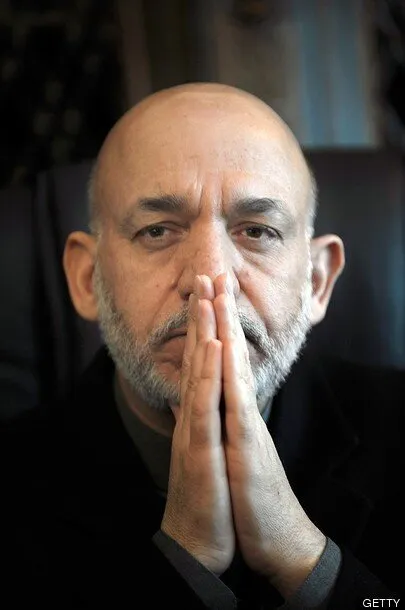
Pop quiz on the news: Who said this week, referring to the dispute between Afghan President Hamid Karzai and U.S. military commander David Petraeus over U.S. Special Forces "night raids" that break into Afghans' homes in the middle of the night:
Many Afghans see the raids as a... humiliating symbol of American power.
Was it:
a) Afghan President Hamid Karzaib) Ohio Representative Dennis Kucinichc) U.S. peace activist Kathy Kellyd) The New York Times
The correct answer is d, the New York Times. Here is the full quote:
Many Afghans see the raids as a flagrant, even humiliating symbol of American power, especially when women and children are rousted in the middle of the night. And protests have increased this year as the tempo has increased.
It is a striking symptom of the moral depravity of the US war in Afghanistan that the policy of night raids, which press reports have suggested is one of the most hated aspects of the U.S. military occupation among the Afghan population, has been the subject of almost no public debate in the United States. Newspaper columnists aren't inveighing against the night raids. Members of Congress aren't demanding that the night raids stop.
The only thing that has occasioned any public debate about them in the U.S. at all is that President Karzai denounced them in an interview with the Washington Post ahead of the NATO summit. And the response of U.S. officials is: wow, this guy Karzai is really an unreliable partner. Is he off his meds? He has some nerve complaining about something that Western press reports suggest is among the aspects of the U.S. military occupation most hated by Afghans.
And the U.S. military's defense of the night raids is basically this: we can't stop the night raids, because they are a cornerstone of our strategy. Is that supposed to be an argument? Petraeus is saying: if you stop the night raids, you stop the war. If that is true, then that is all the more reason to oppose the night raids.
Here is a thought experiment whose answer would tell us something fundamental about the United States: what if Afghans adopted a strategy of nonviolent resistance against the night raids? Could they be stopped?
Unlike U.S. air strikes, U.S. night raids require human contact.
Let's suppose, for the purposes of our thought experiment, that there were a well-organized popular movement in Afghanistan against the night raids. Let's suppose that this movement went around to respected Islamic scholars and got legal judgments that the night raids are an offense against Islam. Let's suppose that this movement prepared to defend villages where U.S. night raids are being carried out, and organized committees of unarmed women to implement this defense. And let's suppose that when a U.S. night raid began, a call would go out from the mosque, and a group of unarmed women would surround the house and say to the US soldiers: you're not coming in, and if you try, we will not move. And let's suppose that some Western NGO issued these women video cameras, as the Israeli human rights group B'tselem has issued Palestinians video cameras. And let's suppose that a group of people in the United States and Western Europe agreed that they would try to support this movement, by vigorously raising their voices in protest whenever US special forces tried to break the line of protesters.
Could the night raids be stopped?
If the night raids could not be stopped, were this thought experiment to come to pass, that would reveal something very terrible about the United States.
If one looks at the history of discussion of proposals to use nonviolent resistance to oppose foreign military occupations, a standard dismissal runs something like this: "sure, nonviolent resistance worked against the British in India, but it would not have worked against the Germans."
Leaving aside the possible implication that the British military occupation of India was a walk in the park (see: "Amritsar Massacre") let's suppose that the framework of this criticism is correct. Let's suppose that there is a kind of number line on which you can place foreign military occupations, according to which you can rate their susceptibility to moral pressure. On one point of the number line, you have the British occupation of India. And on another part of the number line, you have the German occupation of Poland. And somewhere in between, there is a dividing point. On one side of the dividing point, the British side, nonviolent resistance could work. On the other side of the dividing point, the German side, nonviolent resistance couldn't work.
Which side of the dividing point is the U.S. military occupation of Afghanistan on? The British side, or the German side?
If these examples seem long ago and far away for purposes of comparison, let us consider a contemporary example, which is extremely relevant to the U.S.: the Israeli military occupation of the Palestinian West Bank.
As shown in the documentary Budrus, Palestinians in the West Bank village of Budrus -- Palestinian women, in particular -- successfully used nonviolent resistance to defeat the Israeli military's plans to steal their land. (In the trailer below, note particularly the scene where Palestinian women push the Israeli soldiers.) Now, whether such a strategy can be successfully extended to other villages in the West Bank is very much an open question at the moment. But at least in this one village, it worked.
So, if there is no chance that nonviolent resistance could work against the U.S. military occupation of Afghanistan, that would imply that comparing the U.S. military occupation of Afghanistan to the Israeli military occupation of the West Bank on the number line of susceptibility to moral pressure, the Israeli military occupation of the West Bank is more like the British occupation of India, and the U.S. military occupation of Afghanistan is more like the German occupation of Poland.