
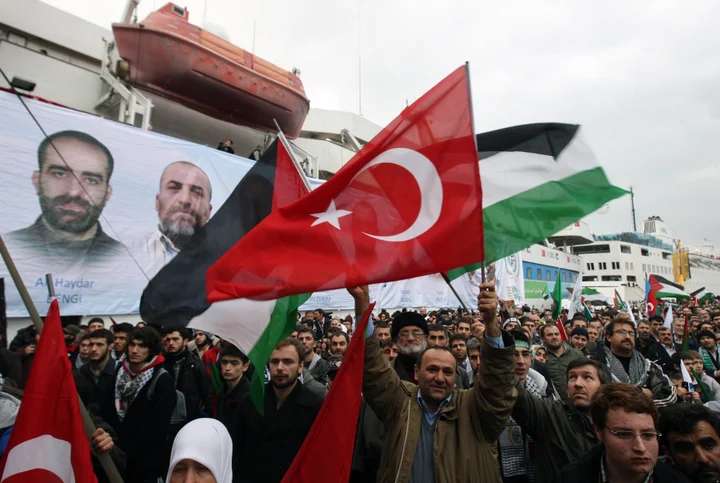
A year ago, peace and solidarity activists tried to break the blockade of Gaza with an international flotilla of ships. They failed, in the sense that the Israeli government attacked the flotilla, took control of the ships, and brought the ships to Israel. They succeeded, in the sense that the flotilla and the Israeli attack brought attention to the Israeli-U.S.-Egyptian siege of Gaza, dramatically increasing political pressure on the three governments, leading to a partial easing of the siege.
Now an even larger flotilla, with the participation of more ships and more activists from more countries -- including, crucially, the U.S. ship Audacity of Hope -- is preparing to set sail in June.
And -- God willing -- when the Audacity of Hope sets sail, I will be on it.
It is our hope and expectation that the Israeli government, after all the negative publicity it received for its attack on last year's flotilla, will allow our ships to pass to Gaza unimpeded. It is our hope and expectation that the Obama Administration will pressure the government of Israel not to attack us, especially with a U.S. boat with well-known American peace activists on board participating in the flotilla.
Nonetheless, there is certainly some risk of confrontation with the Israeli authorities. I can say with absolute confidence that everyone on the American boat is committed to nonviolence; if I were not confident of that, I would not go. If the Israeli authorities attempt to seize our boat, we may engage in nonviolent resistance, but we will not attack anyone and we will neither have nor use any form of weapon. If Israeli authorities attack us physically, the world will know that the Israeli authorities attacked unarmed Americans who were not a threat to anyone. That's a key component of what nonviolent resistance, from Montgomery to Tahrir to Budrus, is all about: not providing any excuse for the violence of the oppressor.
We engage in this voyage because the world, having accepted and even embraced the right of self-determination of Egyptians and Tunisians, cannot any longer deny this right to the Palestinians.
The siege that Gaza may face when the flotilla sets sail may be different in some ways from the siege that Gaza faced when the first flotilla set sail. After the first flotilla, an easing of the blockade was announced. But as the Guardian reported in November:
Gaza's 1.5 million people are still suffering from a shortage of construction materials, a ban on exports and severe restrictions on movement six months after Israel agreed to ease its blockade on the territory, according to a report from 21 international organisations.
The loosening of the embargo has done little to improve the plight of Gaza's civilians, according to the coalition, which includes Amnesty, Oxfam, Save the Children, Christian Aid and Medical Aid for Palestinians. It calls for fresh international action to persuade Israel to unconditionally lift the blockade.
According to the report, "Dashed Hopes," two-thirds of Gaza's businesses had closed since the blockade was tightened in June 2007.
Now the Egyptian government has promised to "permanently open" the Rafah crossing between Egypt and Gaza. This is certainly a very welcome development. But it is important to note the following:
1. As of now, Egypt's promise to open the border is a promise that has not yet been implemented and which could still be delayed or limited by external pressure.
2. In the past, even when the Egypt-Gaza crossing was "open," not all goods or people could pass. As Gisha, an Israeli NGO which campaigns for freedom of movement for Palestinians, noted on April 29:
Rafah was closed following the capture of the Israeli soldier Gilad Shalit in June 2006 and remained mostly closed until June 2010, when Egypt opened it in the wake of the flotilla incident. Between June 2010 and January 2011, 19,000 people per month on average crossed Rafah in both directions, 47% of the number of people who crossed monthly in the first half of 2006.
Today, passage through Rafah is limited to holders of foreign citizenship or residence, holders of visas (including students studying abroad) and those seeking medical attention or study in Egypt. Crossing for Palestinians is limited to those listed in the Israeli-controlled population registry. Since the regime change in Egypt, the number of people permitted to leave Gaza via Rafah has been limited to 300 per day. The crossing is currently open five days per week. Since the 2005 "disengagement", goods have not been permitted to pass via Rafah, except for humanitarian assistance which Egypt occasionally permits through Rafah.
3. Regardless of what Egypt does, there are important aspects of the blockade that are beyond Egypt's direct control or influence.
The Oxfam report noted: "ordinary Gaza residents are still denied access to their friends and family, and to educational opportunities in the West Bank, East Jerusalem and abroad."
Gisha noted "the need also to permit passage of people and goods between Gaza and the West Bank, recognized by Israel as a single territorial unit whose integrity is the basis for a two-state solution... since June 2007, Israel has prevented Gaza residents from transferring goods for sale to Israel or the West Bank, as part of a policy to separate Gaza from the West Bank. Security concerns cannot explain the ban, as Gaza residents are permitted to sell limited quantities of agricultural products to Europe -- via Israel and Israeli security checks. Gaza, Israel and the West Bank are part of a single customs envelope, in which free trade is to take place and in which customs regulations are to be uniform."
The inability of Gaza residents to travel to the West Bank and to East Jerusalem, and the inability of Gaza to export to and import from the West Bank, are beyond direct Egyptian control or influence. They are certainly not beyond U.S. influence.
Moreover, as noted by the Guardian account of the Oxfam report, there was no change to the "buffer zone":
There has been no change on the "buffer zone" around Gaza's perimeters, which swallows 35% of Gaza's arable land and 85% of maritime fishing waters "with devastating impact on the economy and people's rights and livelihoods ... Boundaries of the restricted areas are highly arbitrary and enforced by live fire," says the report. Since the blockade was eased six months ago, six civilians have been killed and 50 injured by Israeli fire in the buffer zone.
This, again, is beyond direct Egyptian influence or control -- but not beyond U.S. influence. The restrictions on the movement of Gaza residents imposed by the Israeli government are quite literally a matter of life and death. In October, Physicians for Human Rights -- Israel reported that Nasma Abu Lasheen, a two-year-old girl diagnosed with leukemia, died in Gaza after Israeli authorities refused her permission to enter Israel for emergency treatment. In January, Physicians for Human Rights -- Israel reported that Anas Saleh, a 20-year-old Gaza resident, died from a liver disease after Israel prevented his exit from Gaza for lifesaving medical treatment in East Jerusalem. But beyond all this, our goal is not merely to end the siege of Gaza once and for all, but to add to political pressure for a resolution of the conflict that brings justice for the Palestinians. The fact that there is other increasing pressure in this direction makes this an even more appropriate time to take action. Egypt has a new policy, which is likely to become even more assertive when it has a democratically-elected government. The Palestinian factions have signed a reconciliation and cooperation agreement, which is likely to spur Palestinian resistance to the occupation and Arab and international support for that resistance. The Europeans are restive. The Palestinian political leadership is planning to go to the UN in September to obtain recognition of a Palestinian state in the West Bank, Gaza and East Jerusalem, which would not only add substantially to pressure for a political resolution, but in the interim would add pressure to protect the Palestinian residents of Gaza, the West Bank and East Jerusalem from the Israeli occupation. There is no time like the present to add to this pressure.
We encourage all Americans to support our voyage, and to agitate with the US government and public opinion to ensure our safe passage to Gaza.