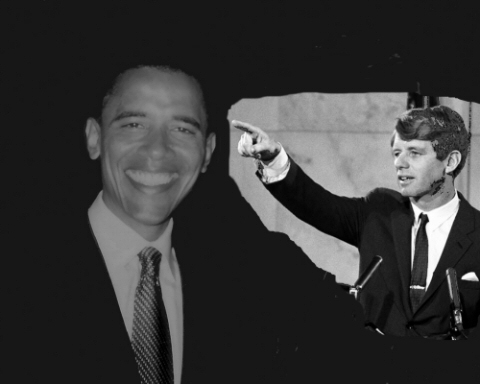
How fitting--even how poetic--it is that Barack Obama has clinched the Democratic presidential nomination during the week in which we mark the fortieth anniversary of the death of Robert F. Kennedy. This harmonic convergence has deep significance.
These events may come to be seen as the bookends of the second American civil war, a war that has divided the nation and been a dominant force in our politics for four decades. There is genuine reason to hope that 2008 will bring at last an armistice--maybe even a lasting peace--in America's Forty Years War, the internal conflict more commonly known as the Culture Wars, which began in 1968.
Of course no peace will be achieved before those who have been the main political beneficiaries of the Forty Years War launch their final offensive--and we can be sure that it will be offensive.
There are a variety of words that have been used as deadly weapons over the course of the Forty Years War. The one we are already hearing fired at Senator Obama from the artillery of the side that faces serious danger of losing the war this year is elitist.
While she still had a chance to win the nomination, Sen. Hillary Rodham Clinton and her supporters eagerly joined with Republicans in asserting that working-class whites will not vote for Senator Obama if he is perceived as an "elitist."
In a recent piece on the Huffington Post, "Barack Obama and the Unmaking of the Democratic Party," distinguished Princeton historian Sean Wilentz forcefully made the argument that Obama and his advisers are elitists who are rejecting the traditional core of the Democratic Party among white working-class people in the Middle Atlantic and Border States.
But the contention that the traditional Democratic working-class voters won't vote for Obama if he is not perceived as "one of them" is belied by historical precedent.
Elitist has been one of the most powerful epithets in the American political dictionary from the earliest days of the Republic. But elitists come in two brands. Through most of American history, the derogatory term was used by those on the other political side from that which has so effectively utilized it during the Forty Years War.
Although they did not always use the specific word, American democrats (whether capital-D Democrats or not) from Thomas Jefferson through Andrew Jackson, Abraham Lincoln, William Jennings Bryan, Bob La Follette, and Theodore Roosevelt, identified themselves as opponents of economic elitists--designated during the Populist and Progressive Eras as "the Interests"--and thereby won the backing of "the People."
Some of the champions of the People, such as Jackson, Lincoln and Bryan, were from humble origins themselves. Through most of American history, however, there was no necessary contradiction between being from a privileged background and being a champion of the "Common Man," as the examples of Jefferson and Theodore Roosevelt show.
Members of the cultural elite were acceptable as leaders of the struggle against the economic elite. This circumstance was particularly evident in the decades from the onset of the Great Depression into the 1960s. During that period, two of the modern presidents most beloved by working-class whites were plainly not "of the people."
Franklin D. Roosevelt came from an undeniably elite background--the Hudson River country gentlemen, Groton, and Harvard. His cousin and uncle-through-marriage had been President of the United States. Pince-nez perched upon his nose and he used a cigarette holder. Yet he identified himself with the downtrodden and most of the American working- and middle classes adored him. FDR left no doubt about whom the elite were when he denounced "economic royalists" and, firmly linking himself with their opponents, proclaimed that he welcomed their hatred.
The New Deal coalition brought together urban working-class whites, rural Southern whites, African Americans, intellectuals, and the arts community, including most of Hollywood.
The elegant, über-upper-class John F. Kennedy ultimately came to elicit the same sort of adoration from large segments of those same classes. As Theodore White noted in his classic, The Making of the President, 1960, "no phrase is more damning" in Kennedy's "personal lexicon" than "He's a very common man" or "That's a very ordinary type." Yet many among those "common men" came (some of them even while he was still alive) almost to worship JFK.
Beyond the elite demeanors of their leaders, both the New Deal and the New Frontier were the almost exclusive provinces of "intellectual elites." It was with reason that the late David Halberstam referred to the Kennedy men who became the architects of the Vietnam War as "The Best and the Brightest." Yet the intellectuals around FDR and JFK were, for the most part, seen as the allies and champions of the "common man," not as his elitist enemies.
Even more than his brother, Robert F. Kennedy succeeded during his 1968 presidential campaign in winning the affection of the disparate precincts of the New Deal Coalition. That Coalition died with Bobby Kennedy forty years ago this week. Its breakup also marked the beginning of the Forty Years War.
The defenders of the traditional, economic elite found that the elitism weapon could be turned into a boomerang--or an unexploded hand grenade that they could hurl back across the lines before it detonated. (Such right-wing populism was, of course, not new in the late 1960s; it had been evident at various points earlier in the nation's history, perhaps most notably during the McCarthy Era. But its greatest successes have been achieved over the past four decades.)
The charge of "elitism" is one that Republicans have heaved at Democratic candidates to great advantage since the Sixties. Indeed, the Republican Party has been running as the anti-Sixties party for four decades now. That has been the main casus belli in America's Forty Years War.
It was in the 1960s that the Republican Party--long (and still) the party of the economic elite--found a way to redirect the anti-elitism of Main Street from its traditional target, Wall Street, toward other thoroughfares that were disliked by Main Street: Pennsylvania and Telegraph Avenues and Santa Monica Boulevard, not to mention Harvard Yard.
The key figure in achieving this redirection was Richard Nixon, who understood the social and cultural resentments of Middle America because he so fully shared them. Nixon could tap into the rage that growing numbers of Americans were feeling in the late Sixties because he felt it, too. Significantly, Nixon had been a pioneer "McCarthyite" in the 1940s, before McCarthy himself joined and gave his name to the political attack on the "Eastern Establishment" elite.
Beginning in 1968, Nixon was the commander-in-chief of the army that launched the Forty Years War. A young Patrick J. Buchanan was its chief strategist. They set out quite consciously to divide the country, to launch a civil war that would be politically advantageous to their side. As Buchanan infamously put it in a 1971 memo to Nixon, his strategy was to cut "the country in half; my view is that we would have far the larger half."
The belief that there are two, essentially incompatible Americas Nixon and his aides thus encouraged was a very different notion of "Two Americas" from that John Edwards has spoken of in recent years--and from that Franklin Roosevelt had implicitly spoken of in the mid-1930s.
Buchanan called his plan for a new American civil war "positive polarization," and positive it certainly was for the political fortunes of the Republican Party. For the nation itself, though, the polarization that was intentionally encouraged by Nixon, Buchanan, and those who perpetuated the strategy in later years, such as Lee Atwater and Karl Rove, has plainly been very negative.
The Republican officers and troops in the Forty Years War could not have been so successful had not their designated opponents walked into their ambushes time and time again. Most notably, in 1972 George S. McGovern reprised the role that had been played almost a century earlier by George A. Custer. Nixon's Sitting Bull massacred the cultural elitist Democrats, who had discharged many of the party's usual troops prior to the battle.
Shortly after his huge victory, Nixon perished from self-inflicted wounds he had incurred on the 1972 battlefield. This loss of its commander caused a temporary reversal of fortune for the anti-cultural elite forces, but they soon regained the offensive when Jimmy Carter provided them with a new target and Ronald Reagan, having come over from the other side, both politically and culturally (he had been an ardent New Dealer and, of course, he came out of Hollywood), took command of their troops.
Reagan was a leader who managed to score major political victories in the Forty Years War, but almost all of the spoils plundered in battle went to the economic elite in whose interests the war was really being fought. Reagan talked a great deal about the cultural issues dear to the hearts of the "anti-elitist" voters that had been won over to the Republican side, but he was simultaneously winking at the other side, indicating that he really wasn't going to go too far in the culturally conservative direction.
By this time, the ranks of the cultural warriors had been swelled by a large number of new recruits who fancied themselves to be Christian soldiers, marching into (rather than as to) war. Those fresh troops helped an elitist who was plainly not one of them, George H.W. Bush, keep the Republicans in the White House in 1988.
By somewhat blurring the cultural elitist issues while emphasizing the economic issues that were troubling so many of the descendents of the old, broken New Deal Coalition in the early Nineties, Bill Clinton was able to win an important battle in the continuing war in 1992. A series of tactical mistakes during Clinton's first two years in office allowed Newt Gingrich to lead the other side to victory in 1994.
It was left to George W. Bush, arguably the first president since Nixon who was really "one of us" in a cultural sense, to carry the cultural warriors to the point of complete smashup.
As long as the basic American division was defined as cultural war based on categories left over from the 1960s, the economic elites were able to count on the support of those at the other end of the economic spectrum: the very people their policies have been keeping down and pushing down farther. If the division is instead defined an economic struggle, the lower classes are likely to be on the other side.
Accordingly, in their attempts to keep the eyes of voters--especially economically hard-pressed white voters--focused on cultural issues so that they don't notice what the economic elite is doing to them, Republicans have raised the specter of "class warfare" every time Democrats attempt to point out to the victims of the economic elites what is being done to them by Republican policies.
In 2008, however, the consequences of elite economics on the middle and lower classes are so stark that it will be much more difficult for Republicans to hide them by firing their customary canisters of Culture War tear gas.
Barack Obama is the first post-Sixties presidential candidate. As such, he will be much harder for the Republicans to tar with the brush they have used, generally successfully, for so long. But they will certainly try. It's the only weapon they have at their disposal.
Obama opened himself to a renewed "elitist" attack by his opponents with his April faux pas in San Francisco about people getting bitter and clinging "to guns or religion or antipathy to people who aren't like them or anti-immigrant sentiment or anti-trade sentiment as a way to explain their frustrations."
Some supporters of Sen. Clinton, along with Sen. McCain and other Republicans, said that the San Francisco remark reflected what Sen. Obama really believes and that he is in fact an elitist who not only cannot win over working-class whites such as those in the regions bordering on the Ohio River, but doesn't even want to try to appeal to them.
Nonsense.
Professor Wilentz warned that there will be "a Democratic disaster among working-class white voters in November should Obama be the nominee" because, he contended, Obama and his backers are ignoring and rejecting this demographic as "essentially racist." But here's what Obama actually said in his San Francisco talk:
"The places where we are going to have to do the most work are the places where people feel most cynical about government. . . . Everybody just ascribes it to 'white working-class don't wanna vote for the black guy.' . . . But the truth is that our challenge is to get people persuaded that we can make progress when there's not evidence of that in their daily lives."
Obama, in short, was saying that white working-class people have been being shafted (by the very economic elitists who denounce Obama and other Democrats as elitists) for decades and that they have every right to be bitter, but that doesn't mean that they are racists or evil people.
Certainly Obama's color is an obstacle as he seeks to identify himself as "one of us" and win back the white voters who have usually voted Republican during the Forty Years War. But that obstacle is neither insurmountable nor one that Obama will not work to surmount. Indeed, he has already demonstrated in his 2004 Senate race how well he can overcome that difference and identify with working-class whites in southern Illinois.
In an election in which there is an overwhelming desire to turn the page, being "one of us" is, like experience and foreign policy capacity, not a comparative question, but a threshold question. Bill Clinton met the "one of us" threshold in the last "it's the economy, stupid" election by saying to economically troubled Americans, "I feel your pain."
For forty years Republicans have usually succeeded in pushing a cultural definition of "us" that linked Democrats to a "them" identified as "elitists" and so obscured the extraordinary degree to which the GOP was actually working for that traditional "them," the economic elite.
If we continue to fight the Culture Wars that arose out of the 1960s, Republicans will have an entree with the people they and the economic elites they represent harm on a daily basis.
But the combination of the chariscuro rendering the Bush administration has painted of how totally the Republicans have been working in the interests of, well, "the Interests," with Barack Obama as the first post-Sixties presidential candidate provides a great opportunity for the Democrats to get voters to see the GOP as the Gone Old Party and for the United States finally to bring its second civil war to an end.
Division is what civil wars are all about, and as the chief strategists of the "conservative" forces, from Buchanan's "cut the country in half" at the beginning to Rove's 50.1 percent politics at the end, made clear, the country they sought to rule was the Disunited States of America. This year we have a real opportunity to reject their divisions and end the long civil war that began four decades ago. Doing so will reestablish the United States of America.
Both the essence of the Forty Years War and how it can be ended is well captured by modifying another of the famous utterances made by Hillary Clinton's husband:
It depends on what the meaning of "us" is.
Historian Robert S. McElvaine is Elizabeth Chisholm Professor of Arts and Letters at Millsaps College. His latest book, Grand Theft Jesus: The Hijacking of Religion in America, has just been published by Crown. He is currently at work on a new history of America in the 1960s, Oh Freedom! (Norton).