
"There is no psychiatrist in the world like a puppy licking your face."
--Ben Williams
Many loyal dog owners generously endorsed my recent article about the advantages of owning a dog as opposed to having a facelift. Hundreds of readers offered wonderful anecdotes, advice and direction regarding dog and cat adoption/rescue and the wonders of owning a pet. Each comment contributed mightily to the content and message of the article. I was surprised, however, that the piece garnered little interest or curiosity about canine-assisted therapy or its counterpart, animal-assisted therapy. The ability to volunteer with your loving animal to help another person who is sick, ailing or simply lonely is a special experience that I would like to share with you. I think it is appropriate to consider this form of volunteering for the good of your fellow man during this holiday season. So please allow me to explain what I believe is the most important reason to get a dog instead of a facelift.
Animal-assisted therapy was first described in the ninth century in Belgium to treat people who were handicapped. In 1792, animals were used in psychiatric hospitals in Great Britain to help patients learn to care for a living creature in a form of what we now call behavioral therapy. Over 100 years ago, Florence Nightingale wrote that pets are perfect companions for patients confined to the hospital with chronic illness. Animal-assisted therapy was first used in the United States in 1940 to treat veterans and allowed them to interact with animals as therapy.
The premise of canine-assisted therapy involves a team composed of a dog and an owner/handler who provide physical and psychological therapy through social interaction from canine companionship. Studies have shown that interaction with the dogs, petting them, handling them and just playing with them reduces stress, increases physical activity, relieves depression and anxiety, calms and motivates patients and helps normalize difficult situations. It is used to assist both children and adults in hospitals, nursing facilities, rehabilitation centers, mental health facilities, elder care centers, boarding schools, college and professional schools, schools for special needs children, juvenile jails and prisons. Groups of people that have benefited from canine-assisted therapy include nursing home patients, hospice patients, cancer patients, pediatric patients, autistic children, children with learning or reading disabilities, children with behavioral problems and teenagers and adults with substance abuse problems.
There are several local and national organizations that administer canine-assisted therapy. Not every dog is a candidate for this program because it requires a canine that is fairly even-tempered, well-behaved, comfortable being petted and touched by strangers and gets along with other dogs. The handler and dog team undergo a five- to nine-week training program (one evening per week) to enable them to be comfortable in a hospital- or institution-type situation and teach them the different types of interaction needed. Dogs that demonstrate good basic obedience, obey commands such as "sit" and "stay" and leash-walk calmly require only the five-week therapy-training course. This once-weekly training includes socialization, instruction on safe dog handling in a healthcare facility, role-playing and desensitization to loud noises and medical equipment such as wheelchairs, crutches and IV poles, etc.
I can speak firsthand about the benefits of volunteering, as I have watched and witnessed the trials and tribulations experienced by my wife Valerie and our 120-pound Bullmastiff Lily. Their nickname is "Beauty and the Beast," but Valerie vigorously objects, arguing that Lily is the "Beauty." Over the last several years they have visited public schools where children with reading disabilities read to the dogs and gain confidence in reading out loud because they understand that the dog will never judge them. They have visited troubled teenagers in juvenile jail, anxious and stressed college and medical school students around exam times, lonely elderly people in nursing homes and cancer patients at Memorial Sloan-Kettering Hospital. Every visit is eventful and memorable for all parties involved. I have watched my no-nonsense, born-and-raised-in-New-York-City wife well up with tears while describing the obvious relief and escape experienced by the cancer patient as she curls up with Lily because she misses her dog so. For a short time she is at peace and forgets her pain. Yes, our beast of a dog gets in bed with some patients (when invited!) and usually naps with them! The hospital visits benefit both patients and staff members alike, as caring for people who are sick and dying can obviously be very stressful.
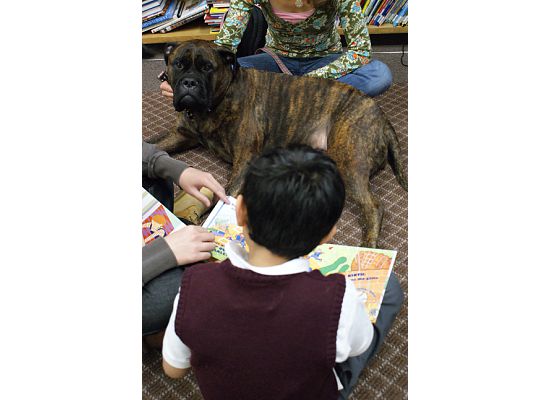
Kids reading to Lily (photo by Andrew Yackira)
The experiences are also invaluable for the therapy team. Dog and owner bond in an even more special and delightful way, as they both realize and enjoy the fact that they are bringing a small but important amount of sunshine into the lives of people who need it most. It is the purest form of giving, and as Susan Ariel Kennedy observed most eloquently, "dogs are miracles with paws"!