
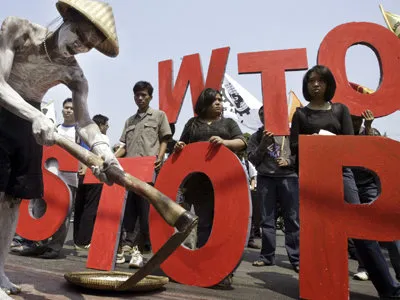
Predictably, the cheerleaders for corporate globalization are bemoaning the collapse of World Trade Organization negotiations.
"This is a very painful failure and a real setback for the global economy when we really needed some good news," said Peter Mandelson, the European Union's trade commissioner.
Even worse, says the corporate globalization rah-rah crowd, the talks' failure will hurt the developing world. After all, these negotiations were named the Doha Development Round.
"The breakdown of these talks is bad news for the world's businesses, workers, farmers and most importantly the poor," laments U.S. Chamber of Commerce President Tom Donohue.
But don't shed any tears for the purported beneficiaries of the WTO talks. If truth-in-advertising rules applied, this might have been called the Doha Anti-Development Round.
The alleged upside of the deal for developing countries -- increased access to rich country markets -- would have been of tiny benefit, even according to the World Bank. The New Delhi-based Research and Information System for Developing Countries points out that Bank analyses showed a successful conclusion of the Doha Round would, by 2015, increase developing country income in total by $16 billion a year -- less than a penny a day for every person in the developing world.
The World Bank study, however, includes numerous questionable assumptions, without which developing countries would emerge as net losers. One unrealistic assumption is that governments will make up for lost tariff revenues by other forms of taxes. Another is that countries easily adjust to import surges by depreciating their currencies and increasing exports.
In any case, the important point is that there was very little to gain for developing countries.
By contrast, there was a lot to lose.
The promise to developing countries was that they would benefit from reduced agricultural tariffs and subsidies in the rich countries. Among developing nations, these gains would have been narrowly concentrated among Argentina, Brazil and a few other countries with industrial agriculture.
What the spike in food prices has made clear to developing countries is that their food security depends fundamentally not on cheap imports, but on enhancing their capacity to feed themselves. The Doha rules would have further undermined this capacity.
"Opening of markets, removal of tariffs and withdrawal of state intervention in agriculture has turned developing countries from net food exporters to net food importers and burdened them with huge import bills," explains food analyst Anuradha Mittal of the Oakland Institute. "This process, which leaves the poor dependent on uncertain and volatile global markets for their food supply, has wiped out millions of livelihoods and placed nearly half of humanity at the brink of hunger and starvation."
Farmers' movements around the world delivered this message to government negotiators, and the negotiators refused to cave to the aggressive demands made by rich countries on behalf of agricultural commodity-trading multinationals. Kamal Nath, India's Minister for Commerce and Industry, pointed out that the Doha Development Round was supposed to give benefits to developing countries -- especially in agriculture -- not extract new concessions.
The immediately proximate cause of the negotiations' collapse was a demand by developing countries that they maintain effective tools to protect themselves from agricultural import surges. Rich countries refused the overly modest demand.
And agriculture was the area where developing countries were going to benefit.
The rough trade at the heart of the deal was supposed to be that rich countries reduce market barriers to developing country agricultural exports, and developing countries further open up to rich country manufacturing and service exports and investment.
Such a deal "basically suggests that the poor countries should remain agricultural forever," says Ha-Joon Chang, an economics professor at the University of Cambridge and author of Bad Samaritans: The Myth of Free Trade and the Secret History of Capitalism. "In order to receive the agricultural concession, the developing countries basically have to abolish their industrial tariffs and other means to promote industrialization." In other words, he says, developing countries are supposed to forfeit the tools that almost every industrialized country (and the successful Asian manufacturing exporters) has used to build their industrial capacity.
In sum, says Deborah James, director of international programs for the Washington, D.C.-based Center for Economic and Policy Research, this was a lose-lose deal for developing countries. "The tariff cuts demanded of developing countries would have caused massive job loss, and countries would have lost the ability to protect farmers from dumping, further impoverishing millions on the verge of survival," she says.
By the way, it's not as if this is a North vs. South, rich country vs. poor country issue. Although there have been multiple lines of fragmentation in the Doha negotiations, the best way to understand what's going on is that the rich country governments are driving the agenda to advance corporate interests, not those of their populations. That's why there is so little public support for the Doha trade agenda, in both rich and poor countries.
Says Lori Wallach of Public Citizen's Global Trade Watch: "Now that WTO expansion has been again rejected at this 'make or break' meeting, elected officials and those on the campaign trail in nations around the world -- including U.S. presidential candidates -- will be asked what they intend to do to replace the failed WTO model and its version of corporate globalization with something that benefits the majority of people worldwide."