
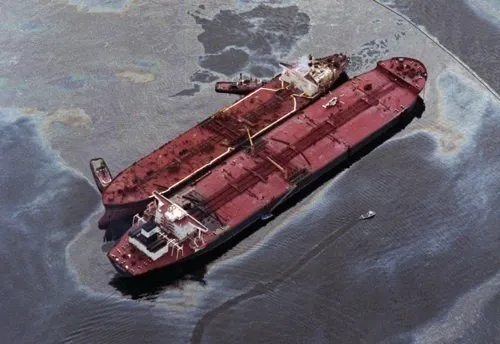
Last month witnessed the extraordinary contrast of two perspectives on crime, punishment and ExxonMobil.
Just two days after leading climate change scientist James Hansen told the U.S. Congress that he believed ExxonMobil and other fossil fuel company CEOs "should be tried for high crimes against humanity and nature" for their role in delaying a serious global response to climate change, the U.S. Supreme Court decreed that a $2.5 billion punitive judgment against Exxon for the Valdez oil spill disaster denied the company the "sense of fairness" to which it is entitled.
Each of these proclamations is extremely significant in its own right.
The Supreme Court's ruling has the more obvious direct importance. Operating in the framework of maritime law, where it is free to establish its own rules in the absence of Congressional guidance, the Court held in a 5-3 ruling that punitive damage awards should not exceed compensatory damages. In other words, the punitive fine imposed by a civil jury should not be greater than the harm the jury found a defendant caused to a plaintiff by its wrongful act.
As a matter of law, this was a remarkable ruling -- a hyper-activist, policy-driven, non-originalist action by a faction of the Court that claims to defer to legislative determinations or seek its legitimacy in the Constitution, law or strongly rooted history. And the policy choices made by the Court are not only corporate-friendly and harmful to the victims of corporate wrongdoing and the environment, they are remarkably poorly argued.
The real premise of the Court's decision, written by Justice Souter, is that "American punitive damages have been the target of audible criticism in recent decades," but it is forced to acknowledge in the same sentence that these criticisms are ill founded. There is no problem of runaway awards, the Court concedes; and punitive damage awards are rising in neither frequency nor amount. Thus the Court is forced to rely on a purported problem of unpredictability in punitive damage awards, even as it acknowledges that appellate courts routinely overturn or limit outlier awards. (Indeed, the original Exxon punitive verdict had been $5 billion.)
Concluding that more predictability is needed, the Court determines that some formula to restrict punitives is appropriate. It settles on the idea of a ratio to compensatory damages. Many states have adopted such ratios, so they seem like a good idea, the Court concludes. A plurality of states have a ratio of 3:1, but having relied on the state experience as the rationale for adopting a federal maritime rule, the Court then declares that the state rules are too different to set the right ratio.
Instead, the Court says it bases its assessment of a reasonable ratio on juries' actual awards -- the very juries it is trying to constrain. The median punitive damage award is less than the compensatory award, so the Court settles on a 1:1 ratio. The Court states, "we would expect that awards at the median or lower would roughly express jurors' sense of reasonable penalties in cases with no earmarks of exceptional blameworthiness within the punishable spectrum." You can read that a few times. It still won't make sense.
In a very concise dissent, Justice Stevens takes apart the majority argument. In short, he writes, if Congress has not acted, and there are no constitutional issues (none were involved in this case), then appellate courts should review punitive awards and overturn them only if they constitute an abuse of discretion. If the only problem is a few outlier awards, then appellate review easily solves the problem.
"On an abuse-of-discretion standard, I am persuaded that a reviewing court should not invalidate this award," Justice Stevens wrote. "In light of Exxon's decision to permit a lapsed alcoholic to command a supertanker carrying tens of millions of gallons of crude oil through the treacherous waters of Prince William Sound, thereby endangering all of the individuals who depended upon the sound for their livelihoods, the jury could reasonably have given expression to its 'moral condemnation' of Exxon's conduct in the form of this award."
Left unstated, but most important for the purpose of deterring bad corporate behavior, is that the very unpredictability disdained by the Court's majority is one of the core benefits of punitive damages. Corporations are not people, and the Court's rhetoric about preserving a "sense of fairness in dealing with one another" is inapposite as regards corporations' wrongful acts against real people. The point that corporations are not people is not just rhetorical; they have different forms of calculus and are differently affected moral restraints. The possibility of facing an outlier punitive verdict for wrongful conduct is a needed control on corporate recklessness.
The direct precedential value of the Exxon decision is limited, because it was issued in the confines of maritime law, and includes some caveats. But it will cast an ominous shadow over state and federal court decisions on punitive damages for years to come.
Dr. James Hansen, the NASA climatologist who was one of the first to sound the alarm on global warming and who has refused to capitulate in the face of Bush administration efforts to silence him, does not specialize in the law but he offers a far keener sense of justice than did the Supreme Court.
"CEOs of fossil energy companies know what they are doing and are aware of long-term consequences of continued business as usual," Hansen told a Congressional committee. "In my opinion, these CEOs should be tried for high crimes against humanity and nature" for spreading doubt about global warming and obstructing needed action.
This notion of justice suggests individual as well as organizational responsibility; insists on connecting the predictable and intended consequences to ultimate instigators without being distracted by intervening factors; and refuses to let perpetrators establish rules to legitimize their conduct.
However, Hansen noted, "conviction of ExxonMobil and Peabody Coal CEOs will be no consolation, if we pass on a runaway climate to our children."
Even more significant than Hansen's call for prosecution of CEOs for crimes against humanity was his description of his latest research. Hansen and colleagues have concluded that the safe level of atmospheric carbon dioxide -- the level below which catastrophic, self-reinforcing climate change can be averted -- is considerably lower than previously thought. Not only must the world slow its carbon emissions, Hansen argues, it must reduce atmospheric carbon from current levels. This remains achievable, Hansen believes, if immediate, far-reaching action is taken.
A society reveals its values in what it tolerates and proscribes, in what it authorizes and punishes. The U.S. Supreme Court held that basic fairness means that Exxon, which made more than $40 billion in profits last year, should not be slapped with a $2.5 billion punitive verdict. Representing humanity's better face. Dr. James Hansen asserted that the basic principles of justice and accountability to which street criminals are held should be applied to the rich and powerful, particularly when their intentional actions recklessly endanger the lives of not just one or two or five people, but millions.
The Supreme Court signaled that ExxonMobil should continue business as usual. Hansen said that business as usual is intolerable.
"In my opinion," Hansen said, "if emissions follow a business-as-usual scenario, sea level rise of at least two meters is likely this century. Hundreds of millions of people would become refugees. No stable shoreline would be reestablished in any time frame that humanity can conceive."