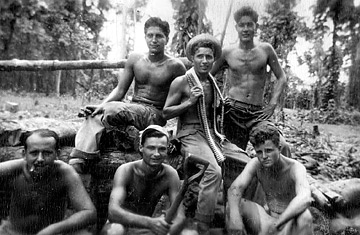
 Latino soldiers in Cebu , Phillipines during WWII
Eighty-seven year-old Carlos Alvarez remembers his first experience of war, when he dodged the bullets of Japanese gunners and airplanes in the Philippine jungles during World War II. Now, 60-plus years later, he's on the front lines of a media war pitting grassroots Latino groups against the multimillion-dollar guns of PBS, its corporate sponsors and legendary filmmaker, Ken Burns.
Since learning that "The War" initially excluded him and the more than 500,000 other Latinos who fought, were injured or died in World War II, Alvarez says he was "upset but not surprised" by what he calls "Mr. Burns negligence for omitting the Hispanic WW II experience." Rather than fume about it, he and other friends in Brawley, CA collected money and took out a full page ad in their local newspaper. The former Private First Class, in the Army's 7Th Cavalry's Troop G, hopes that his campaign would "make people think and realize World War II was not fought and won solely by white males."
Though "The War" now includes 28 minutes of footage of two Latino veterans, most major leaders of Latino organizations, members of the Congressional Hispanic Congress and a constellation of grassroots groups across the country remain dissatisfied. Different groups with different agendas have organized a number of activities to show dissatisfaction including protests, forums and possibly even boycotts of PBS and their corporate sponsors Anheuser Busch, General Motors and Bank of America.
Burns and PBS have, for the better part of the year, been embroiled in the "War" controversy since early March, when UT Austin scholar Maggie Rodriguez and several other Latino leaders discovered that the film excluded Latino vets. After an initial March 6th meeting between activists, PBS CEO Paula Kerger and advertising and public relations executive Lionel Sosa (a PBS board member and former chief Latino strategist to Ronald Reagan and Karl Rove), Rodriguez and several other Latino leaders organized the "Defend the Honor" (DTH) campaign. After initially agreeing to some of the demands of DTH, Burns - who was not in the initial meeting - held a separate meeting in May with two other Latino groups, the American GI Forum (AGIF) and the Hispanic Association on Corporate Responsibility (HACR) and eventually reached what HACR Chairman, Manuel Mirabal called "an understanding" about the film.
Since then, the national PBS office, which sent a press satement in lieu of the interview requested, has widely distributed that statement, which says, "the producers have shown portions of these stories to audiences at screening events, including one at annual conference of the American GI Forum, a national organization for Latino veterans; The reaction has been overwhelmingly positive." Asked if any groups besides AGIF and HACR were part of their consultations with groups other than DTH, both the PBS national office and its local affiliates contacted did not name any.
Burns, PBS and their supporters are now on the offensive. In addition to making Latinos a visible part of their unprecedented $10 million marketing campaign for the film, they have also heavily promoted the deal struck with AGIF and HACR. The PBS local affiliate in Orange County said that "the vast majority of concerned groups and individuals have found the PBS response and additional materials produced for the series to be a good solution to the matter" while noting that "there are still a couple of fringe groups who refuse to be satisfied." Burns went on the attack during a speech at the National Press Club, saying that no Latinos came forward when he put out the call for war stories in the four towns spotlighted in the film: Mobile, Ala., Luverne, Minn., Waterbury, Conn., and Sacramento, Calif. Burns also stated that no one came forward to provide him with databases and other archival material about Latinos for the film.
In response, DHS leaders point out that the filmmakers selected sites with miniscule Latino populations: Latinos in Luverne make up 1.56 percent of the population and 1.42 percent of Mobile. They also say that the little, if any (Rodriguez does not believe Burns did any) outreach to the 15 percent of Sacramento's population that is Latino and Westbury's 21.7 percent - took place only after the DHS campaign forced PBS and Burns to hire filmmaker Hector Galán in April. The interviews included in the film came from Los Angeles, which along with San Antonio, is home to the overwhelming majority of Latino WWII veterans.
As they prepare to launch rallies, protests, forums and other activities criticizing the film, Rodriguez and her colleagues say that PBS and Burns's response is actually helping shape the Latino civil rights tradition that began when veterans returned to fight discrimination they found following WWII, a tradition that led to the establishment of most major Latino civil rights organizations. Says Rodriguez, "History tells us that whenever civil rights groups demand their rights, the inevitable response is that they are called "fringe" and "deviant."
For his part, Alvarez also said he would continue to the fight for memory. "Even though we were treated as second class citizens (and worse) we served, fought, bled and died to free countries occupied by the enemy powers and to ensure this country remained free. Yet our contributions and sacrifices remain largely unknown or ignored by most of our fellow citizens. Perhaps my little statement will open a few eyes."