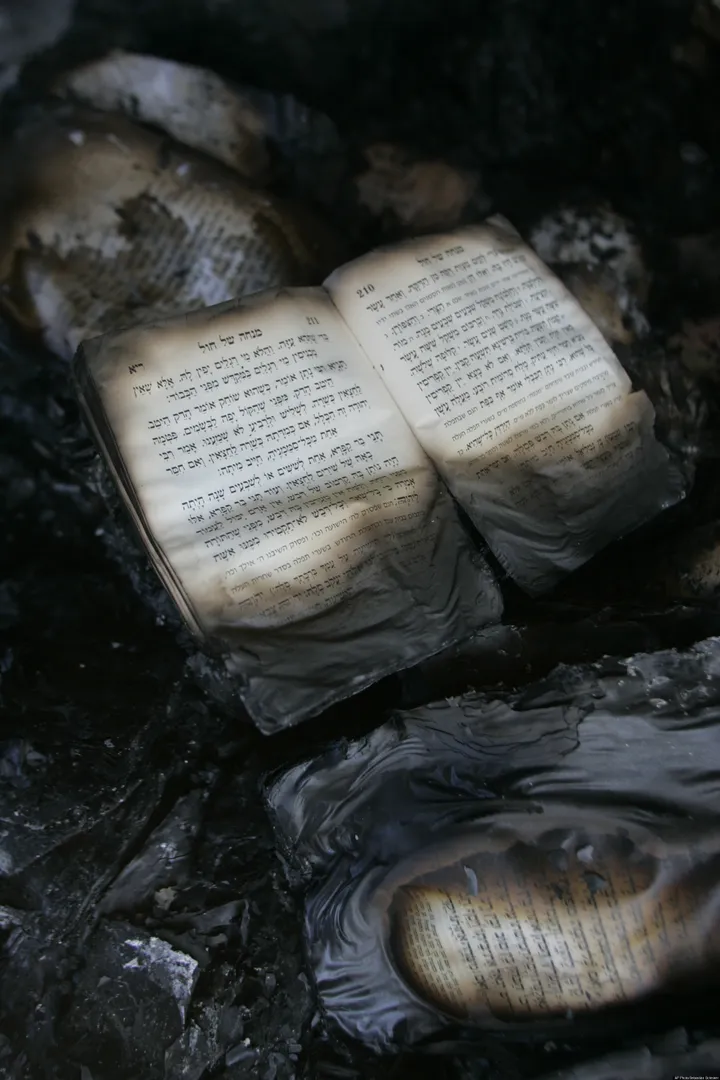
Moral idiots can be useful irritants, so maybe the Florida pastor who wants to burn Korans isn't all bad. He got me thinking about the great shift to e-books. That technology may finally end the long tragic history of book burning, from the library of Alexandria to the Nazi pyres. You can't burn an e-book.
The three major Western religions all have the same three features: a holy teacher, a community of readers, and a sacred book. There's Moses, the community of Israel and the Torah; there's Jesus, the Church and the Christian Bible. There's the Prophet Mohammed, the Ummah and the Koran.
Gathering a community around reading a sacred book is at the heart and soul of religious tradition.
Judaism has the oldest regular book club on the planet. The weekly cycle of readings goes back to the fifth century BCE. In Nehemiah chapter 8 Ezra brings forth the Torah at the Water Gate in Jerusalem and the returning exile wept for they had no understanding. The scribes interpreted for them. And so it has gone on ever since, each week, and all over the world.
In synagogues the way the Torah scroll is ceremonially held aloft, and paraded through the synagogue, could look like to any outsider like book worship, or bibliolatry. Jews kiss the Torah. We even dance with it. When Christians and Muslims gather, the sacred book is likewise read with great ceremony.
This feeling of reverence extends to books in general. For me it's about the physical book, a sacredness bound in binding, in the cover, the type, the feel of the paper, even the smell of a new book. It's hard for me to discard a book even when I know I'll never read it again. They may sit on the shelf for decades like rows and rows of mute little idols. They surround me in my life and offer a reassurance of continuity with the past, and promise of the future. Owning lots of books I've not yet read feels like a minor form of immortality.
But the e-book challenges these old and soulful connections. Will releasing books from their old physical form bring an end to that special reverence? Perhaps not, though at first it would seem difficult to feel attached to a mutable swirl of electrons.
Jewish mystics were among the first to imagine the e-book, for they conceived of the "primordial Torah" as black fire on white fire. To a kabbalist like the hasidic master Rabbi Nachman of Bratslav, this primordial Torah was the blueprint for creation and also the source for all new revelations.
To Rabbi Nachman, who wrote kabbalah disguised as fairy tales, the act of writing in itself was holy.
In Burnt Books I tell the story of how he gathered his disciples around him, wrote something on a piece of paper, then burned it before their eyes. They were mystified because they truly wanted to read any revelation the rebbe had "brought down" from the higher worlds. Rabbi Nachman explained that the mere act of writing -- drawing down "torah" into the shapes of letters and words -- was in itself a miraculous event. To publish such a work, was also a huge event in his view, but not always necessary or even wise. The world is not always ready for holiness, and judging from what we read in the news, that's still true.
Rabbi Nachman burned his writing in front of his followers' eyes to teach a lesson. The ultimate Torah is not a physical object, but a holy manifestation of the ineffable. To draw the primordial Torah down into letters and words is a supreme feat all in itself. Even if no one ever reads it.
In secular terms we could think of this primordial Torah -- as the source of our imaginative life, of our inspiration, of our new ideas and concepts and of the deepest way we can feel. It may exist in our unconscious and certainly in our dreams. This Torah of black fire on white fire has one advantage over any physical book. It can't be burnt.
It's burning already.