
In December 2010 I decided to open source my investment strategy, in the form of a slide show and presentation called Ten Hypotheses for Tech Investing. When you open source ideas, you expose them to improvement. I presented the Ten Hypotheses to many smart people, including executives at Google, Facebook, Twitter, Yelp, the New York Times, Wall Street Journal, NBC, and many others ... and they shredded them. It was fantastic!!!
From that process emerged ideas like the Hypernet. While I characterize the Hypernet as a hypothesis, it already exists. We use it every day. In reality, the first four of the Ten Hypotheses are new interpretations of the present, rather than predictions about the future. This blog post will focus on those four hypotheses.
* * *
The world thinks about the online world in terms of a network layer (The Internet) and a software layer (The Web).
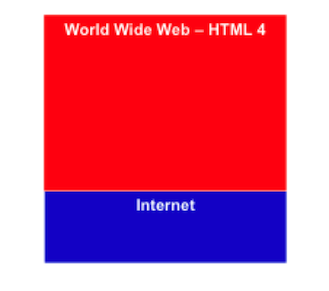
The online world is no longer so simple. Apple introduced the iPhone in January 2007, and with it a new model of online user experience: apps. Today, app-centric smartphones and tablets represent half of all connected devices. Half. On app-based devices, the Web is just one application among many, rather than the center of online activity. It is a huge change.
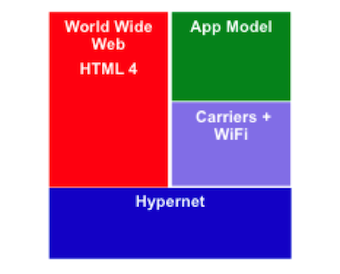
Since the online world now consists of two pieces of equal size, I believe the traditional vocabulary is obsolete. I have proposed that we refer to the new network layer -- the sum of the wired Internet and the mobile data infrastructure for cellular and Wi-Fi -- as the Hypernet. Its software counterpart is the Hyperweb, which today includes the traditional Web and app model, but which may evolve to include other technologies in the future.
Why do we need new vocabulary? Everything about the app market works differently from the Web. The failure to recognize this is one reason why Web leaders like Google have been unable to build profitable businesses around apps. When companies incorrectly define their market -- as the railroads did in the face of competition from trucks and jets -- they leave themselves vulnerable. Hence, the need for new vocabulary.
When Google started in 1998, it transformed Web monetization with index search. To make that happen, Google adhered to the cultural norms of the open source community by focusing on the long tail, making everything free, commoditizing content, and encouraging an "anything goes" atmosphere. This was no problem when the Web was small, but once it hit critical mass the "techie" Web experience began to lose its allure. One factor was the static nature of the Web itself. For more than a decade, the web has been stuck with HTML 4 as its platform and Flash as its media format. No wonder content was commoditized. There was no way to differentiate without spending more than customers would pay.
Any time a product stagnates, as Windows did after 1995 and the Web has done in recent years, it is vulnerable to competitors. In this case, the competitor was Apple and platform was iOS.
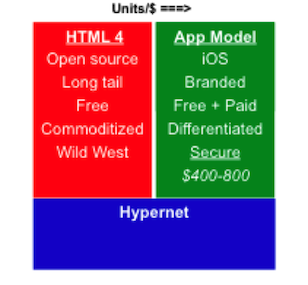
What Apple did with iOS was to create a user experience that was "one minus the Web." Instead of open source, Apple used a proprietary operating system (iOS). Instead of long tail, Apple focused on branded products. In addition to free, Apple encouraged the development of paid applications. Instead of commoditizing content, Apple enabled limited differentiation among apps (but huge differentiation relative to Web). Instead of "anything goes," Apple offered a secure environment. On top of that, Apple charged $400 to $800 for the hardware that delivers its user experience ... using content and data that for the most part are already free on desktops.
What happened? Consumers adopted Apple's model faster than any technology in history. When you include the dollars spent on hardware -- how can you not do so? -- it is possible that Apple's ecosystem may be larger than the Web ecosystem. Whoa!
For the leading Web companies -- Google, Microsoft and Facebook -- the economic consequences of Apple's success have been masked by other factors, but they have been enormous. We'll start with Microsoft. Before the iPhone, 95% of connected devices ran Windows. I don't know what Windows' share is today, but it must be less than half that, as Microsoft's share of app phones is roughly zero. For all intents and purposes, Microsoft lost half its addressable market to app-based devices. The same is true of Google. Before the iPhone, Google accounted for roughly three-fourths of index search, which accounted for about 90% of Web search. The other 10% of Web search was controlled by a rapidly growing group of specialized search engines: Wikipedia, Facebook, Twitter, Yelp, Realtor.com, Match.com, etc. In the app model, customers use apps to search, not Google. It is my understanding that for a given consumer, index search happens with the following frequency by platform: desktop web 100%, iPad 10%, iPhone 1%. Given that high value transactions are moving rapidly to mobile, it seems unlikely that index search will provide Google with the control point it has grown accustomed to. Margins must fall. Notwithstanding the huge unit volume of Android, Google has yet to produce any profits from smartphones. Even though Google's Web business continues to grow, the company has lost half its addressable market. The third Web giant is Facebook. Like Microsoft and Google, Facebook has not been able to migrate its profit model to mobile. All three derive their online profits from a business that will continue to lose share in coming years and may even begin to shrink.
It's not too late for Microsoft, Google and Facebook. All three can respond to this disruption as Apple did a decade ago. Microsoft may already have made the critical first move. The acquisition of Skype gives Microsoft the only product with a larger engaged online audience than Facebook. Skype is perfectly positioned for mobile, especially in the developing world, and Microsoft got it for a small fraction of its strategic value.
To a much greater degree than Microsoft, Google has experimented with new business models. Unfortunately, some of these experiments have come off the rails. I believe Google has irretrievably messed up Android's architecture and business model, and made a terrible mistake in buying Motorola, but the company still has fantastic human capital and more cash than Croesus. But it has to recognize that it no longer controls the most important value streams in the online world. If Google wants to be a market leader in the future, it will have to reinvent itself. If it were to make a proprietary Motorola phone with Chrome OS, then Google would have a chance to leverage its strengths to compete with Apple.
Facebook was very slow to figure out mobile, but it has far fewer barriers than Microsoft and Google. The company has just introduced mobile ads. If Facebook were to introduce mobile use cases that are valuable (e.g., peer-to-peer wireless "friending"), it might find that the business model in mobile is better than in desktop.
The key point here is that Apple's position of market dominance is unstable. Giant tech companies with giant cash positions have been left out of the Apple ecosystem ... and they will eventually seek a way to get back into the game. Google, Microsoft, Facebook, Cisco, Intel, Oracle, and others have the scale, the cash, and the compelling incentive to develop an alternative to Apple's app model. One or more of them may succeed.
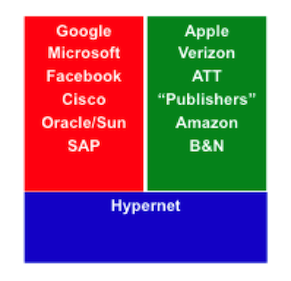
But success for these companies will not be significant if it is measured by market share of Apple's ecosystem. They need a new and really big ecosystem. I believe the new ecosystem will be based on HTML 5.
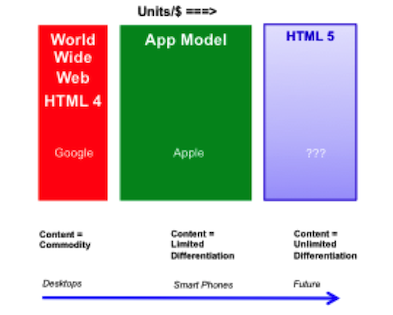
I spent six months trying to convince entrepreneurs and investors that HTML 5 will change the world before I realized that my message was not getting through. So I spent the past year developing and deploying HTML 5 functionality on behalf of my band, Moonalice. One of our HTML 5 tools enables live HD video over 3G cellular with no buffer. Another enables fans of Moonalice to listen to any of 400 shows. Both applications are live on http://www.moonalice.com, but they only work on iOS. Why? Android does not have a standard HTML 5 implementation. Most people at Google don't know that.
I have been told that HTML 5 is "just another programming language." For content creators, however, HTML 5 offers the possibility of production values previously unheard of in the online world.
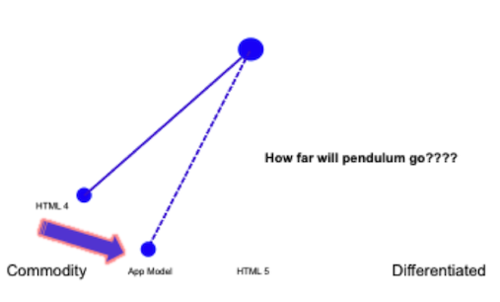
I am convinced that the pendulum of technology swings between commoditization and high production values. Before 1984, there were no production values in tech content: green ASCII text against a black background was the standard. Then Apple introduced the Mac, with Adobe's Postscript. Postscript enabled WYSIWYG, desktop publishing, Photoshop, PowerPoint, Acrobat, and increasingly high production values. From 1984 to 1998, content looked better every year. Then came Google and the commoditization of content. That lasted for ten years before Apple's app model enabled limited differentiation. HTML 5 will remove the limits.
Online content has depended on Adobe Flash for video and animation for more than a decade, but the limits of Flash are significant, especially in mobile. It was never designed for today's mobile use cases, much less the ones that are coming. Each instance of Flash on a webpage increases load times and instability. In mobile, the overhead is so great that that live video experience on 3G networks is exceptionally lame.
HTML 5 incorporates the functionality of Flash into the HTML standard. In mobile, the overhead is tiny in comparison to Flash. But that's just the beginning. As the tool set gets fleshed out, HTML 5 will transform the creation and presentation of content. HTML 5 will be a creative canvas unlike any in the past history of technology. Unlike the HTML 4 world we live in today, where every page looks similar and all can be compared in an index, HTML 5 will enable huge variation in production values, from the sepia of Kansas to the 3-D Technicolor of Oz. Before Google, higher production values translated into higher economic value, and I believe that will be the case again, only more so. In fact, the process has already begun with iPhone applications. Major League Baseball has done a brilliant job of translating production values into revenue. What they and others will be able to do with HTML 5 must be left to the imagination for the moment, because HTML 5 is still a very young language.
Cross-posted from Roger and Mike's Hypernet Blog