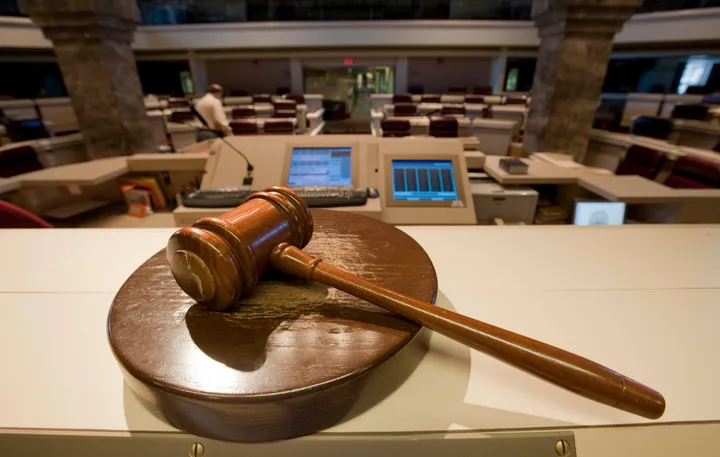
There's encouraging news out of Atlanta today for all Americans. The third hearing before the court of appeals left me feeling optimistic about the future of the Affordable Care Act.
But let's start from the beginning. There have been approximately two dozen suits filed against the Affordable Care Act's individual responsibility provision. All but two of the cases decided so far by federal district courts threw out those challenges, most on procedural grounds but several on the constitutional merits.
But Florida judge Roger Vinson, weighing in on a 26-state lawsuit against the new law, took his anti-health reform stance to the extreme. In February, he ruled that because he found the individual responsibility provision unconstitutional, the entire law should be thrown out with it.
Roger Vinson's ruling is simply conservative judicial activism run amok. Long-standing judicial principles make clear that courts should deal with constitutional challenges as narrowly as possible -- a principle Judge Vinson cited in his opinion and then did the exact opposite. Additionally, experts from both sides of the aisle have said his ruling goes too far.
Just a few days after Judge Vinson's extreme ruling, the Obama administration appealed his decision, which leads us to round two: Arguments at the 11th circuit court in Atlanta, Georgia. And this morning, three judges heard oral arguments to determine whether Judge Vinson's ruling can stand or whether it should be overturned.
The arguments put forward today by the federal government illustrate why the Affordable Care Act is both constitutional and good policy. As most courts have found, the individual responsibility provision challenged by the Attorneys General is easily within Congress's constitutional commerce clause powers.
All three judges remarked at some point that health care is a "unique" part of commerce. And they're right. Three aspects make it unlike any other part of the economy. First, everyone seeks health care -- even when they don't expect to (such as after an accident, heart attack, stroke, or other unexpected problem). Second, for those needing such care, it must be provided; hospitals and doctors can't turn someone down who is at risk of losing life or limb. Third, when an uninsured person receives such care but cannot pay for it, this results in a direct and substantial cost shift to others with insurance -- a premium add-on that averages over $1,000 for family coverage. This makes health care unique and -- unlike a requirement to purchase any other product -- makes it constitutionally appropriate for Congress to establish a personal responsibility provision.
It seems that the lawyer for the states even understands this fact. He conceded that Congress can require people to buy health insurance when they are at a hospital -- but he said that they could not force someone to buy insurance before then. According to that logic, it's just a timing thing.
The fact of the matter is the individual responsibility provision is good policy. It protects the overwhelming majority of Americans who have insurance. They will no longer have to pay higher premiums to cover the costs of caring for those who refuse to purchase insurance.
To throw out the entire law would do a great disservice to American families, who, for far too long, have been trapped in an unfair system. Thanks to the Affordable Care Act, children can no longer be denied access to insurance because they have a pre-existing condition. Seniors and people with disabilities can receive preventive care services free-of-charge. And insurance companies cannot arbitrarily jack up premiums just to increase their profit margin.
To suggest that Americans are better off without these new rights is ludicrous. Were the court to uphold the District Court's decision striking down the entire law, it could have devastating consequences for America's families.
After hearing today's arguments, however, I am feeling optimistic that this court will reject the Attorneys' General arguments in their entirety and leave the new law in place.
We've taken big strides forward with the Affordable Care Act, now is not the time to take a giant leap back.
Wendell Potter: Cost of health insurance leaves working folks further and further behind
Linda Bergthold: The Best Kept Secret of Health Reform
The argument comes down to what consitutents care and then whom is to pay for it. The affordable care act is law and will stay that way. ( the plank is in leading to single payer ) Allready you have Vermont leading the way with a form of single payer and more states will follow . ( especially after their success ) I give it about 12- 15 years before it is across the land.
The only question now is whether the american voters will bring in enough true democrats next year to enact a strong public option speeding up the process to single payer.
I think they will.
The author forgets to mention that Obamacare fails to stipulate that if any part of the law is found void then the remainder stays in effect (but that’s beside the point).
The author does have one thing right – we have taken great strides with Obamacare and going back is not an option – we do need real reform. The problem is that Obamacare and socialism are steps in the wrong direction. We need to move towards capitalism, free markets, and personal freedom (not to mention refusing to give up our constitutional right not to be forced to buy something in order to remain a citizen in good standing).
Don't be ridiculous.
will end ignores the most relevant consequence. Taxpayers will
now subsidize the uninsured and those earning under $88000 for the mandated "cadillac" policies and pay the direct cost of buying bloated coverage. In addition, all premiums will rise to offset the costs of "free" preventative care, guaranteed issue, community rating, removal of annual and lifetime caps. One estimate of the current cost for the uninsured was $45 billion
(exponentially less than the burden Obamacare will put on the
49% of the country who still pay income taxes.) The middle
class will be sadly disappointed to discover increasing taxes on the top 2% will not cover the added costs of this demented legislation. Both their taxes and health insurance premiums will also "necessarily skyrocket". The fallback plan to control costs
is to cut payments to medical providers, which, if the laws of supply and demand still hold, will severely limit the availability of care. Expecting doctors to accept a 20% reduction in pay is insulting on its own, but even more so when government unions are thuggishly protesting having to pay anything for their health
insurance. Those wondering why so few jobs are being created should review the countless pages of regulations created by Obamacare, financial reform, Cass Sunstein and the EPA.
Businesses do NOT expand when they haven't a clue about
the rules or the cost of the rules. If only Obama had studied Friedman instead of Alinsky ....
Are they 'countless', because there really aren't any?
Name a few, along with their adverse consequences.
If you can.
This whole "Businesses do NOT expand when they haven't a clue about
the rules or the cost of the rules" nonsense is a total load of cr@p.
1) Everyone seeks health care
2) It can't be denied
3) Someone else has to pay for it when the recipient can't.
Can you solve this problem fairly in a different way? Or would you change the only one that can be changed, #2? Or as I suspect, are you just saying No like a spoiled child who can't get the world to be as he likes?
And it made me wonder. If the Federal Government is to be forbidden from requiring all citizens acquire a class of product (health insurance), is the converse true, too? If they take this tack, then is the Federal Government also forbidden from prohibiting the purchase of a product? Good bye drug laws, good bye product safety. You get the picture
It isn't like state level mandates (like for purchasing auto insurance) where the government can fine you, jail you, or seize your property.
It simply states that if you do not purchase (or otherwise have provided for you) health insurance, then you will be taxed a certain amount to offset the costs that guarenteeing you access to health care entails.
So this notion that this is some radical expansion of Federal authority is ridiculous...and if its underlying principle is struck down...you are right.
Not only do broad areas of the governments ability to regulate commerce become open to challenge....so to does the government's ability to protect people from discrimination...as well as the basis for most of the tax incentives in our tax code.
I don't see anywhere in the Constitution justification for a draft, yet we institute one from time to time, and the machinery to do so is still in place.
"The Congress shall have Power To lay and collect Taxes, Duties, Imposts and Excises, to pay the Debts and provide for the common Defence and general Welfare of the United States; but all Duties, Imposts and Excises shall be uniform throughout the United States;"
"To raise and support Armies, but no Appropriation of Money to that Use shall be for a longer Term than two Years;
To provide and maintain a Navy;
To make Rules for the Government and Regulation of the land and naval Forces;
To provide for calling forth the Militia to execute the Laws of the Union, suppress Insurrections and repel Invasions;
To provide for organizing, arming, and disciplining, the Militia, and for governing such Part of them as may be employed in the Service of the United States, reserving to the States respectively, the Appointment of the Officers, and the Authority of training the Militia according to the discipline prescribed by Congress;"
It doesn't specifically mention 'draft' and doesn't need to.
You really didn't look too hard, did you?
There is nothing "affordable" about it. The mandate to be forced by law to purchase garbage policies peddled by predatory corporations is obscene. There is NOTHING motivating the costs downward because there is no competition.
You get what you deserve America!
The insurance companies will still exist, and are going to be falling over themselves trying to capture a fair share of the many millions of new consumers flooding the market.
And do you really think that there won't be any savings achieved through economies of scale, not to mention a public that is much healthier, seeking medical help earlier and getting it - due to insurance policies that will be required to spend 85% of premiums on... health care?
The problem is that you are up against an emotional argument.
Unfortunately many progressives are simply more interested in waging war against corporations than they are in actually providing health care to people who currently priced out of the market.
So it is more important to them that insurance companies are denied profit, than it is that sick people actually get the health care that they need.
I don't expect any savings from this law. If there is, it will arise from (a) more people paying in and (b) care for the bottom half won't have to be conducted through the Emergency Room.
Having said that, the law, as it is today, is better than nothing, and is certainly a start.
That's a lot more than we have had in the last 45(!) years.
Actually, if you checked you facts, you would know that it was the Republicans who pushed for the elimination of the public option.
Guess what, I got my ass out of bec about 14 years ago and went to work. Then I got a job w health benifits and moved on w my life. I understand people need help from time to time but I do not appreciate the federal government shoving these programs down our throat
1. "Obamacare" is not a single-payor system. A single-payor system is truly SOCIALIZED health insurance system, where only the government is permitted to provide health insurance and pay for healthcare.
2. What "Obamacare" is IN REALITY....is a system with an individual mandate, and subsidized premiums. IOW, insurance companies are denied the rigth to refuse to sell health-insurance to the sick...and in return, all adults are required to have some form of health insurance. For those who do not have it provided as a work benefit...and cannot afford an individual policy...the government pays for part of their premiums....
...or taxes them an additional amount to help offset the cost of providing them coverage.
3. No one is shoving anything "down your throat". Because here's the reality. YOU ARE ALREADY PAYING FOR OTHER PEOPLE'S HEALTH CARE. Your taxes are going to pay for Medicare and Medicaid. About $1200 per year of the insurance premiums that your employer is paying for on YOUR behalf...goes to offset the costs of providing "emergency care" to the uninsured.
I am so impressed now that I am considering switching now from my previous opposition to looking forward to the mis-nomered "Affordable Healthcare Act" becoming law
Do you realize that about at the time it comes into legal effect approximately 60% of Americans will be in unable to afford adequate shelter and food for themselves, let alone afford to even WISH they could obey the new law.
Thus, in a single stupid swoop, the new "Vacuum in Every Wallet" law will turn over half of America into criminals. All subject to penalty liens in addition to backcharges, surcharges, etc. at least in the eyes of the present seditiously installed Government of the United States...
Some insurance is better than NO insurance.
Tens of millions of Americans WHO HAVE JOBS don't have health insurance.
There are a gazillion 'freebies', as you call them, occurring all the time! In Emergency Rooms all across the country. YOU and I are paying for that. And, believe me, it ain't 'free'.
If you want the Federal government to have a more restricted role than that, then I suggest you amend the Constitution.
Otherwise, you are putting forward a baseless argument.
I say that "at least in theory" part, because, if that is true, we would already be mimicing one of the methods of healthcare/insurance delivery in use in Europe, ALL of which are cheaper and ALL of which provide better outcomes in aggregate.
I guess that goes to show you that you can lead a horse to water, but you can't keep him from being his own rear end.
Really?
http://www.huduser.org/portal/datasets/manu/subprime_2006_distributed.xls